
Introduction: Tired but Unable to Rest

The workday ended. You made it home. But the mind is still running — today’s conversations, tomorrow’s tasks, unresolved problems cycling through without stopping.
This is not a failure of willpower. Urban environments are structurally designed to demand directed attention continuously — traffic signals, noise, crowds, screens, notifications. That sustained demand depletes cognitive resources, and the depletion is what keeps the mental loop running after the day is done.
Contact with nature intervenes in this structural depletion — without requiring a trip out of the city. The sky visible through a window, a nearby park, a street tree. Brief contact with nature that already exists in the urban environment restores depleted cognitive resources and neurologically interrupts the thought loop.
Session 1: How the City Depletes and Nature Restores

The fatigue that urban environments produce and the recovery that nature contact enables operate through two connected layers.
The first is the depletion structure. Urban environments continuously demand directed attention — the effortful, consciously controlled cognitive processing required to navigate traffic, follow conversations, respond to notifications. All of these draw on the same finite cognitive resource. As the depletion accumulates, thought loops become harder to stop, and self-referential rumination becomes easier to sustain.
The second is the restoration structure. Natural environments offer something structurally different — stimuli that hold attention without requiring any effort to sustain it. The movement of clouds, the shifting of leaves, the change of light. Because these do not require directed attention, the depleted cognitive circuit gets the time it needs to recover. Natural environments also interrupt the self-referential thought circuits that sustain rumination — not through suppression, but through redirection toward something outside the self.
This recovery does not require a weekend trip or a forest. It happens with brief contact with whatever nature already exists in the urban environment.
Session 2: Accessing Nature in the City
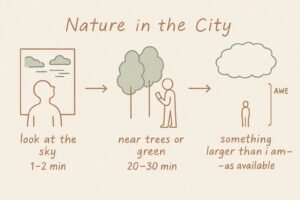
STEP 1: Look at the sky (1–2 minutes)
During a break in work or while in transit, find a piece of sky — through a window, between buildings, from a doorway.
Follow the movement of clouds, the quality of the light, the shift in color.
The sky is here, right now — and that is sufficient to begin.
No analysis. Just looking. This effortless attention lets directed attention rest — and recovery begins.
STEP 2: Spend 20–30 minutes near trees or green space (a few times a week)
A park, a street lined with trees, any patch of accessible green — the specific form doesn’t matter.
Walk or sit. Phone put away.
Something is alive here. So am I.
Twenty to thirty minutes is the range of greatest efficiency. Less still has effect. The goal is not to find sufficient nature — it is to be present with whatever nature is available.
STEP 3: Direct attention toward something vastly larger (as available)
Sky, a wide river, a large park, a canopy of trees, stars at night — anything that dwarfs the scale of personal concerns.
Stay with the scale of it a little longer than feels necessary.
This is much larger than I am.
This noticing generates awe, which shrinks self-focused thought and expands the subjective sense of time.
Session 3: Four Findings That Ground the Practice
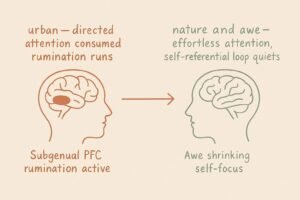
Why urban environments deplete and natural ones restore
Rachel Kaplan and Stephen Kaplan’s Attention Restoration Theory, from The Experience of Nature (1989), establishes the structural account. The Kaplans showed that urban environments generate directed attention fatigue by continuously demanding the effortful, top-down cognitive processing required to filter and navigate a high-stimulus environment. Natural environments, by contrast, offer fascination — stimuli that capture attention involuntarily and effortlessly, allowing directed attention to rest and recover. The key distinction is not between pleasant and unpleasant environments but between environments that consume directed attention and those that do not require it. Natural stimuli — moving water, shifting leaves, cloud formations — engage attention without depleting it, which is what makes the recovery possible.
The neural mechanism that interrupts rumination
Gregory Bratman and colleagues’ research, from PNAS (2015), identifies the neural mechanism that the Kaplans’ behavioral account pointed toward. Bratman’s team showed that a 90-minute walk in a natural setting significantly reduced both self-reported rumination and neural activity in the subgenual prefrontal cortex — a brain region associated with maladaptive self-referential thought and elevated depression risk — whereas a 90-minute walk through an urban environment produced no such effects. The same behavior, the same duration, two different environments, two different neural outcomes. This finding positions nature contact not as mood enhancement but as a specific neural intervention: the natural environment interrupts the self-referential circuit that rumination depends on, while the urban environment leaves it running.
How much nature contact is enough
MaryCarol Hunter and colleagues’ dose-effect research, from Frontiers in Psychology (2019), translates both findings into practical terms for urban life. Hunter’s team showed that contact with urban nature — parks, gardens, outdoor green spaces where participants felt a sense of nature — reduced cortisol levels by an average of 21.3% per hour, with the greatest efficiency occurring in sessions of 20 to 30 minutes. Participants chose their own timing, location, and form of nature contact across an eight-week period, making the findings directly applicable to the variability of daily life. The critical implication is that no special nature is required: any outdoor environment that generates a personal sense of connection with nature produces measurable physiological recovery. The threshold for effect is low enough to be reached within the urban environment itself.
What awe adds
Melanie Rudd, Kathleen Vohs, and Jennifer Aaker’s research on awe, from Psychological Science (2012), adds a further dimension to what nature contact can produce. Rudd and colleagues showed across three experiments that awe — the emotional response to perceived vastness or something that exceeds current mental frameworks — expands the subjective sense of time, increases life satisfaction, and brings people into the present moment. The mechanism is the self-diminishment that awe generates: when something is experienced as vastly larger than the self, self-focused thought shrinks, and attention shifts toward what is present rather than what is pending. Urban nature can generate this response — a wide sky, a large tree, a body of water — without requiring the scale of wilderness. What Theravāda Buddhism observed as Paṭicca-samuppāda — that the boundary between self and environment is a construction rather than a fixed division — names the structural condition that both Bratman’s rumination reduction and Rudd’s awe research arrive at through different routes: nature contact loosens the grip of self-referential processing and opens awareness to a larger context.
Conclusion: The City Never Cut You Off
Urban environments had been depleting directed attention and sustaining rumination. Nature contact restores both — reducing the neural activity of self-referential loops while recovering the cognitive resources that directed attention exhausted. Twenty to thirty minutes, in whatever urban nature is available, is enough.
The city didn’t separate you from nature. It just stopped asking you to notice it.
KEY TERMS
Attention Restoration Theory
Rachel and Stephen Kaplan’s account, from The Experience of Nature (1989), that urban environments generate directed attention fatigue through continuous effortful cognitive demands, while natural environments restore it through fascination — stimuli that capture attention without requiring effort. Establishes the structural basis for urban cognitive depletion and the mechanism by which nature contact reverses it.
Nature Walk and Rumination Reduction
Gregory Bratman and colleagues’ finding, from PNAS (2015), that a 90-minute walk in a natural setting reduces rumination and subgenual prefrontal cortex activity — associated with maladaptive self-referential thought — while an equivalent urban walk produces no such effect. Shows that nature contact functions as a specific neural intervention, interrupting the rumination circuit that depleted directed attention sustains.
Urban Nature Dose Effect
MaryCarol Hunter and colleagues’ finding, from Frontiers in Psychology (2019), that 20–30 minutes of urban nature contact reduces cortisol by an average of 21.3% per hour under real-world conditions. No special nature required — any outdoor environment generating a personal sense of nature connection produces measurable physiological recovery, placing the effective threshold within reach of daily urban life.
Awe and Time Perception
Melanie Rudd, Kathleen Vohs, and Jennifer Aaker’s finding, from *Psychological Science* (2012), that awe expands the subjective sense of time, increases life satisfaction, and draws attention into the present moment through self-diminishment. Provides the experiential basis for Paṭicca-samuppāda as a lived response: contact with something vastly larger loosens self-referential processing and opens awareness to a wider context.