
Introduction: The Same Hour, a Different Density

A walk in the forest on a weekend. On the way back, a glance at the watch — more time had passed than expected, or less. Either way, something about that hour felt different from an hour in the city. This is an experience most people recognize without being able to explain.
It is not imagination. Natural and urban environments produce the same length of time with different subjective densities. Ten minutes in a forest feels longer than ten minutes on a city street — and in terms of how the brain processes that duration, it genuinely is longer.
This article explains why. The neuroscience of time perception, what awe does to the experience of time, the biochemical pathway by which compounds released by trees act directly on the immune and nervous systems — these layers overlap to give forest time its particular weight.
Session 1: The Speed of Time Is Set by the Environment

Time feels like a constant flow, but the rate at which the brain experiences it shifts depending on the environment it is in.
In urban environments, the brain is continuously predicting and processing. Traffic signals, crowds, notifications, noise — these are all familiar patterns. The brain compresses known information as it processes it, which is why city time tends to fly. A great deal appears to be happening, but the density of what gets recorded in memory is low.
In natural environments, the structure of stimulation is different. Leaves moving in wind, shifting light, birdsong — these carry an unpredictable complexity that resists being mapped onto existing patterns. When the brain encounters more genuinely new information, it generates more records of the experience. The result is that the same length of time holds more content and feels subjectively longer.
Natural environments also change time through a second pathway. The volatile compounds released by trees act directly on the body, shifting the state of the nervous system — and that physiological state forms the ground on which time is experienced.
Session 2: Entering Forest Time
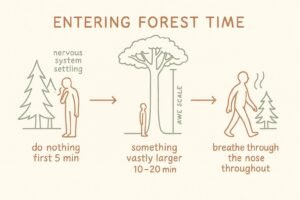
STEP 1: Do nothing for the first five minutes (5 minutes)
After arriving at a forest or green space, resist the impulse to start walking immediately.
Stop. Breathe.
Something in the body is already beginning to settle — that is the transition working.
Phone away. Photos can wait.
This transition period prepares the nervous system to shift out of the urban mode it arrived in.
STEP 2: Stay with something vastly larger than yourself (10–20 minutes)
A tree trunk, a canopy overhead, a path extending further than sight, an open expanse of sky — find something that dwarfs the scale of the body, and direct attention toward it.
Not just a glance. Stay with its scale a little longer than feels necessary. A useful measure: three seconds past the point of thinking I’ve seen enough.
This is much larger than I am.
This noticing generates awe, and awe changes how time is experienced. Self-focused thought contracts, and engagement with the present moment deepens. Awe is the entry point.
STEP 3: Breathe through the nose, throughout the walk
In the forest, breathe slowly and deeply through the nose rather than the mouth.
Especially in dense tree cover, after rain, in the early morning — wherever the air has perceptible weight.
There is something here the city air doesn’t carry — stay with it a little longer.
Phytoncides released by trees are absorbed through the olfactory pathway. Deliberate nasal breathing increases exposure to these compounds, and also has a direct effect of activating the parasympathetic nervous system independent of the compounds themselves.
Session 3: Four Findings That Explain the Density
The experimental evidence that forest time is longer
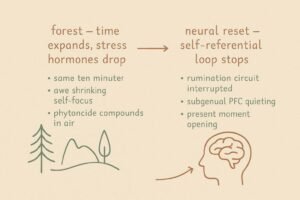
Mariya Davydenko and Johanna Peetz’s research, from the Journal of Environmental Psychology (2017), provides the experimental foundation: the same ten minutes, in two different environments, produce two different subjective lengths. Davydenko and Peetz showed that a ten-minute walk in a natural setting caused participants to overestimate the time they had spent — they perceived the walk as longer than it actually was — while a walk of identical duration through an urban environment was estimated accurately. The nature walk also produced marked improvements in mood and significant reductions in stress. This finding establishes that the experience of forest time as slower or fuller has a measurable cognitive basis, not merely an emotional one.
How awe changes the experience of time
Melanie Rudd, Kathleen Vohs, and Jennifer Aaker’s awe research, from Psychological Science (2012), identifies one mechanism through which time perception changes in natural environments. Across three experiments, Rudd and colleagues showed that awe — the emotional response to perceived vastness or to something that exceeds current cognitive frameworks — expands the subjective sense of time available and draws attention into the present moment. The mechanism is self-diminishment: when something is experienced as vastly larger than the self, self-referential thought contracts and attention shifts toward what is immediately present rather than what is pending or past. Large trees, open sky, an unbroken canopy — the scales available in natural environments that are difficult to encounter in cities are precisely what generates this response.
The biochemistry of forest air
Qing Li and colleagues’ research, from the International Journal of Immunopathology and Pharmacology (2009), explains at the biochemical level why time in a forest is a physiologically different experience from time in a city. Li’s team showed that exposure to phytoncides — the volatile organic compounds released by trees, including α-pinene and β-pinene — significantly increased natural killer cell activity and the proportion of NK cells in the blood, while simultaneously reducing urinary concentrations of adrenaline and noradrenaline. Phytoncides are detectable in forest air at measurable concentrations; they are nearly absent in urban air. The reduction in stress hormones shifts the state of the nervous system, and that shifted state forms the physiological ground on which time perception operates — connecting Li’s immunological findings to Davydenko and Peetz’s observations about duration.
What natural environments interrupt at the neural level
Gregory Bratman and colleagues’ research, from PNAS (2015), identifies what natural environments interrupt at the neural level. Bratman’s team showed that a 90-minute walk in a natural setting significantly reduced both rumination — the self-referential thought patterns associated with elevated depression risk — and activity in the subgenual prefrontal cortex, while an equivalent walk through an urban environment produced no such effects. Same behavior, same duration, two environments, two different neural outcomes. When rumination stops, the mind is no longer cycling through past regret and anticipated difficulty — an opening toward present-moment awareness that the other mechanisms described here converge in producing.
Conclusion

Time in natural environments is experimentally longer. Awe generates self-diminishment, phytoncides reduce stress hormones, and the neural circuitry of rumination quiets — these effects overlap to give a forest hour its particular density. No distant forest is required. Find trees, stay with something larger than yourself for a little longer than feels necessary, breathe through the nose. That is the entry point.
The forest doesn’t slow time down. It fills it.
KEY TERMS
Nature and Time Perception
Mariya Davydenko and Johanna Peetz’s finding that a walk in a natural setting causes participants to overestimate elapsed time while an equivalent urban walk is estimated accurately. Establishes that the experience of forest time as longer or fuller has a measurable cognitive basis independent of mood or preference. Published in the Journal of Environmental Psychology (2017).
Awe and Subjective Time
Melanie Rudd, Kathleen Vohs, and Jennifer Aaker’s finding that awe expands the subjective sense of time available and draws attention into the present moment through self-diminishment. Provides the mechanism by which directing attention toward something vastly larger changes the felt quality of time in natural environments. Published in Psychological Science (2012).
Phytoncides and NK Cell Activity
Qing Li and colleagues’ finding that volatile organic compounds released by trees significantly increase natural killer cell activity and reduce stress hormone levels. The near-absence of phytoncides in urban air marks a biochemical difference that contributes to the physiological distinctiveness of forest time. Published in the International Journal of Immunopathology and Pharmacology (2009).
Nature Walk and Rumination Reduction
Gregory Bratman and colleagues’ finding that a 90-minute walk in a natural setting reduces rumination and subgenual prefrontal cortex activity while an urban walk of the same duration produces no such effect. When self-referential thought quiets, the conditions for present-moment awareness that the other mechanisms in this guide converge to produce become fully available. Published in PNAS (2015).