
Introduction: The World Changes Every Day at That Door
You push open the door and step outside. The air hits the skin, the light shifts, something moves against the face or the hair. And then — almost immediately — it’s gone. Already filed away. Already on to the next thing.
It happens several times a day, this crossing of the threshold. And it is completely different every time — different temperature, different light, different quality of air. The sensory event was always there. What tends to be missing is the second or two of actual reception. Today’s practice is about what happens when that reception is allowed to complete.
Session 1: Why This Particular Moment
The skin is the body’s largest sensory organ, continuously detecting temperature, pressure, humidity, and airflow through a dense network of receptors. These signals are always arriving. What varies is whether they reach conscious awareness — repeated sensory contexts get suppressed through habituation, the brain’s mechanism for routing familiar, predictable input around conscious processing.
The transition from indoors to outdoors is one of the few moments in a typical day when this suppression is naturally interrupted. The abrupt environmental shift — different temperature, different light, different air movement — registers as novel input. The orienting response fires: the cortical attention reflex triggered by novelty that briefly lifts habituated suppression and opens the sensory system to incoming data. For a few seconds, perception is genuinely available. This practice is simply about being there when that happens — and extending the window by one deliberate breath.
Session 2: One Breath at the Threshold
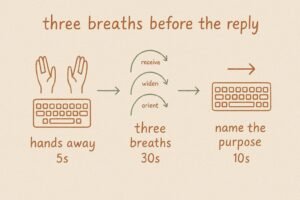
STEP 1: Stop at the boundary (10 seconds)
At the door or entrance, pause before moving on. One moment of stillness. Internally: I’m about to step into a different environment. The pause itself resets the autopilot.
STEP 2: Receive three things simultaneously (20 seconds)
As you take one breath, open attention to three channels at once.
Temperature — the quality of the air against the skin. Warmer than inside, or cooler? Sharp or soft?
Wind — any movement against the face, hair, or clothing. Direction, strength, rhythm.
Light — the quality of what the eyes are receiving. The brightness, the shadows, the colors that are present right now.
Not sequentially. Not analytically. All at once, as a single experience.
STEP 3: Notice what the body does with it (10 seconds)
After the breath, check inward. Did the body respond — a slight relaxation, a held breath, a shift in mood? Is there a memory the sensation is pulling at? No analysis required. Just noticing the response.
Session 3: Why Three Things at Once Works Better Than One at a Time
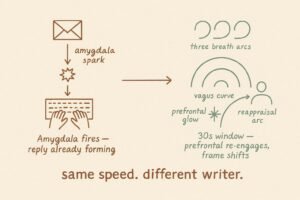
When multiple sensory modalities are engaged simultaneously, the brain doesn’t simply process each channel in parallel and add up the results. The signals converge — in the superior colliculus of the brainstem, which integrates visual, auditory, and somatosensory input for spatial orientation and attentional direction, and in the parietal association cortex, which constructs the higher-order representation of where the body is and what environment it currently occupies. This convergence produces something qualitatively different from the sum of the individual inputs.
The specific phenomenon is called multisensory enhancement: when inputs from multiple modalities arrive simultaneously and from the same spatial location, the cortical response to each individual input is stronger than it would be if that input arrived alone. Feeling cool air on the skin while simultaneously tracking wind movement and the quality of the light produces a richer, more precise sensory registration of each element than attending to them in sequence. The simultaneity is what generates the enhancement.
This has a practical implication beyond the richness of the experience. When the parietal association cortex is actively constructing a detailed model of the external environment — which multisensory input requires — default mode network activity is correspondingly reduced. Opening the perceptual field outward across modalities simultaneously suppresses the internal narrative loop in a way that single-modality attention does not. The full sensory landing of a moment outside is, neurologically, one of the more effective natural interruptions of rumination available in daily life.
The inward turn after the external reception — noticing the body’s response after the breath — moves attention from the parietal association cortex’s environmental model to the insular cortex’s interoceptive processing. The outward and inward, held in sequence within a single breath cycle, is what makes the practice complete rather than merely stimulating.
Conclusion: It Was Always Different Out There
Once today. At whatever door leads outside. One breath, three things at once — and then the brief inward check of what the body did with it.
The sensory event was always happening at that threshold. What changes with one deliberate breath is not the weather. It’s the quality of the crossing.
The air was different today. It was always going to be. The only question was whether anyone was there to feel it.
KEY TERMS
Multisensory Integration
The brain’s construction of unified experience from simultaneous inputs across multiple sensory modalities. Processed via convergence in the superior colliculus and parietal association cortex. Produces qualitatively richer experience than sequential single-modality attention.
Multisensory Enhancement
The phenomenon whereby simultaneous inputs from multiple modalities produce stronger cortical responses to each individual input than would occur if the inputs arrived alone. The simultaneous reception of temperature, wind, and light is designed to engage this effect.
Superior Colliculus
A brainstem structure integrating visual, auditory, and somatosensory signals for spatial orientation and attentional direction. One of the primary neural substrates for multisensory convergence, and the structure that makes the simultaneous reception of temperature, wind, and light neurologically coherent rather than merely metaphorical.
Parietal Association Cortex
The cortical region constructing the higher-order representation of the body’s current environmental context. Active engagement of this region during multisensory input correspondingly reduces default mode network activity — the mechanism behind the mood shift that often accompanies stepping outside and actually paying attention.
Orienting Response
The brain’s automatic attention reflex triggered by novelty or unexpected change in the sensory environment. The indoor-to-outdoor transition naturally triggers this response, briefly interrupting habituated sensory suppression. This practice is the decision to be present for the window that response opens — and to extend it by one deliberate breath.
Defusion
A core skill in Acceptance and Commitment Therapy (ACT): the capacity to observe thoughts and judgments as passing mental events rather than facts. When too cold or too bright arrives as a verdict rather than a sensation, noticing it as a judgment — and returning to the raw sensory input — is defusion applied to environmental perception.