
Introduction: The First Bite Is Always the Most Interesting One. Most People Miss It

Same dish, same ingredients, same everything — and yet the first bite is different. You’ve noticed this. Everyone has.
It isn’t about hunger, or anticipation, or the mood you’re in. The first bite is neurologically distinct from every bite that follows. What happens in those first seconds — before the fork is set down, before the chewing begins — is the most information-dense moment of the entire meal.
Today’s practice is about being there for it.
Session 1: Why the First Bite

Taste receptor cells adapt.
When a chemical stimulus — the molecules responsible for sweetness, saltiness, umami — binds to receptors in the taste buds, those receptors become temporarily less sensitive to the same stimulus. This is gustatory adaptation, and it begins with the first bite. By the second bite, the same food is already processed as slightly less intense. By the third, slightly less again. The flavor doesn’t change. The receptor sensitivity does.
This means the first bite contains more sensory information than any bite that follows. Not metaphorically — neurophysiologically. If there’s a moment in a meal worth being fully present for, this is the one the nervous system would choose.
The experience actually starts before the first bite. Visual and olfactory input from the food reaches the orbitofrontal cortex and activates dopaminergic reward prediction — the anticipatory signal that fires before eating begins. What feels like appetite or excitement is, at the neural level, a prediction being generated. Receiving the food before eating it is an invitation to be conscious during that prediction rather than just waiting for it to resolve.
Session 2: Three Steps
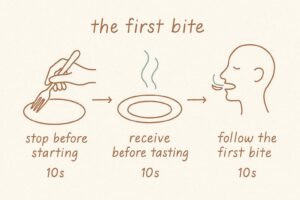
STEP 1: Stop before starting (10 seconds)
With the utensil in hand, pause before the first bite. If there’s a sense of urgency — the meal as something to get through — note it. Let the simple fact of there is food in front of me and I am about to eat register as an actual event rather than a transition.
STEP 2: Receive it before tasting it (10 seconds)
Before the food reaches the mouth, open the available channels.
Vision — the colors, the textures, the way the light falls on the surface
Smell — what’s rising from the plate, what it tells you about ingredients and heat and preparation
Touch — the temperature and weight of the utensil, the warmth radiating from the dish
The reward prediction is already running. Don’t interrupt it — receive it.
STEP 3: Follow the first bite all the way through (10 seconds)
When the food enters the mouth, don’t swallow immediately. Follow what unfolds.
The first flavor, and how it shifts within seconds
Temperature, texture, the way it spreads across the tongue
The scent arriving through the back of the throat — the part of taste that most people don’t realize is smell
This is the most information the meal will offer. Stay with it.
Session 3: Why the First Bite Contains More Information Than All the Rest Combined
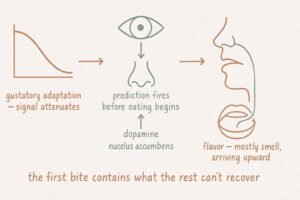
Taste buds contain chemoreceptor cells that bind to flavor molecules dissolved in saliva. When these receptors are continuously exposed to the same chemical stimulus, their response magnitude decreases — a process of receptor-level adaptation that begins within the first few seconds of eating. The brain receives a progressively attenuated signal from the same food as the meal continues. Nothing about the food changes. The sensitivity of the system receiving it does. Gustatory adaptation is why the last bite of a meal rarely matches the first, why a dish that seemed overwhelming at the start becomes manageable, and why the first encounter with a flavor carries an intensity that can’t quite be recovered.
Before eating begins, the visual and olfactory properties of food are processed by the orbitofrontal cortex — a region at the intersection of sensory processing and reward evaluation — which sends anticipatory signals to dopaminergic neurons in the ventral tegmental area and nucleus accumbens. These neurons fire not in response to the food itself, but in response to the prediction of it. The feeling of wanting to eat, the pull toward the plate, the slight sharpening of attention when food arrives — these are expressions of a prediction signal, not a consumption signal. Receiving the food’s appearance and smell consciously, before the first bite, is participation in this predictive processing rather than bypassing it on the way to eating.
What happens inside the mouth during the first bite is more complex than most people realize. The sensation commonly called “taste” is actually a multisensory integration of gustatory input, retronasal olfaction — volatile aromatic compounds released by chewing that travel from the back of the oral cavity upward into the nasal passage — tactile feedback, temperature, and proprioceptive information from the jaw and tongue. Research suggests that retronasal olfaction contributes more to flavor perception than taste receptor input alone. This is why a head cold that blocks nasal airflow makes food taste flat — the gustatory receptors are intact, but the retronasal channel is closed. The richness of flavor that most people attribute to taste is largely smell, arriving through a route they’ve never thought about.
Pausing before the first bite is not a new idea. Across traditions and centuries — monastic dining practices, the choreography of formal tea service, ritualized meal openings in cultures with no shared language or geography — the moment before the first bite has been treated as significant. The specific reasons given differ. The behavior is preserved. Something in accumulated human experience recognized that the first bite, approached with preparation, is qualitatively different from the first bite taken on autopilot. Neuroscience can now describe the mechanism. The observation is much older.
Conclusion: The Most the Meal Will Ever Offer

Once today. One meal, one first bite. Stop, receive it before eating it, follow it all the way through — and stay with it long enough for the adaptation to begin, because that’s when you’ll know what you were just given.
The intensity was always there at the start. The practice is just deciding to be present before it passes.
KEY TERMS
Gustatory Adaptation
The reduction in taste receptor cell sensitivity that occurs with continuous exposure to the same chemical stimulus. Begins within seconds of the first bite and progresses through the meal. The neurophysiological reason the first bite is always the most intense — and why that intensity can’t be fully recovered once it’s passed.
Predictive Reward Processing
The anticipatory firing of dopaminergic neurons in response to food-related visual and olfactory cues, before eating begins. Processed via the orbitofrontal cortex and ventral tegmental area. The neural substrate of appetite and food anticipation — the signal that fires in response to the prediction of eating, not the eating itself.
Retronasal Olfaction
The pathway by which aromatic compounds released during chewing travel from the back of the oral cavity into the nasal passage, contributing substantially to flavor perception. Responsible for a significant portion of what is commonly experienced as taste. The reason flavor disappears during nasal congestion — the gustatory receptors remain intact, but the retronasal channel is closed.
Oral Multisensory Integration
The convergent processing of gustatory, retronasal olfactory, tactile, thermal, and proprioceptive input that occurs during eating. Unlike the brain’s integration of environmental stimuli arriving from separate external sources, oral multisensory integration occurs within a single small space inside the body, with the eater as both environment and instrument.
Cephalic Phase Response
The body’s digestive preparation triggered by sensory engagement with food before eating begins — sight, smell, even the anticipation of taste. Stimulates the release of saliva, gastric acid, and digestive enzymes. Receiving food’s appearance and smell consciously before the first bite completes the preparation the body has already started, rather than bypassing it.
Defusion
A core skill in Acceptance and Commitment Therapy (ACT): the capacity to observe thoughts and impulses as passing mental events rather than facts. When just eat already or I don’t have time for this arrives at the table, recognizing it as a thought rather than a directive — and returning attention to what’s on the plate — is defusion applied to the specific impatience of hunger.