
Introduction: Before a Presentation, Mid-Meeting, or Just Vaguely Unsettled — There’s Always Somewhere to Return

Before a presentation. Mid-meeting. Or simply a quiet moment when the mind won’t settle. There are moments when you notice that attention has been elsewhere. Replaying something that already happened. Rehearsing something that hasn’t. A general sense of not quite being here.
Getting back doesn’t require anything complicated. The breath is already present — in a way that nothing else quite is. It doesn’t exist in the past or the future. It exists only now, as sensation, in this moment.
This practice is about using that quality deliberately — treating the breath not as something to control, but as a place to return to.
Session 1: Why Breath Works as an Anchor

Mind-wandering has a neurological structure.
When the mind is running on autopilot — moving naturally toward past events and future possibilities — this movement is automatic, energy-efficient, and happens without deliberate intention. It is not a malfunction. It is the brain’s default.
Returning requires a different system: the executive attention network, centered on the dorsolateral prefrontal cortex and anterior cingulate cortex. This network monitors the current state of attention, detects when it has drifted from the intended object, and redirects it back. Psychologist Michael Posner’s research on this network established what has since been widely confirmed: executive attention is trainable. Repeated practice of noticing drift and returning strengthens the network’s efficiency. The meditation research finding that mindfulness improves attentional control reflects this mechanism at the neural level.
What makes breath particularly well-suited as the return object is its presentness. The sensation of breath — the temperature differential in the nasal passage, the movement of the chest or abdomen — exists only in the current moment. It cannot be remembered or anticipated in the same way a visual image or a piece of music can. This is not a metaphor. The mind’s characteristic rumination and anticipation are directed at objects that exist in other times. Breath sensation is directed at an object that exists only now. That asymmetry is what makes returning to breath a reliable interruption of mind-wandering rather than simply a replacement of one mental object with another.
Session 2: Three Steps
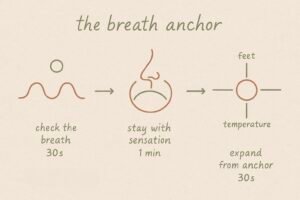
This can be used the moment distraction or agitation is noticed — anywhere, without preparation.
STEP 1: Check the current state of the breath (30 seconds)
When the mind is recognized as scattered or tense, turn attention inward without trying to change anything first.
The breath is shallow and fast
There’s effort in the exhale
The breath is here, right now
Not controlling it. Just making contact with what’s already happening. This is the moment the anchor touches ground.
STEP 2: Stay with the physical sensation (1 minute)
Direct attention to the sensory detail of breathing.
Nasal passage — the temperature difference between incoming and outgoing air
Chest and abdomen — the expansion on the inhale, the settling on the exhale
The full cycle — from the beginning of one breath to the beginning of the next
When thinking resumes and carries attention with it — which it will — notice that, and return to the sensation. The returning is the practice, not a sign that the practice has failed.
STEP 3: Expand from the anchor (30 seconds)
This step is easily skipped — the mind has just returned and wants to stay with the breath exclusively. While maintaining awareness of the breath, widen attention slightly. The contact of feet on floor. The sounds in the room. The temperature of the air. The breath remains the center — the other sensations are received around it. This is what being grounded in the present moment, rather than just thinking about it, actually feels like.
Session 3: Why Every Return Is the Training, Not the Recovery From It
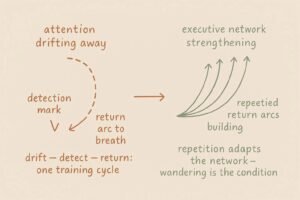
The instruction to return attention to the breath whenever it wanders is, at first glance, the simplest possible meditation instruction. It is also, neurologically, a specific and measurable intervention.
The executive attention network — the prefrontal and anterior cingulate system responsible for deliberate attentional control — operates in three phases during this practice: monitoring the current state of attention, detecting the departure from the intended object, and executing the return. Each complete cycle of drift-detection-return constitutes a discrete activation of this system. Neuroimaging studies of experienced meditators consistently show structural and functional differences in exactly these regions, suggesting that repeated activation of this cycle produces lasting changes in network efficiency. The analogy to physical training is imprecise but directionally accurate: repeated activation produces adaptation in both.
Attentional anchoring describes the process by which a specific sensory stimulus, used repeatedly as the target of attentional return, becomes increasingly effective as a retrieval cue for present-moment awareness. Through repeated pairing of drift-detection with the return to breath sensation, something resembling a conditioned association forms: the state of detected mind-wandering begins to trigger the breath-oriented return more automatically. This is related to the if-then linking of a trigger state to a specific response — but operates through a more direct sensory-motor pathway rather than through explicit verbal planning.
The specific advantage of breath over other anchors — a sound, a visual object, a mantra — is its temporal structure. Any sensation that exists as a discrete, separate object can become the basis for mental elaboration: thinking about the sound, about the object. Breath sensation is continuous and present-bound in a way that resists this elaboration. The current inhale has no fixed form to analyze; it is simply what is happening now. This is why instructions across many contemplative traditions have converged on breath as the primary anchor for attention training — not as doctrine, but as something practitioners repeatedly found to be the case when they worked with it directly. The executive attention research and the practice observation point toward the same feature of breath: it is the most reliably present thing available.
The framing that the returning is the practice, not a sign of failure, reflects something that the neuroscience makes precise. The strengthening of the executive attention network requires the full cycle: drift, detection, return. A session in which attention never wandered would produce no training stimulus. The mind wandering is not the obstacle to the practice. It is, in a specific sense, the necessary condition for it.
Conclusion: The Returning Is What Builds Something

The mind will wander. That isn’t a failure of the practice or a sign that something has gone wrong — it is the condition that makes the practice possible. Without drift, there is no return. Without return, there is no training stimulus. The system is doing exactly what it needs to do.
The mind will wander. Every return is the training.
KEY TERMS
Executive Attention Network
The prefrontal and anterior cingulate system responsible for monitoring attentional state, detecting drift from the intended object, and executing the return. Trainable through repeated use: each drift-detection-return cycle activates and strengthens the network. The neural basis for why the practice of returning — rather than the experience of stable attention — is what produces improvement.
Attentional Anchoring
The process by which repeated use of a specific sensory stimulus as the target of attentional return builds an increasingly automatic association between detected mind-wandering and return to that stimulus. Breath becomes a more effective anchor through use, not through any inherent quality other than its consistent presentness. Related to but distinct from explicit if-then planning: it operates through a more direct sensory-motor pathway.
Presentness of Breath
The quality that distinguishes breath sensation from most other attentional objects: it exists only in the current moment, without memory or anticipation as intermediaries. The mind’s characteristic rumination and anticipation are directed at objects in other times. Breath sensation is directed at something that only exists now. This asymmetry makes returning to breath a genuine interruption of mind-wandering rather than a substitution of one mental object for another.
Ānāpānasati — The Return Dimension
One of the oldest documented attention-training practices centers on the repeated return of awareness to the breath. Earlier in this series, this practice was approached through close attention to the subtlety of the breath itself — its texture, its depth, its rhythm. This guide approaches its more foundational application: the repeated return to breath as the training act. The observation that this return — practiced consistently — changes the relationship between the mind and its own wandering has been central to this practice for a very long time. The executive attention research describes the mechanism. The observation preceded the mechanism by centuries.
Defusion
A core skill in Acceptance and Commitment Therapy (ACT): the capacity to observe thoughts as passing mental events rather than facts requiring immediate response. When *I keep getting distracted, this isn’t working* arrives as a verdict, recognizing it as a thought — and returning to the breath rather than engaging with the self-assessment — is defusion applied to the self-critical response that practice tends to generate.