
Introduction: Something Changed. Most People Walk Past It.

The practice just ended. Maybe two minutes, maybe five. After a few minutes of breath awareness, or a short body scan, or any of the practices in this series — there is often something slightly different. The shoulders have dropped a little. The thoughts are a little quieter. The breath is a little deeper.
Most people pass through this moment without registering it. The practice ended; time to move on. The transition back to the day is automatic.
But this is the minute that determines whether the practice builds into a habit or stays as an obligation. What happened needs to be received to count.
Session 1: Why the Afterglow Matters

Understanding how habits actually form changes what this minute is for.
The behavioral science framework for habit formation identifies three components: cue, routine, and reward. The reward is what the brain uses to decide whether the routine is worth repeating. But rewards only function when they are received — the same coffee consumed while answering email produces less of the effect, because the experience isn’t being registered. The subtle shift after a mindfulness practice — the slight quieting, the softened tension, the deeper breath — is the reward in the habit loop. Left unnoticed, it doesn’t register as reward. The brain doesn’t file it as evidence that the practice produces something worth having. The deliberate act of comparing the internal state before and after is how the reward system receives what it needs in order to learn.
There is a second mechanism at work. Research on motivation maps it along a spectrum from external to internal: from I have to toward I want to. Practices sustained by external obligation — discipline, scheduled reminders, accountability — are fragile. Practices sustained by genuine internal motivation are not. The shift from one to the other happens when the practitioner discovers, through their own experience, that the practice produces something they value. Noticing the afterglow is how that discovery happens.
Session 2: Three Steps

These work after any practice — one minute of breath awareness, a body scan, or anything else in this series.
STEP 1: Mark the ending (10 seconds)
At the close of the practice, make a small
At the close of the practice, make a small deliberate gesture — resting the hands on the thighs, taking one full breath, briefly closing the eyes. The specific gesture doesn’t matter. What matters is the intention it carries: the practice is complete, and what follows is reception rather than continuation.
STEP 2: Check the interior (30 seconds)
Compare the current internal state with the one that was present before the practice began.
Mental state — is the volume or pace of thinking different?
Physical state — shoulders, breath, jaw, abdomen — is anything different from before?
Overall quality — does something feel slightly more spacious, or settled, or simply different?
If something has changed, note it. If nothing seems different, note that too. Both are accurate observations.
STEP 3: Receive what’s there (20 seconds)
If a change was found, stay with it briefly — not analyzing it, just allowing it to be present for a moment. If nothing was found, acknowledge that the practice was completed. No evaluation of whether it was done correctly, no assessment of whether it was worth the time. Simply: it happened, and this is what followed.
Session 3: Why the Reward Only Works When It Is Received
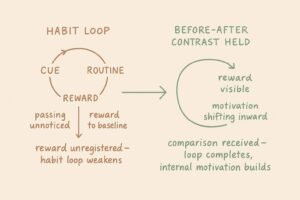
Why meditation is easy to start and hard to sustain is a behavioral science question as much as a psychological one.
The habit loop framework identifies reward as the mechanism by which the brain encodes a behavior as worth repeating. The reward signal doesn’t have to be large — it has to be present and registered. Research on habit formation consistently shows that the strength of the cue-routine-reward association depends not just on the reward’s objective value but on how consciously it is attended to. A small reward fully received builds stronger behavioral associations than a large reward that passes unnoticed. This is why practices that produce subtle, gradual effects — and mindfulness is essentially defined by producing subtle, gradual effects — are particularly vulnerable to habit loop failure: the reward exists, but it doesn’t get registered as reward. Pausing to receive the change is the intervention at this specific point in the loop.
Hedonic adaptation compounds the problem. Humans adapt rapidly to repeated positive experiences, reclassifying them as baseline rather than gain. The effect of a practice that is done daily will feel smaller after three months than it did after three days — not because the practice is producing less, but because the brain has adjusted its reference point. What was once noticeably calmer becomes just how I feel when I’ve practiced, which registers as nothing. The before-and-after comparison — checking the internal state before against after — is a deliberate mechanism for counteracting this adaptation. By explicitly re-establishing the contrast rather than allowing it to fade into background, the change becomes visible again. The practice produces the same effect; the comparison makes it available to the reward system.
Research on self-determination theory provides the motivational frame. External motivation — practicing because it should be done, because it was committed to, because someone or something expects it — is functionally effective but cognitively costly. It requires continuous expenditure of self-regulatory resources to override competing impulses. Internal motivation — practicing because the experience itself is valued — requires no such expenditure. The behavior is pulled rather than pushed. The transition from external to internal doesn’t happen through reasoning or commitment. It happens through repeated personal discovery: I practiced, and afterward something was different, and I noticed the difference. That cycle, repeated enough times, shifts the motivation structure. The afterglow is the discovery. Noticing it is the cycle.
The instruction to acknowledge the practice even when nothing was felt is not a consolation. It reflects a specific motivational principle: when the reward is made contingent on a particular outcome — the practice only counts if I felt something — days without a felt outcome become demotivating. Decoupling the acknowledgment from the result keeps the motivational structure intact on the days when the effect is too subtle to detect.
Conclusion: The Loop Only Closes If You Notice

The practice changes something. But the brain doesn’t register a reward it hasn’t received — and a change that passes unnoticed leaves no trace in the habit loop. The effect was real. Without the noticing, the system has no record of it.
The reward only registers when it is received. That minute is not the aftermath of the practice. It is the part that teaches the brain to return.
KEY TERMS
Habit Loop
The behavioral framework identifying cue, routine, and reward as the three components of habit formation. Reward is the mechanism by which the brain encodes a behavior as worth repeating — but only when it is consciously received. The subtle shift after mindfulness practice is the reward in this loop. Unnoticed, it doesn’t register. Pausing to receive it is the act of closing the loop.
Hedonic Adaptation
The rapid reclassification of repeated positive experiences as baseline rather than gain. Produces the consistent finding that practice effects feel smaller over time — not because the practice is producing less, but because the brain has adjusted its reference point. The before-and-after comparison is a deliberate mechanism for making the contrast visible again, counteracting the adaptation that would otherwise suppress it.
Self-Determination Theory
A motivational framework mapping the spectrum from external obligation to internal interest. The transition from I have to practice to I want to practice doesn’t happen through commitment or reasoning — it happens through repeated personal discovery that the practice produces something valued. Noticing the afterglow is the discovery mechanism that drives this transition.
Interoceptive Sensitivity
The capacity to detect subtle changes in the body’s internal state — breath depth, shoulder tension, the quality of mental activity. Developed through repeated directed attention to these signals. As this sensitivity increases, the afterglow becomes easier to find, which reinforces the habit loop and counteracts hedonic adaptation simultaneously.
Defusion
A core skill in Acceptance and Commitment Therapy (ACT): the capacity to observe thoughts as passing mental events rather than facts requiring immediate response. When I didn’t feel anything, so it didn’t work arrives as a verdict after the practice, recognizing it as a thought rather than an accurate assessment — and returning attention to the physical state that is actually present — is defusion applied to the self-evaluative response that practice tends to generate.