
Introduction: The Processing That Made It Larger

When a strong emotion arrives, most people do the same thing. They process it as theirs. I am angry. I am anxious. This is who I am when things go wrong. The emotion becomes a statement about the self.
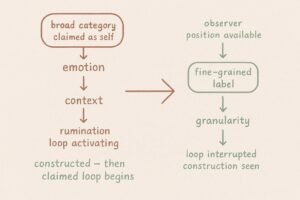
That processing is what makes the emotion larger. The moment a feeling is registered as my feeling, associated memories, self-evaluations, and past experiences of a similar kind are activated in sequence. The rumination loop starts — not because the emotion was significant, but because it was claimed.
What if the emotion was not a fixed thing emerging from inside you, but something the brain assembled in the moment from available conditions — body state, context, and patterns learned from the past? That reframing is not a coping technique. It is a more accurate description of what the emotion was.
Session 1: Emotions Are Constructed, Not Discovered

When an emotion is processed as mine, two things happen in sequence.
The first is a structural misunderstanding of what the emotion is. Anger, anxiety, sadness — these do not exist as fixed systems in the brain, waiting to be triggered. The brain takes the body’s current internal state — heart rate, muscle tension, breathing pattern — combines it with the present context and with conceptual patterns learned from past experience, and constructs an emotional state on the spot. The same elevated heart rate becomes excitement in one context and dread in another. The feeling that arrives is not revealing a fixed internal truth. It is the brain’s best prediction about what is happening, assembled from what was available at that moment.
The second is what happens when that assembled state is processed as self. The moment I am anxious replaces anxiety is present, self-referential processing activates. Related memories surface, self-evaluation engages, the history of similar feelings becomes available. The constructed state is fixed into a statement about who the person is, and the loop runs on that statement. The feeling was already complete. The loop was added by the claim.
Session 2: Working With the Construction
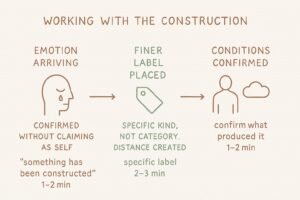
STEP 1: Confirm that something has arrived (1–2 minutes)
Is there an emotional state present right now — anger, anxiety, sadness, irritability, in any form?
Without claiming it as a self-state, confirm its presence.
Something has been constructed here.
This is the first movement — from inhabiting the emotion to registering that it has arrived.
STEP 2: Place a more specific label (2–3 minutes)
Distinguish the emotion more finely than its category name allows.
Not just anger — what kind?
This is the anger that comes from feeling ignored.
This is the anxiety that arrives when something important is uncertain.
This might be an irritable response to being tired, more than a response to what just happened.
The more precisely the emotion is named, the less automatically the broader category activates its associated loop. The label does not need to be accurate. The act of distinguishing is what creates the distance.
STEP 3: Confirm the conditions that produced it (1–2 minutes)
Bring attention briefly to what was available when the emotion was constructed.
What is the body’s current state — tired, hungry, carrying tension from earlier?
What is the immediate context — what just happened, what has been building?
When the emotion becomes recognizable as a product of specific conditions rather than a statement about the self, the relationship to it changes — not because the conditions disappear, but because the claim does.
Session 3: Four Findings That Explain the Construction
How emotions are assembled
Lisa Feldman Barrett’s Theory of Constructed Emotion, published in Social Cognitive and Affective Neuroscience (2017), provides the foundational account of how emotions are generated. Barrett’s research showed that emotions do not exist as discrete, dedicated circuits in the brain — there are no neurons that fire exclusively for fear, no region that activates only for anger. Instead, the brain takes interoceptive signals from the body, combines them with the current context, and applies conceptual frameworks learned from prior experience to construct an emotional state in the moment. The same physiological arousal — elevated heart rate, tension in the chest — becomes excitement in one context and anxiety in another, depending on what conceptual frame the brain applies. Barrett’s framework carries a precise implication: an emotion is not revealing something fixed and essential about the person who feels it. It is the brain’s prediction, assembled from what was available. The general reader account of this framework is accessible in How Emotions Are Made (2017).
What happens when the constructed state is claimed as self
Susan Nolen-Hoeksema’s response styles theory, from Journal of Abnormal Psychology (1991), identifies what happens when the constructed state is processed as a self-defining truth. Nolen-Hoeksema’s research showed that directing sustained, repetitive, analytical attention toward a negative emotional state — rumination — functions as a misdirected problem-solving effort that maintains and intensifies the state rather than resolving it. The transition from anxiety is present to I am an anxious person initiates self-referential processing: past instances of similar anxiety become relevant, self-evaluative conclusions activate, the history of the emotional pattern becomes part of the current experience. The constructed emotion was already complete. Rumination is what the self-referential claim adds to it.
Why finer labeling interrupts the loop
Kashdan, Barrett, and McKnight’s research on emotional granularity, published in Current Directions in Psychological Science (2015), identifies the practical mechanism Barrett’s framework makes available. Kashdan and colleagues showed that people who experience their emotions with greater granularity — who distinguish not just anger but the specific kind of anger, not just anxiety but what the anxiety is responding to — show significantly better emotion regulation under distress: less recourse to maladaptive strategies such as binge drinking and aggression, lower neural reactivity to rejection, and reduced symptoms of anxiety and depression. The mechanism connects directly to Barrett’s constructivist account: finer-grained labeling interrupts the automatic activation of the broader emotional category and its associated loop. Naming the specific construction — rather than claiming the general category — is what prevents the constructed state from becoming a self-defining one.
The observer position that granularity moves toward
Ethan Kross and Ozlem Ayduk’s work on decentering, synthesized in Perspectives on Psychological Science (2011), identifies the neural and cognitive shift that fine-grained labeling moves toward. Kross and Ayduk showed that adopting a distanced observer perspective toward one’s own emotional states — moving from I feel this to this feeling is occurring — reduces self-referential rumination and improves emotional regulation. Barrett’s account of emotion as construction and Kashdan and colleagues’ account of granularity as interruption both prepare the ground for this shift: understanding that the emotion was assembled from conditions rather than expressed from a fixed self makes the observer position available; applying a specific label makes it operational. What Theravāda Buddhism recorded as mental arising (Citta) — the observation that mental events arise moment by moment from conditions, pass through, and are succeeded by the next — arrived at the same operational conclusion: emotions are not what you are. They are what the conditions produced, for that moment, in that configuration.
Conclusion: The Claim Was the Loop

The emotion was constructed from available conditions — body state, context, learned pattern. It was complete before the claim was made. The claim — this is mine, this is me — was what started the rumination loop and fixed the constructed state into a statement about the self.
Emotional granularity and the observer position are interventions into the claim, not the emotion. The construction can remain present. Recognizing it as a construction is what removes the loop.
The feeling wasn’t revealing something fixed about you. It was something the brain constructed, from the conditions available in that moment.
KEY TERMS
Theory of Constructed Emotion
Lisa Feldman Barrett’s framework, from Social Cognitive and Affective Neuroscience (2017), showing that emotions are not fixed neural circuits but states the brain assembles moment-to-moment from interoceptive signals, context, and learned conceptual frameworks. The same physiological arousal becomes different emotions depending on the conceptual frame applied. Reframes emotion from self-revelation to brain construction, providing the basis for understanding why claiming an emotion as self-defining is a processing error rather than an accurate description. Accessible in How Emotions Are Made (2017).
Rumination and Self-Referential Processing
Susan Nolen-Hoeksema’s finding, from Journal of Abnormal Psychology (1991), that repetitive analytical attention directed at a negative emotional state maintains and intensifies it through misdirected problem-solving. The transition from anxiety is present to I am anxious activates self-referential processing — surfacing related memories, self-evaluations, and emotional history — and converts a constructed state into a self-defining loop.
Emotional Granularity
Kashdan, Barrett, and McKnight’s finding, from Current Directions in Psychological Science (2015), that distinguishing emotions with greater specificity — naming not just the category but the particular construction — is associated with better emotion regulation, reduced maladaptive coping, and lower anxiety and depression symptoms. Finer-grained labeling interrupts the automatic activation of the broader emotional category and its associated rumination loop, operationalizing the observer position Barrett’s constructivist framework makes available.
Decentering and the Observer Position
Ethan Kross and Ozlem Ayduk’s account, from Perspectives on Psychological Science (2011), that adopting a distanced observer perspective toward emotional states reduces self-referential rumination and improves emotional regulation. Barrett’s construction framework and Kashdan and colleagues’ granularity research prepare the conditions for this shift: recognizing the emotion as assembled rather than expressed makes the observer position conceptually available; specific labeling makes it practically operational. Corresponds to the Theravāda Buddhist observation of mental arising (Citta) — that mental events arise from conditions, moment by moment, without constituting a fixed self.