
Introduction: The Source of the Voice That Says “Do Better”

After a mistake, after missing a deadline, or sometimes for no reason at all — I’m such a failure. I messed up again. I can’t do this. The voice arrives without invitation.
Many people believe this voice is what drives them forward. That strictness produces growth, that self-softening leads to complacency — this belief is what makes self-criticism so difficult to release.
But self-criticism is neither a character flaw nor a failure of willpower. It is a neural mechanism that evolved to serve survival in a specific kind of environment, and the structure of contemporary society keeps that mechanism running far past its useful range. This article traces it through three layers: evolutionary origin, social amplification, and what the research shows about its actual effect on performance.
Session 1: The Critic Was Never a Character Flaw — It Was a Misfiring System

When self-criticism won’t stop, most people conclude something is wrong with them. That conclusion is itself part of the pattern.
Human beings evolved in groups. Expulsion from the group once meant death. The brain therefore developed a system dedicated to monitoring whether the self was meeting the group’s standards — and to generating corrective responses when it detected shortfall. Self-criticism is that system’s output: an internal alarm signaling you may be falling below the threshold; adjust before you are excluded.
In contemporary environments, this system runs in conditions it was not designed for. Workplace performance reviews, social comparison on digital platforms, the persistent pressure to achieve and excel — all of these register in the brain as social rank threats, keeping the exclusion-avoidance system in chronic activation. The alarm sounds even when there is no danger.
What makes this more than an inconvenience is that the alarm does not actually support the performance it claims to be protecting. Self-criticism feels like motivation, but the research tells a different story — one this article returns to in Session 3.
Session 2: Creating Distance from the Critic’s Voice
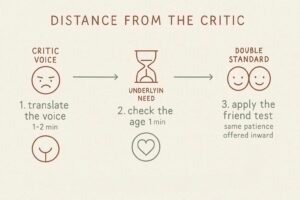
STEP 1: Translate the voice (1–2 minutes)
When self-criticism surfaces, the first move is not to silence it but to observe it.
Catch the words as they arise — I failed again. I’m not good enough.
Then ask: What is this voice trying to warn me about?p
Self-criticism is usually a distorted expression of something real — the wish to be seen as competent, the fear of being overlooked, the desire to do meaningful work. Translating the criticism into the underlying need shifts it from an abstract attack into something specific and workable.
STEP 2: Check the age of the voice (1 minute)
Once the voice is visible, ask it a different question:
Is this voice responding to what is actually happening now — or is it replaying a rule that was learned somewhere else?
Much of what self-criticism insists on was learned in earlier environments — a school where mistakes were publicly judged, a household where approval was conditional, a context where falling short had real social consequences. Those environments may no longer exist.
Noticing the age of a voice doesn’t dissolve it. It does change the relationship to it.
STEP 3: Apply the friend test (2–3 minutes)
Take the situation the inner critic is responding to. Now imagine a close friend experiencing the same thing.
What would I say to them?
This substitution makes the double standard visible. The same situation that generates harsh internal judgment tends to invite patience and perspective when it belongs to someone else. When that asymmetry becomes clear, the critic’s logic becomes harder to sustain. What you would offer a friend — this was hard, and you did what you could — is available to offer yourself too.
Session 3: Four Findings That Explain the Critic
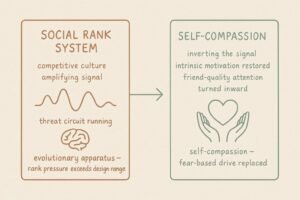
Where self-criticism originates
Paul Gilbert’s social rank theory, synthesized in the British Journal of Clinical Psychology (2014), establishes the evolutionary account of where self-criticism originates. Gilbert showed that the human brain contains a social rank monitoring system oriented toward competitive navigation of status, social resources, and the risk of exclusion. In ancestral environments where group membership was a survival condition, an internal system that detected personal shortfalls before they resulted in social punishment was adaptive — self-criticism functioned as a preemptive submission signal directed inward, a way of registering defeat before others could impose it. The problem is not the system’s design but its context: an apparatus calibrated for small-group social survival now runs continuously in environments structured around competition, performance metrics, and visible comparison. The mismatch between the system’s original conditions and the environments it now operates in is what produces chronic self-criticism in the absence of genuine threat.
How contemporary culture amplifies the signal
Thomas Curran and Andrew Hill’s meta-analysis, published in Psychological Bulletin (2019), quantifies the social conditions that keep Gilbert’s system in overdrive. Curran and Hill analyzed 164 studies comprising 41,641 American, Canadian, and British college students who completed perfectionism measures between 1989 and 2016. All three dimensions of perfectionism — self-oriented, socially prescribed, and other-oriented — increased linearly across that period. Their explanation centers on the expansion of competitive individualism since the 1980s: neoliberal governance in the US, Canada, and UK created cultural conditions in which people are structurally pressured to perfect themselves and their outcomes. Social media, continuous performance evaluation, and the persistent visibility of others’ achievements translate into the brain’s threat-detection architecture as chronic rank pressure. The evolutionary apparatus Gilbert described is being run at conditions that exceed its designed operating range.
How self-criticism differs from rumination at the neural level
Research on the default mode network identifies depressive rumination with sustained activity in self-referential circuits, particularly the subgenual prefrontal cortex. Self-criticism, as Gilbert’s threat system account describes, activates a different pathway: threat-detection circuitry including the amygdala, generating cortisol and adrenaline release and producing the paradoxical neural state of being simultaneously the attacker and the target. The two overlap in experience but call for different points of intervention — which is part of why trying to think your way out of self-criticism tends not to work.
What self-criticism actually does to performance
Kristin Neff and colleagues’ research, published in Self and Identity (2005), provides the empirical evidence on what self-criticism actually does to performance. Across two studies with 222 and 110 undergraduates respectively, Neff and colleagues found that self-compassion — the inverse of self-criticism — was positively associated with mastery goals and intrinsic motivation, and that self-critical individuals showed lower perceived competence and diminished intrinsic motivation following academic failure. Self-criticism operates as fear-based motivation: it functions in the short term by activating the threat system, but over time it erodes the intrinsic motivation and sense of competence that sustained performance requires. Gilbert’s submission signal was designed for survival, not for growth — and Neff’s data confirms that asymmetry holds in measurable terms.
Conclusion

Self-criticism was not a flaw in the design. It was a survival mechanism — one that contemporary competitive culture has pushed far beyond its original function. The chronic activation of a threat system that evolved for group membership now runs against intrinsic motivation, undermines long-term performance, and mistakes old danger signals for current reality.
Understanding where the critic comes from doesn’t silence it. It just means the voice no longer has the final word.
The critic was never the one keeping you safe. It was just the loudest voice in the room.
KEY TERMS
Social Rank Theory and Self-Criticism
Paul Gilbert’s account that the human brain monitors social rank and generates self-criticism as a preemptive submission signal to reduce the risk of social exclusion. Reframes self-criticism as an evolved survival mechanism rather than a character trait, and provides the theoretical foundation for understanding why contemporary competitive environments keep the system in chronic activation. Synthesized in the British Journal of Clinical Psychology (2014).
Competitive Individualism and Rising Perfectionism
Thomas Curran and Andrew Hill’s finding that all three dimensions of perfectionism increased linearly among college students between 1989 and 2016 across 164 studies and 41,641 participants. Identifies the expansion of competitive individualism since the 1980s as the structural condition that keeps Gilbert’s evolved threat system in chronic activation. Published in Psychological Bulletin (2019).
Self-Criticism and Rumination: Neural Distinction
Self-criticism activates threat-detection circuitry — including the amygdala — generating a stress response in which the self is simultaneously attacker and target, as described in Paul Gilbert’s threat system account. Depressive rumination engages self-referential circuits including the subgenual prefrontal cortex. The two overlap experientially but require different points of intervention.
Self-Criticism and Performance
Kristin Neff and colleagues’ finding that self-critical individuals show lower intrinsic motivation and perceived competence following failure. Self-criticism functions as fear-based motivation in the short term but erodes the internal conditions that sustained performance depends on over time. Published in Self and Identity (2005).