
Introduction: More Efficient — and Somehow Less Whole

No commute. Work at your own pace. Finally, an environment where you can actually concentrate. And yet, when you close the laptop at the end of the day, what spreads through the room is quiet and a little empty.
No small talk. No chance encounters. Without noticing, life has narrowed to two worlds — work and home — with the space that used to exist between them gone.
This is not a sign of failure to adapt. That feeling knows something. This is a practice for learning to hear it.
Session 1: What Remote Work Quietly Takes Away

There used to be conversations that served no purpose. The offhand exchange at the coffee machine with someone from another team. The brief hello with a colleague you ran into in the hallway. None of it was directly work-related — and yet it quietly sustained the sense of being part of a larger web. You were somewhere. You belonged to something loosely but genuinely.
Remote work removes almost all of this. What remains are meetings with agendas and messages with requests. Information continues to flow, but the feeling of simply being present alongside other people — the ambient sense of shared space, the small reassurance of another person’s proximity — doesn’t travel well through a screen.
And when home becomes the workplace, the transition between modes becomes harder to find. The workday doesn’t end cleanly. The professional self stays on longer than it should, quietly crowding out the other versions of who you are.
These aren’t separate problems. They are different faces of the same erosion — the slow thinning of what makes connection feel like connection.
Session 2: Practice — Small Acts of Rebuilding
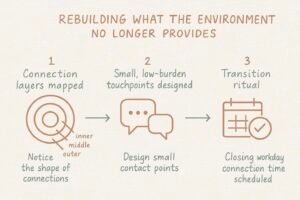
This practice is about working within the environment you have — and deliberately creating the conditions for connection that the environment no longer provides automatically.
STEP 1: Notice the shape of your connections
Bring to mind, without judgment, the people you are currently connected to. Those you work with regularly. Those you can speak honestly with about what matters. And then the middle layer — the people you occasionally encounter on social media, or reach out to every few months.
In a remote-centered life, this middle layer tends to thin dramatically. Noticing that thinning is the first step toward knowing what you might want to rebuild.
STEP 2: Design small points of contact
Recovering weak ties doesn’t mean reconstructing an office. It means building small, low-burden touchpoints that don’t depend on chance.
Letting the first few minutes of an online meeting be unhurried conversation before the agenda begins. Creating a space in a team chat for something other than work — a channel where people share what they’re reading or thinking, joined only when it feels right. Going to a café or co-working space once a week, not necessarily to meet anyone, but to feel the presence of other people working in the same room.
The goal is not deep friendship. It is the modest but real sense of being part of a shared network — of existing in relation to others.
STEP 3: Build a transition
Create a small, repeatable signal that the workday has ended. Close the laptop. Clear the desk. Step outside for a short walk. Even the smallest ritual, repeated consistently, gives the brain a reliable cue that one mode is ending and another is beginning.
Scheduling time for connection — treating it with the same weight as a meeting — is another version of this. Time that isn’t for producing anything, but simply for being with people in an unstructured way. That time quietly restores something that productivity metrics don’t measure.
Session 3: The Structures Underneath the Feeling
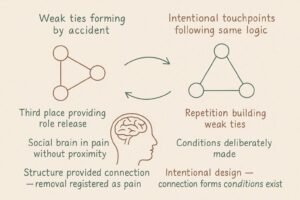
What the office was doing without anyone noticing
In the 1970s, sociologist Mark Granovetter showed that the information and opportunities most useful to people tend to arrive not through close friends — what he called strong ties — but through acquaintances, people seen occasionally, known loosely: weak ties. Strong ties tend to share the same information; weak ties serve as bridges to different worlds. In the decades that followed, sociologist Ray Oldenburg described what he called the “third place” — spaces that are neither home nor workplace, like cafés, libraries, and parks — where informal interaction builds the connective tissue of community.
The office, it turns out, was doing both of these things simultaneously. It was a place where weak ties formed by accident, and where the role you held at your desk could be temporarily set aside. What the environment no longer generates on its own, intentional structure can begin to create.
Why it feels physical
Neuroscientist Matthew Lieberman’s research shows that the human brain is set, by default, to social processing mode. When there are no external tasks demanding attention, the brain moves automatically toward thinking about other people — this is its resting state. Further, social exclusion and isolation are processed through the same neural circuits as physical pain.
The heaviness of remote loneliness — the way it registers in the body rather than just the mind — is not weakness or failure to adjust. It is the brain functioning exactly as it was designed to, signaling honestly that something it needs is missing.
Where intentional contact leads
Weak ties were never cultivated in the traditional sense. They formed through repetition and proximity — the same hallway, the same coffee machine, over time. Intentionally created touchpoints follow the same logic. The colleague you exchange a few sentences with at the start of every call. The chat channel you check without obligation. The café where the person at the next table eventually becomes a familiar face.
Connection tends to form where the conditions for it exist — and that holds for conditions that were deliberately made.
Conclusion: The Loneliness Was a Signal

The loneliness is not evidence of weakness. It is the honest voice of a brain built for social life, asking for what it needs.
Responding to that voice — once, today, in a small way. Five minutes of conversation that wasn’t strictly necessary. The atmosphere of a café where other people are working. A short walk after the laptop closes. These are not grand solutions. They are the conditions from which connection grows, made deliberately, one day at a time.
Loneliness was not the problem. It was the most honest signal the brain knows how to send.
KEY TERMS
Weak Ties
A concept introduced by sociologist Mark Granovetter. In contrast to strong ties — close friends and family — weak ties are the loose connections with acquaintances and occasional contacts. New information and unexpected opportunities tend to arrive through weak ties rather than strong ones, because weak ties bridge different social worlds. When remote work thins this layer, both the diversity of information and the ambient sense of belonging diminish together.
Third Place
A concept developed by sociologist Ray Oldenburg. The spaces that are neither home nor workplace — cafés, libraries, parks, community centers — where informal interaction creates the connective tissue of community. In these spaces, the roles and titles of daily life can be temporarily set aside. The office carried some of this function without being recognized for it.
Social Brain
A framework developed by neuroscientist Matthew Lieberman describing the brain’s default orientation toward social processing. In the absence of external tasks, the brain moves automatically to thinking about other people. Social exclusion and isolation are processed through the same neural circuits as physical pain — which is why remote loneliness often registers in the body as well as the mind.
Default Effect
A concept from behavioral science. In the absence of deliberate choice, people tend to remain in whatever state their environment provides as the default. Connection was the default in a shared physical space — it happened without intention. In remote environments, that default is absent, and connection requires deliberate design.
Sati
Pāli for “awareness” or “mindfulness.” The capacity to bring quiet attention to present experience — including the experience of loneliness — without immediately moving to judgment or remedy. The orientation underlying all three steps of the practice in Session 2.