
Introduction: Why Recycling Sometimes Makes You Feel Worse

You refuse the plastic straw, then buy the over-packaged convenience store lunch anyway. You share an article about renewable energy, then reach for the air conditioning remote. Each contradiction lands as another layer of guilt.
The news runs climate stories daily. The message arrives constantly: your choices save or destroy the planet. That pressure mixes legitimate concern with something that feels less like motivation and more like weight. This is not simply worry about the environment. It is what happens when a structural problem is redirected, with considerable precision, onto individual psychology.
Session 1: The Spiral of Powerlessness — The Trap of Personal Responsibility

The discourse around climate crisis tends to collapse a complex structural problem into a single point of personal culpability — and that collapse produces a particular kind of exhaustion.
At the center is the moralization of individual choice. A problem caused by decades of industrial policy, fossil fuel subsidies, and corporate behavior gets translated into the language of consumer ethics. Flying is a moral failure. Veganism is virtue. The framework ensures that the moments when you fall on the wrong side of the line multiply constantly, and the guilt of those moments becomes its own ongoing burden.
Onto this layers the collision with an impossible ideal. The image of a fully sustainable life — zero waste, zero emissions, zero contradiction — is presented as the standard, against which your actual life (the occasional car trip, the non-recyclable packaging) registers as deficiency. If I can’t do it all, none of it means anything. This all-or-nothing logic allows small efforts to be dismissed by the person making them.
Then there is the collapse that follows inflated expectation. When individual action is framed as capable of solving a planetary problem, the inevitable failure to see results produces a specific kind of defeat — what psychologists call learned helplessness. Nothing I do makes any difference. The action stops feeling like participation and starts feeling like performance.
This is not weakness. It is the predictable outcome of a frame that was never designed to make you feel capable.
Session 2: Practice — From Guilt to Values-Based Action
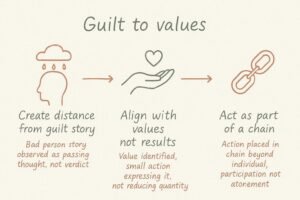
This practice is about replacing guilt — which burns fast and leaves ash — with something that can actually sustain movement over time.
STEP 1: Create distance from the “bad person” story
When the thought arrives — I’m bad for the environment, my life isn’t sustainable — pause before accepting it as fact. Instead, notice it:
“My mind is running the ‘I’m not doing enough’ story right now.”
Observe that thought as a passing event rather than a verdict. This is not denial — it is the step back that makes it possible to act from something other than shame. The person underneath the guilt is someone who noticed the problem, cares about it, and wants to do something. That is a different starting point than I am the problem.
STEP 2: Align with values rather than results
Instead of a target — reduce carbon output by X — identify the value that underlies your concern, and let a small, concrete action express it.
Buying local produce once a week as a practice of feeling connected to where food comes from. Turning off the lights as a small expression of respect for what resources are. The focus shifts from the quantity of what is reduced to the quality of what is expressed. Results are not in your control. Today’s intention always is.
STEP 3: Act as part of a chain, not as a lone actor
Rather than carrying the action as a solitary fight, locate it within a larger continuity.
“Separating this waste connects me to the people who process it, the policy that made it possible, and whoever comes after.”
This reframe doesn’t inflate the significance of any single act. It places it accurately — as one condition among many in a network that extends well beyond what any individual can see. The action stops being atonement and starts being participation.
Session 3: The Guilt Was Designed
The guilt was designed
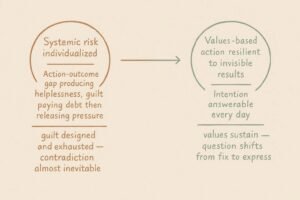
The concept of the “personal carbon footprint” was popularized through an advertising campaign launched by BP in 2004 — a deliberate strategy to shift the frame of climate responsibility from industrial systems to individual consumer behavior. Sociologist Ulrich Beck’s concept of the “risk society” describes the broader structural pattern at work: the risks generated by global industrial and political systems are systematically redistributed onto individuals, who are then asked to solve through lifestyle choices what was produced by policy and corporate structure. Beck called the resulting paradox the individualization of systemic risks — the cause is structural, the responsibility becomes personal.
The guilt you feel when you forget your reusable bag is not evidence of your moral inadequacy. It is evidence that a very effective public relations strategy worked exactly as intended.
Why the motivation disappears
Psychologist Albert Bandura’s research on self-efficacy established that sustained action requires the felt sense that one’s actions are connected to outcomes — that what you do makes a difference to something. Climate communication, when it links individual consumer choices directly to a planetary-scale problem, structurally undermines this sense. One person refusing a straw has no measurable effect on annual plastic production in the hundreds of millions of tons. When that gap between action and visible result repeats often enough, the brain arrives at the conclusion that action is pointless — the condition Bandura’s contemporary Martin Seligman described as learned helplessness.
All-or-nothing thinking accelerates this: if my effort doesn’t solve the problem, it counts for nothing. Neither the helplessness nor the all-or-nothing thinking is a character flaw. Both are predictable responses to a frame that systematically breaks the connection between action and meaning.
The unexpected psychology of contradictory behavior
Social psychologists have documented a phenomenon they call moral licensing: after performing a virtuous act, people are measurably more likely to allow themselves a behavior they would otherwise avoid. Refuse the straw, buy the over-packaged lunch. Bring the reusable bag, drive further than necessary. This is not hypocrisy in the ordinary sense. It is the structural limitation of guilt-based motivation. Guilt functions as a debt — performing the virtuous act pays down the debt, and once the debt is cleared, the pressure to continue dissolves. Action driven by the desire to reduce guilt runs out of fuel the moment the guilt is reduced.
This is why the shift from guilt to values is not just a reframe. It removes the mechanism that makes the contradiction almost inevitable.
Guilt exhausts. Values sustain.
Research on values-based action in behavioral science consistently shows that when behavior is aligned with personally held values rather than directed at external outcomes, it proves more resilient to the absence of visible results. The action feels meaningful not because it demonstrably changed something, but because it expressed something true about what the person cares about.
The question did my action fix anything? leads to learned helplessness. The question did my action reflect what I actually value? is answerable every day, regardless of what the planet does. The intention is always available. The result never was.
Conclusion: Guilt Won’t Fix the Climate

The frame was built to protect industrial systems, not to help you act. Knowing where it came from is the first condition for choosing a different one.
Your values, acted on today, are always available. They don’t require a visible result, a perfect record, or a planet that responds on your timeline.
KEY TERMS
Eco-Anxiety
The chronic anxiety, guilt, and sense of powerlessness generated by repeated exposure to climate crisis information. A contemporary form of psychological distress in which a structural problem is redirected onto individual psychology. Intensified by messaging that frames personal consumer choices as the primary lever of planetary outcomes.
Systemic Individualism
The structural pattern identified in Ulrich Beck’s risk society framework: risks and harms generated by global industrial and political systems are redistributed onto individuals, who are then asked to solve through lifestyle choices what was produced by policy and corporate behavior. The popularization of the personal carbon footprint concept by BP in 2004 is a documented instance of this transfer.
Self-Efficacy
Albert Bandura’s term for the felt sense that one’s actions are connected to outcomes — that what you do makes a difference. A necessary condition for sustained motivation. When individual consumer behavior is directly linked to planetary-scale problems, the absence of visible results systematically undermines this sense, producing learned helplessness.
Moral Licensing
The social psychology finding that performing a virtuous act generates a sense of moral credit that makes subsequent contradictory behavior more likely. The structural reason why guilt-based environmental behavior tends to undercut itself: once the guilt is reduced by a virtuous act, the motivational pressure dissolves. The psychological basis for the shift from guilt to values in Session 2.
Values-Based Action
An approach from behavioral science in which behavior is aligned with personally held values rather than directed at external outcomes. More resilient to the absence of visible results than guilt-based or outcome-based motivation. The question shifts from did my action fix anything? — unanswerable and demoralizing — to did my action reflect what I value? — answerable every day, regardless of what happens next.