
Introduction: Why Information About Making the World Better Is Making Us Worse

You wake up and open your phone to news about an endangered species. On the commute, a podcast about a social crisis. At lunch, your feed fills with posts urging ethical consumption. In the evening, a documentary confronts you with the reality of climate change.
With each exposure, the helplessness grows. So does the urgency — the sense of not knowing enough, not doing enough. This is the exhaustion of good intentions. And it is not a sign of weakness.
Session 1: The Exhaustion of Good Intentions — When the Empathy Circuit Overloads

For anyone who genuinely wants to make things better, information doesn’t arrive as neutral knowledge. It arrives as moral obligation.
At the center is the automatic fusion of knowing and responding. The moment you see evidence of environmental destruction or social injustice, the thought activates reflexively: I know about this now, so I must do something. The accumulation of this obligation, proportional to the volume of information consumed, produces a weight no individual can carry.
Onto this layers the compulsion toward complete understanding. The belief that you cannot act correctly without first understanding fully drives an impossible effort — attempting to grasp the whole picture of problems that even specialists cannot fully map. Information gathering becomes an endless form of penance rather than preparation.
Then there is the paralysis that comes from contradictory information: recycling matters / recycling doesn’t matter; this solution works / this solution has unintended consequences. When every direction seems potentially wrong, the will to act in any direction freezes.
The more you know about the world’s suffering, the more you simultaneously know your own powerlessness. The good intention becomes the fuel that burns.
Session 2: Practice — From Consuming Information to Engaging with It
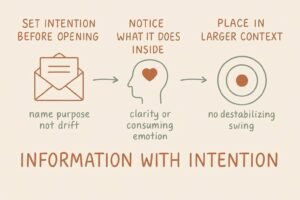
This practice is about shifting from passive, reflexive information consumption toward a conscious and selective way of engaging — so that information becomes a source of clarity rather than depletion.
STEP 1: Set your intention before you open anything
Before opening a news app or scrolling a feed, pause and ask:
“What am I actually trying to get from this right now?”
Is it the vague anxiety of not wanting to miss something? Is it specific knowledge needed for a concrete action? Is it context that deepens understanding of something you’re already engaged with? Making the purpose explicit prevents you from being carried by the current rather than swimming in a direction. Purposeless browsing almost always ends in depletion.
STEP 2: Notice what the information does inside you
After encountering a piece of information, observe your internal state.
“Is this producing something sustainable — clarity, motivation, a sense of direction? Or is it only amplifying anger, despair, and self-reproach?”
Evaluate information not only by its content but by what it generates internally. Engagement that only produces consuming emotions without moving toward any kind of action needs to be handled differently — not avoided, but approached with more deliberate attention to what it is actually doing.
STEP 3: Place it in a larger context
Before reacting to a single piece of information, locate it within a bigger picture.
“Which part of a larger problem is this reflecting?”
“What sits on the other side of this, or adjacent to it?”
Treating one data point as the full truth — rather than as one part of a complex whole — is what produces the most disorienting swings. This reframing creates the intellectual steadiness to engage without being destabilized.
Session 3: Your Compassion Is Being Treated as a Resource
The exhaustion is not weakness — it’s a circuit shutting down
Psychologist Charles Figley introduced the concept of compassion fatigue to describe what happens when repeated exposure to the suffering of others overloads the neural circuits involved in empathy — particularly the anterior cingulate cortex and the mirror neuron system. The result is emotional numbness, helplessness, and avoidance. The concept was originally observed in emergency medical workers and social service professionals, but the transformation of the digital media environment has extended the same phenomenon to ordinary news consumers.
The impulse to stop looking is not indifference. It is a protective response.
What happens when the overload reaches its limit
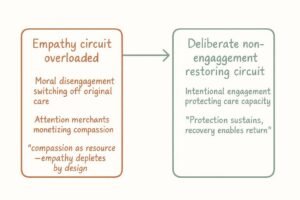
As compassion fatigue deepens, a further mechanism activates. Psychologist Albert Bandura described what he called moral disengagement: a self-protective process in which, under the weight of excessive moral demand, a person progressively disconnects — emotionally and cognitively — from the problem. I’ve stopped feeling anything when I see this. Whatever I do, it won’t make a difference. These are not failures of character. They are the nervous system’s adaptation to a load it was not designed to sustain indefinitely. The problem with moral disengagement is not just the numbness itself — it is that the genuine care and motivation the person originally carried get switched off along with the overwhelm.
Your compassion is being treated as a resource
There is also a structural explanation for why this overload is so pervasive. Media historian Timothy Wu described what he called the attention merchants — the commercial infrastructure built around the capture and sale of human attention. In this framework, social issue content that triggers emotional response, emphasizes urgency, and generates guilt is not primarily designed to inform. It is designed to capture and hold your attention, because your attention is what is being monetized. People with strong moral commitments are particularly susceptible to this design — their compassion makes them more responsive, and therefore more valuable as an audience.
The exhaustion you feel is not a personal failing. It is an honest response to having your empathy treated as a commercial resource.
Protecting compassion is the prerequisite for sustained engagement
The research literature on compassion fatigue is consistent on one point: deliberate periods of non-engagement are not avoidance — they are the condition under which the empathy circuit recovers. The capacity to care is not infinite and self-replenishing. It depletes and requires restoration.
Protecting the resource of compassion is not a retreat from the world. It is what makes remaining in it, over time, possible.
Conclusion: Protecting Your Compassion

The information will keep flowing. The empathy circuit will keep being taxed. The attention economy will keep treating your good intentions as fuel.
The intention hasn’t gone anywhere. It just needs a different relationship with the information feeding it — one built around choice rather than obligation, engagement rather than consumption.
Protecting your compassion isn’t stepping back from the world. It’s how you stay in it.
KEY TERMS
Compassion Fatigue
A concept introduced by psychologist Charles Figley describing the state that results from repeated exposure to others’ suffering — overloading the neural circuits involved in empathy and producing emotional numbness, helplessness, and avoidance. Originally observed in medical and social service professionals, now widely documented in general news consumers due to digital media saturation. The impulse to stop looking is not indifference. It is a protective response.
Moral Disengagement
A concept from psychologist Albert Bandura describing the self-protective process by which a person progressively disconnects — emotionally and cognitively — from moral demands that have exceeded their capacity to process. The numbness and fatalism that follow prolonged compassion fatigue. Not a character flaw, but a nervous system adaptation — one that unfortunately disengages genuine care along with the overwhelm.
Attention Economy
The commercial infrastructure, described by media historian Timothy Wu as the “attention merchants” model, built around the capture and monetization of human attention. Social issue content that triggers emotional response and emphasizes urgency is designed primarily to hold attention, not to inform. People with strong moral commitments are particularly susceptible — their compassion makes them more responsive, and therefore more valuable as an audience.
Selective Engagement
An approach to information consumption drawn from compassion fatigue research: engaging with information deliberately and purposefully rather than reflexively and continuously. Setting intention before consuming, observing internal effects, and placing individual pieces in larger context. Not avoidance — a redesign of the relationship with information from being consumed to choosing how and when to engage.
Compassion Resources
A concept from compassion fatigue research framing the capacity for empathy as a finite resource subject to depletion and recovery rather than an unlimited supply. Deliberate periods of disengagement are not withdrawal — they are the conditions under which the empathy circuit recovers. Protecting compassion resources is not a retreat from engagement with the world. It is what makes sustained engagement possible.