
Introduction: Why More Information Makes It Harder to Decide

The unread badge on the news app. The infinite timeline. The unbroken stream of work notifications. The intention was to gather knowledge and make better decisions. What accumulates by the end of the day is fatigue and the sense that nothing got decided.
This is not an information shortage. It is a structural paradox: the more information arrives, the harder the decisions become.
Session 1: Deciding Is the Thing That Wears You Down

The reason information undermines judgment rather than supporting it is that judgment itself consumes a resource — and the resource is finite.
Every encounter with information involves a small decision: read this or skip it, trust this or question it, act on this or let it pass. These micro-decisions are easy to overlook individually. They accumulate. The hundreds of inputs arriving across a day — each requiring some form of evaluation and response — quietly drain the cognitive capacity that would otherwise be available for the things that actually matter.
As that depletion progresses, the quality of judgment shifts in recognizable ways. Important decisions get deferred. Minor choices absorb disproportionate energy. The impulse to gather more information before deciding anything — which feels like due diligence — is often the depleted system’s way of avoiding the moment of commitment.
Session 2: Practice — From Receiving to Selecting
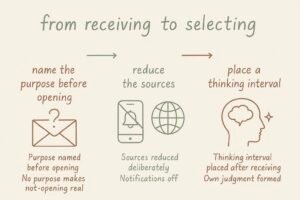
This practice is not about consuming less information. It is about changing the relationship with information — from passively receiving whatever arrives to actively deciding what to let in and what to leave out.
STEP 1: Name the Purpose Before Opening
Before opening a news app, before scrolling a feed, pause for a single breath.
Why am I opening this right now?
For entertainment, for a specific piece of information, or for no particular reason? When the purpose is clear, it becomes possible to stop when the purpose is met. When there is no purpose, not opening becomes a real option for the first time. That breath is the first interruption in the automatic chain.
STEP 2: Deliberately Reduce the Number of Sources
Trying to process all available information from all available sources is not thoroughness. It is the fastest route to depletion. It can feel like wilful blindness to stop. It isn’t. Identify a small number of sources that have proven reliable and let them do most of the filtering. Turn off push notifications entirely and redefine information as something that is sought rather than something that arrives.
This is deciding that cognitive resources belong to the person who owns them — not to the systems designed to consume them.
STEP 3: Place a Thinking Interval After Receiving
After taking in a piece of information, resist the immediate move to the next one. Hold a brief pause.
What do I actually think about this?
Walking, or simply sitting without input for a few minutes, allows the received information to be processed in the person’s own terms rather than immediately displaced by the next incoming signal. The interval between information and the next information is where the information becomes usable. Without it, input accumulates without ever becoming judgment.
Session 3: Every Decision Was Costing Something
The Resource That Runs Out
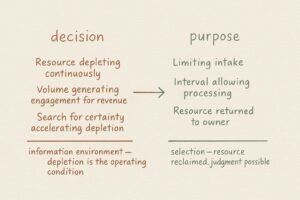
Psychologist Roy Baumeister’s influential work on ego depletion proposed that the act of making decisions draws on a cognitive resource that diminishes with use — and that as the resource depletes, the quality of subsequent decisions degrades. This is distinct from the familiar observation that an abundance of options reduces satisfaction after a decision is made. What ego depletion describes is more fundamental: the act of choosing, regardless of how many options are involved, costs something. The contemporary information environment runs this cost continuously. Read or skip. Trust or question. Respond or ignore. Open or close. Each of these is a judgment, and the hundreds of them distributed across a day leave less available for the decisions that actually require careful thought. Decision paralysis at the end of an information-saturated day is not a character deficiency. It is the predictable functional state of a system that has been billing itself all day for small transactions and has run short.
More Information Was the Product
The model that positions behavioral data as the commodity being harvested describes one layer of the contemporary information economy. What the information industry adds is a further mechanism: volume itself generates engagement, and engagement converts to advertising revenue. Articles are written not primarily to be read but to be clicked. Notifications are designed not primarily to inform but to reopen the application. The architecture that produced the infinite scroll — removing the natural stopping points that would allow disengagement — is the same architecture that operates across news feeds, recommendation systems, and content platforms. The sustained sensation of *there is still more I haven’t seen* is not a side effect of the information environment. It is the environment’s primary output. Baumeister’s depletion is not an incidental cost of using these systems. It is the condition that keeps the engagement running.
The Search for Certainty That Made Things Less Certain
Psychologist Arie Kruglanski’s research on the need for cognitive closure describes a specific response to uncertainty: the motivated drive to reach a definite answer and stop processing competing information. In moderate form, this is adaptive — it gets decisions made. Under conditions of information overload and cognitive depletion, it takes a different shape. The person who feels unable to decide reaches for more information, driven by the belief that certainty is one more data point away. But each additional piece of information introduces new considerations, new micro-decisions, and new depletion. Kruglanski’s research also shows that under high need for closure, information processing becomes selectively confirmatory — the mind becomes more likely to accept inputs that fit existing frameworks and less capable of integrating genuinely new ones. The search for the information that will finally make the decision possible accelerates the depletion that makes deciding difficult. More information was never the answer to decision paralysis. It was the mechanism producing it.
Conclusion: The Quiet Mind Was Always the Resource

The information industry will keep generating the sensation of incompleteness. Ego depletion will keep accumulating with each micro-decision the environment requires. The need for cognitive closure will keep redirecting the exhausted mind toward more searching rather than toward the decision itself. The structure does not change. But the question why am I opening this right now can be asked before any notification, before any scroll, at any moment when the next input is about to arrive. That question returns the decision about what enters the mind to the person whose mind it is — which is the only place that decision was ever going to produce anything useful.
More information was never what the decision needed. A quieter mind was always already there.
Key Terms
Ego Depletion
Roy Baumeister’s proposal that the act of making decisions draws on a cognitive resource that diminishes with use, degrading the quality of subsequent judgments as it depletes. Distinct from the observation that too many options reduce satisfaction after decisions are made: what ego depletion describes is the cost of the decision act itself, regardless of outcome. The mechanism by which an information-saturated day leaves less cognitive capacity available for the decisions that actually require it — decision paralysis as functional depletion rather than personal failure.
Industrial Amplification of Information Volume
The information industry’s mechanism by which volume itself generates engagement and engagement converts to revenue — distinct from the data-harvesting model. Articles written to be clicked rather than read, notifications designed to reopen applications rather than inform, recommendation systems optimized to sustain the sensation of incompleteness. The condition that keeps Baumeister’s depletion running is not a side effect of these systems. It is their primary operational output.
Need for Cognitive Closure
Arie Kruglanski’s term for the motivated drive to reach a definite answer under conditions of uncertainty. Under information overload and cognitive depletion, it produces the belief that one more piece of information will make the decision possible — a belief that generates additional micro-decisions, additional depletion, and increasingly confirmatory rather than genuinely integrative information processing. The mechanism by which the search for the information that would end the paralysis deepens the paralysis instead.
Cognitive Resource Management
The practice of treating attention and decision-making capacity as finite resources to be allocated deliberately rather than distributed automatically across whatever the information environment presents. Redefining information as something sought rather than received, reducing active sources to a trusted few, and placing a thinking interval after input rather than moving immediately to the next — each of these is an act of allocation rather than consumption.
Defusion
The capacity to notice that the belief — one more piece of information will make this decision possible — has fused with the experience of being unable to decide, and to create observational distance from it. The breath before opening an application — why am I opening this right now — is the interval in which the automatic information-seeking chain can be interrupted, and the decision about what enters the mind returned to the person making it.