
Introduction: How One Small Checkmark Can Derail an Entire Day

You send a message. The read receipt appears. No reply comes. Did I say something wrong? Are they angry? Do they just not want to talk to me anymore? As the silence stretches, the questions harden into something that feels uncomfortably like certainty.
That a single digital indicator can produce this much anxiety is not a character flaw. It is what happens when a brain designed to detect social threat encounters an environment almost completely stripped of the signals it needs to do that accurately.
Session 1: The Interpretation That Runs Away — What Flows Into the Silence

Read-receipt anxiety is driven by the fusion of a digital indicator with the fears already living underneath.
The foundation is the over-reading of intent. A neutral fact — the message was seen, and no reply has come — gets loaded with human motivation. Deliberate avoidance. A signal of rejection. The function of a technology becomes a verdict about the relationship. What the app did and what the person meant collapse into the same thing.
Onto this layers the quantification of approval. The time between read and reply, the length of the response, the presence or absence of warmth — these get processed, unconsciously, as measures of how much you matter to the other person. A slow reply means I’m not a priority. A short one means they’re losing interest.
Then there is the loss of pacing. In a face-to-face conversation, both people share the rhythm. In asynchronous text, one person sends and then waits, with no influence over what happens next. For relationships that carry significant emotional weight, this relinquishment of control can activate a low-grade separation anxiety — and the read receipt makes that anxiety visible by marking the exact moment the message arrived and was left unanswered.
While the silence continues, we appear to be thinking about the other person. We are mostly thinking about ourselves.
Session 2: Practice — Three Points of Intervention in the Automatic Loop
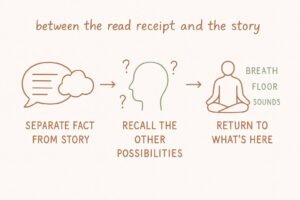
This practice places three small interruptions into the chain of interpretation that a read receipt can set in motion.
STEP 1: Separate the fact from the story
When the automatic thought arrives — they’re ignoring me, they’re upset, something is wrong — pause before accepting it as information about reality.
“My mind is generating a story to fill this silence.”
Receive that story as a radio drama playing in the background — audible, but not necessarily true. The fact is that a message was read and no reply has come. Everything else is a narrative the mind constructed, using available materials, in the absence of actual evidence.
STEP 2: Recall the other possibilities
The anxious interpretation tends to arrive as the only possible explanation. The practice is to deliberately remember that it is one of many.
The person is in a meeting, driving, unwell, or simply didn’t notice the notification. They want to reply thoughtfully and haven’t found the moment. They’re figuring out what to say. The app glitched. The phone is in another room.
The goal is not to find the correct explanation. It is to restore the accurate sense that the world is more complex than any single reading of silence — and that the most frightening interpretation is rarely the most probable one.
STEP 3: Return attention to what’s actually here
When the interpretive loop begins pulling, redirect attention from the screen to the body.
“Breathing in. Breathing out.”
The contact of feet with the floor. The sounds in the room, received without evaluation. This is the practice of placing the anchor somewhere that the read receipt cannot reach — in present-moment sensation, where the story has no jurisdiction.
Session 3: Why Silence Becomes a Verdict
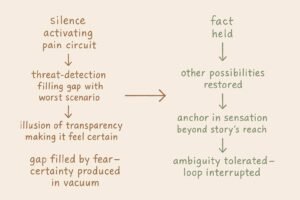
When approval is outsourced, silence becomes pain
Neuroscience research shows that social approval activates the brain’s dopamine reward circuit — and that its absence is not simply neutral. Matthew Lieberman’s research established that social exclusion activates the same neural circuitry as physical pain. This is not metaphor. When a message goes unanswered after being read, the nervous system registers something that functions neurologically like rejection. In a state where self-worth has been tied to digital responses, this activation is amplified: the silence arrives not just as the absence of a reply, but as evidence about the self. The pain and the interpretation feed each other — and the loop begins.
Why the brain fills the gap with its worst scenario
The tendency to read ambiguous information pessimistically is not a psychological weakness. It is an evolutionary design. Detecting threats that don’t exist is less costly than missing threats that do — so the brain errs toward danger. In the context of digital notifications, this design misfires. The silence that follows a read receipt is genuinely ambiguous. But a brain running its threat-detection protocol on ambiguous social information will tend to treat the worst explanation as the most likely one. And when self-worth is already in a fragile state — already dependent on incoming approval — that pessimistic tilt intensifies. The pain circuit and the interpretation bias reinforce each other, making the most frightening reading feel the most credible.
Why you’re so sure you know what it means
Social psychologists have documented what they call the illusion of transparency: the consistent overestimation of how accurately one can read another person’s internal state. In a face-to-face conversation, this bias is partially corrected by expression, tone, and timing — real-time signals that provide friction against the most distorted interpretations. In text-based communication stripped of those signals, no correction is available. The reading the mind generates goes unchallenged. Obviously they’re upset. It’s clear they’re pulling away. The certainty feels earned. It was not. It was produced in an information vacuum, by a brain that needed to resolve the ambiguity, and filled it with what the fear suggested.
The problem is structural, not perceptual.
The loop was structurally accelerated
Read-receipt anxiety did not emerge from human psychology alone. The expectation of near-immediate response — the norm that receiving a message and not replying promptly is a social failure — is not a natural feature of human communication. It was produced by the design of platforms whose business model depends on continuous engagement. The read-receipt function specifically was built to make the sender’s awareness of the recipient’s attention unavoidable, generating exactly the kind of ambient vigilance that drives return visits to the app.
The outsourcing of approval to digital responses, the pessimistic interpretation of silence, the unfounded certainty — all three are intensified by a communication environment designed to keep people monitoring for signals.
Conclusion: The Silence Is About You, Not Them

The read receipt marks one fact: the message arrived. The story that follows — about rejection, about worth, about what the relationship has become — is generated by the mind in the absence of actual information, shaped by whatever fears are already present.
Placing a moment of observation between the fact and the story is what interrupts the loop at the point where it is most vulnerable.
The silence says nothing about them. It says everything about where you’ve placed your sense of worth.
KEY TERMS
Social Pain
The neuroscientific finding, established through Matthew Lieberman’s research, that social exclusion activates the same neural circuitry as physical pain. The reason a read receipt without a reply can register as something that genuinely hurts rather than merely disappoints. When self-worth is tied to digital responses, the absence of a reply activates this circuit more readily.
Pessimistic Interpretation Bias
The brain’s tendency to resolve ambiguous social information by defaulting to the most threatening available explanation — an evolutionary design that misfires in the context of digital communication. In the absence of actual evidence, silence gets treated as rejection. The bias intensifies when self-worth is already in a fragile or dependent state.
Illusion of Transparency
The consistent overestimation of one’s ability to read another person’s internal state accurately. In face-to-face conversation, partial correction comes from nonverbal signals. In text-based communication, those corrective signals are absent, leaving unfounded certainty to accumulate unchallenged. The conviction that you know what the silence means is a structural artifact of information scarcity, not accurate perception.
Always-On Norm
The social expectation, produced by platform design rather than natural communication norms, that receiving a message and not responding promptly constitutes a social failure. The read-receipt function was specifically built to make the sender aware of the recipient’s attention — generating the ambient vigilance that makes silence feel like a statement. The norm did not exist before the technology created the conditions for it.
Defusion
The capacity to notice the fusion between a digital fact — the message was read — and the fear-generated story that immediately attaches to it, and to place a moment of observational distance between them. Receiving the story as a narrative the mind is producing, rather than as information about reality, is the first point at which the loop becomes interruptible.