
Introduction: Why Talking About Race or Gender Can Make the Words Stop Coming

Before speaking in a meeting, you run the words through your head several times. Before posting on social media, you spend ten minutes checking the phrasing. When the topic involves a particular group, the anxiety arrives before the sentence does — is this appropriate, will this offend someone — and often nothing gets said at all.
The intention to use the right words is genuine. But when that intention hardens into I cannot speak unless I have the perfect words, the conversation stops. This is not a failure of will. It is what happens when moral concern takes a particular turn.
Session 1: What the Freezing Actually Is — The Trap of the Perfect Word

The freezing of communication comes from a state in which word choice and moral self-worth become fused.
At the center is the fear of moral labeling. The sense that a single imperfect phrase could mark you as a bigot, as ignorant, as someone who doesn’t belong on the right side — and that this label, once applied, would stick. The word choice stops being a communication decision and becomes evidence in a case about the kind of person you are.
Layered onto this is the compulsion toward complete knowledge. The belief that you have no right to speak about a group until you have fully mastered its internal diversity, its preferred terminology, its current debates. Since the norms keep shifting, this standard is structurally impossible to meet. The result is that almost everyone feels underqualified, and silence becomes the safer option.
Then there is the helplessness produced by the gap between intention and impact. The principle that impact matters more than intent — a reasonable starting point — can slide into the fear that good intentions count for nothing, that no matter how carefully you chose your words, you could be judged entirely on how they landed. When your internal state has no bearing on the verdict, every word feels like a gamble with stakes you can’t calculate.
Communication has become moral self-defense rather than the exchange of meaning. That is why the words freeze.
Session 2: Practice — From Frozen to Engaged
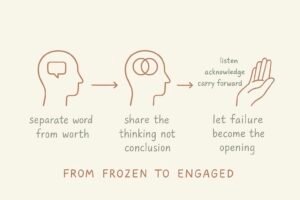
This practice shifts the aim from achieving perfect correctness toward something more durable: a way of being in dialogue that can survive imperfection.
STEP 1: Separate the word from your worth
When the feeling arrives — I may have said something wrong — pause before letting the attached thought complete itself: which means I’m a bad person.
“My mind is running a story that conflates the word I chose with the kind of person I am.”
The word was chosen. That choice is part of a learning process. The choice and the self are not the same thing. This separation — small, quiet, internal — is what creates enough room to remain in the conversation rather than retreating from it.
STEP 2: Share the thinking, not just the conclusion
When the topic is genuinely difficult, resist the pressure to arrive with a finished, vetted position. Instead, make the process of thinking visible.
“I don’t think I fully understand this yet. Let me try to put into words what I’m working with — and if something I say doesn’t land right, please tell me.”
“I want to learn what language feels right to you here. Can you help me understand how you’d frame it?”
This releases the pretense of complete knowledge and replaces it with something more accurate: two people thinking together. The shift from performance to inquiry is what makes the conversation real.
STEP 3: Let the failure become the opening
When words miss — when something lands wrong, or someone points out that it did — resist the impulse to defend or to go silent. Move through a sequence instead.
First, listen and confirm: “It sounds like what I said affected you. Can you help me understand which part, and how it felt?” — understanding the experience before evaluating whether the criticism is correct.
Then acknowledge the impact: “I hear that. My phrasing wasn’t careful enough.” — without leading with the defense that the intention was good.
Then receive it: “Thank you for telling me. I’ll carry that forward.” — treating the correction as information rather than attack.
This is the reframing that changes the meaning of failure: not a conclusion, but a beginning.
Session 3: When Moral Concern Becomes Moral Performance
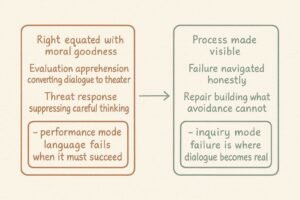
The perfect word becomes proof of goodness
Moral psychologist Jonathan Haidt’s research established that moral judgment is driven primarily by emotion rather than reason — we feel the verdict first and construct the justification afterward. When this process operates in the context of political correctness, it produces a particular equation: having the right words becomes proof of being a good person. The inverse follows automatically: not having the right words becomes evidence of moral failure. The problem this creates is not that people stop caring about language — they care intensely. It is that caring about language becomes entangled with the need to demonstrate that care publicly, which is a different objective entirely. Understanding deepens through dialogue. Moral self-demonstration tends to shut dialogue down.
Being watched turns dialogue into theater
Evaluation apprehension — the well-documented shift from genuine inquiry to social impression management that occurs when people feel observed — is one of the structural mechanisms behind the freezing. In an environment where every public statement is potentially subject to review, the question running beneath any utterance stops being what do I actually think and starts being how will this be received. The conversation converts from an exchange of meaning into a performance of moral positioning. Every participant is simultaneously playing judge and defendant, which means no one is actually in the room to think together. The freezing is not cowardice. It is the rational response to an environment in which the costs of an imperfect word appear to exceed the benefits of honest engagement.
Why the mind goes blank
Neuroscience research shows that the perception of social threat activates the amygdala and suppresses prefrontal cortex function — the part of the brain responsible for nuanced, contextual, empathic thinking. When the fear of saying something wrong triggers a threat response, the cognitive capacity needed to find the careful, considered word is precisely what gets reduced. The harder the effort to find the perfect phrase, the more the ability to find any phrase diminishes. This is the neurological explanation for the experience of going blank — not weakness, not indifference, but a nervous system adaptation that reliably fires when social exclusion feels possible. The pressure that is meant to produce better language is producing the conditions in which language fails.
The repair is where understanding actually happens
Research on restorative practices — approaches to repairing harm through dialogue rather than punishment — shows that the relationships most capable of surviving disagreement and mistake are not the ones in which no wrong word was ever spoken. They are the ones in which the process of repair was navigated honestly. A relationship maintained entirely by the avoidance of imperfect language tends to be brittle — it has never been tested. A relationship that has moved through failure and repair has learned something that perfect language use cannot teach. The failure is not the end of the conversation. It is the point at which the conversation becomes capable of going somewhere real.
Conclusion: The Perfect Word Doesn’t Start the Conversation

The loop begins in genuine concern and ends in silence — which serves no one.
But the sentence “I’m still learning” is always available. That sentence opens the door that perfect language keeps closed — the door into a conversation where two people are actually thinking together rather than performing at each other.
The perfect word doesn’t start the conversation. The imperfect one, offered honestly, does.
KEY TERMS
Moral Perfectionism
The state in which having the right words becomes equated with being a good person — and not having them becomes evidence of moral failure. Rooted in Jonathan Haidt’s finding that moral judgment is emotionally driven, this equation makes the pursuit of perfect language feel urgent and the failure to achieve it feel damning. The structural source of the freezing: moral concern so intense it prevents the moral engagement it intends.
Evaluation Apprehension
The social psychological shift from genuine inquiry to impression management that occurs when people feel observed. In environments where statements are potentially subject to review, the operative question shifts from what do I think to how will this look. Dialogue becomes performance — everyone playing judge and defendant simultaneously, and no one actually thinking together.
Social Threat and Prefrontal Suppression
The neuroscientific mechanism by which the perception of social exclusion risk activates the amygdala and reduces prefrontal cortex function — the cognitive capacity responsible for nuanced, contextual thinking. The experience of going blank when trying to find the right word is this mechanism in action. The pressure meant to improve language use produces the neurological conditions in which language fails.
Restorative Practices
An approach to repairing harm through dialogue rather than punishment or exclusion. Research in this area consistently shows that relationships capable of surviving disagreement are not those in which no wrong word was ever spoken, but those in which the repair process was navigated honestly. The failure is not the end of the conversation — it is where the conversation becomes capable of going somewhere real.
Defusion
The capacity to notice the fusion between a word choice and a verdict about one’s character — I said the wrong thing, therefore I am a bad person — and to place observational distance between them. The separation of action from identity is what creates the psychological room to remain in a conversation that carries the risk of imperfection, rather than retreating from it entirely.