
Introduction: Why Every New Place Feels Like a Relationship with an Expiration Date

A job transfer. A degree abroad. A better opportunity in another city. Each move carries the feeling that the connections built in the last place are being erased. You start over — introductions, surface-level common ground, the slow work of becoming comfortable — and just as something real begins to form, the next move appears on the horizon. Somewhere in the accumulation of these cycles, a quiet decision forms: if I’m going to leave before it gets deep, I might as well stay shallow from the start.
But that decision may be solving the wrong problem. The feeling that moving resets relationships — that depth requires permanence — may be the very thing preventing depth from forming.
Session 1: What the Shallowness Actually Is — The Trap of the Temporary Self

The relational shallowness that comes with frequent moves doesn’t arrive from the outside. It forms from within, when the premise this relationship is temporary fuses with how you show up in it.
At the center is the automation of investment calculation. Without noticing it, emotional investment starts being processed as a cost with an uncertain return. If I’m leaving in two years, deep involvement is irrational. This logic intercepts the willingness to be open — which is inherently a risk — before it has a chance to act. The prediction of future separation begins governing present behavior.
Layered onto this is what happens to self-disclosure. Deep relationships form through the gradual sharing of vulnerability — actual fears, real feelings, the places where life is uncertain or difficult. But when a relationship is already labeled temporary, this process stops at a particular shallow depth without announcement. Work and surface interests are available; loneliness, doubt, and what actually matters are not.
Then there is the absence of felt belonging. Without a long-term community to be embedded in, the sense of I’m not quite fully here, not fully part of this becomes chronic. Relationships stay at the level of present convenience, unable to accumulate the shared history that gives them weight.
Wherever the temporary-self story is running, deep connection gets deferred to the next place — which turns out to have the same story waiting.
Session 2: Practice — Finding Depth Inside the Temporary
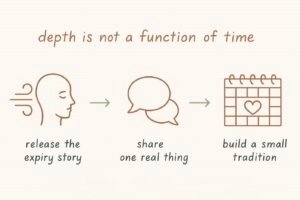
This practice shifts the focus from how long a relationship lasts to what quality it carries — and builds the small, repeatable habits that make genuine connection possible within constraints.
STEP 1: Release the expiry story
When the thought arrives in a new encounter — this will end when I leave — pause before letting it operate as a fact.
“My mind is running the story that this relationship has an expiration date.”
Receive that thought as a passing weather pattern rather than a reliable forecast. Return attention to the actual present: two people in the same place, in the same moment, choosing to be here. The length of a relationship does not determine its quality. That premise, held even briefly, begins to change what is available.
STEP 2: Share one real thing
Depth doesn’t require confession. It requires a small departure from the managed version of yourself — something genuine offered in an ordinary moment.
“I actually made a mistake today and I’ve been carrying it. I’m not sure why I’m telling you, but it helps to say it out loud.” A quiet admission that the new city is lonelier than expected. A moment after performing competence: “That was harder than I made it look.”
These are not dramatic disclosures. They are small gifts of an unguarded moment. The person receiving them tends to respond in kind — and when that happens, the conversation moves to a different level than it was on before.
STEP 3: Build a small tradition
Without geographic permanence, shared history has to be made deliberately. Two people can create a small repeating pattern — a particular café on Tuesday mornings, a specific GIF sent only when something genuinely good happens, a bench in a park where you sit once a month without much agenda.
These rituals do something that accumulates: they give the relationship a rhythm, a private language, a set of shared references that belong only to the two of you. That is what turns an acquaintance into someone whose life you are actually inside. And when the move comes, the ritual can continue — in a different form, across distance — because what it created was never location-dependent.
Session 3: Depth Is Not a Function of Time
The equation that was never quite right
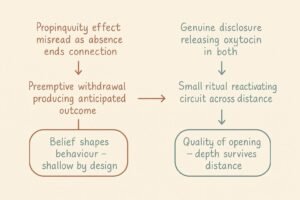
The propinquity effect — the well-documented finding that physical proximity increases the likelihood of relationship formation — is one of the most reliably reproduced results in social psychology. We form connections with the people we repeatedly encounter: the same commute, the same building, the same routine. What the propinquity effect describes, though, is formation, not maintenance. A relationship that has already been built doesn’t depend on continued proximity to survive.
The problem is that the effect gets misread: proximity causes connection slides into absence ends it. That misreading becomes a belief, the belief shapes behavior, and the behavior — the preemptive withdrawal, the decision to stay shallow — produces exactly the outcome it was anticipating. The feeling that moving erases relationships is not a fact about relationships. It is a fact about what happens when a particular belief runs unchallenged.
Depth is not a function of time
Psychologist Arthur Aron’s research on intimacy and self-disclosure showed something that runs against intuition: the depth of a relationship is not primarily determined by how long two people have known each other, but by the quality and reciprocity of what they have shared. In a now widely replicated experiment, pairs of strangers who spent 45 minutes working through a set of progressively personal questions reported levels of closeness comparable to long-term friendships. Two hours of genuine mutual disclosure can produce something that two years of surface interaction does not.
The implication for a mobile life is direct: what you cannot give a relationship is unlimited time. What you can give it, at any point, is depth — and depth is created through the quality of opening, not the quantity of days.
What happens in the brain when you share something real
Neuroscience research on oxytocin and social bonding shows that when vulnerability is shared — when something genuine and slightly unguarded is offered — oxytocin is released in both the person disclosing and the person receiving. This is not reserved for significant confessions. It happens in small moments: the admission of a mistake, the acknowledgment of loneliness, the honest answer to a question that usually gets a managed one.
The social trust formed through this mechanism does not require physical proximity to persist. The circuit, once opened, is not closed by distance. The small rituals that a relationship builds — the Tuesday café, the particular message — function as regular reactivations of that circuit, keeping the connection alive across the gap. The key to depth is not the one resource that mobility takes away. It is the one that remains available regardless of where you are.
Conclusion: The Relationship Doesn’t Live in the Place

None of this is a consolation. It is a different account of what relationships actually are.
What a mobile life cannot provide is time. What it can always provide is the decision to open — one small genuine thing, offered now, in this place, to this person.
The relationship doesn’t live in the place. It lives in the opening — and that can happen anywhere.
KEY TERMS
Propinquity Effect
The social psychology finding that physical proximity increases the likelihood of relationship formation — we tend to form connections with people we repeatedly encounter in the same spaces. Describes formation, not maintenance. The misreading of this effect — proximity causes connection, therefore absence ends it — is the origin of the belief that moving resets relationships, and the source of the preemptive withdrawal that prevents depth from forming in the first place.
Self-Disclosure and Intimacy
Arthur Aron’s research finding that the depth of a relationship is determined primarily by the quality and reciprocity of self-disclosure rather than by duration. Pairs of strangers who engaged in progressively personal mutual disclosure for 45 minutes reported closeness comparable to long-term friendships. In a mobile life, this finding reframes what is actually required for depth — not time, but the quality of opening.
Oxytocin and Social Trust
The neuroscientific finding that sharing vulnerability — even in small, ordinary moments — triggers oxytocin release in both parties, rapidly forming social trust. The trust created through this mechanism is not dependent on physical proximity; the circuit, once opened, persists across distance. The basis for understanding why small genuine disclosures work, and why the rituals built around them continue to function after a move.
Liquid Modernity
Zygmunt Bauman’s term for the social condition in which employment, values, and living arrangements are in continuous flux, structurally reducing the time and geographic stability that deep relationships have traditionally required. The difficulty of building depth in a mobile life is a structural feature of this arrangement, not a personal failing — which means the solution is not to resist mobility but to understand what depth actually requires.
Defusion
The capacity to notice the fusion between the thought this relationship has an expiration date and the way that thought governs present behavior — the preemptive shallowness, the withheld opening — and to place observational distance between the thought and the action. The first step toward making depth available in a temporary place.