
Introduction: Why Conversations That Once Flowed Now Sometimes Just Stop

You meet up with a close friend from university. The old stories come easily. But when the conversation turns to how you actually think now, what you value, how you live — something doesn’t quite connect. Have we just become different people? Has this friendship become a relic of the past?
The discomfort is not a sign that the relationship has broken. It is the inevitable friction between two people who have both kept changing — and haven’t yet found a new way to meet. That the friction hurts has a reason.
Session 1: What the Discomfort Actually Is — The Illusion of the Fixed “Us”

The unease that surfaces with old friends comes from a gap between the past self and the present self, the past relationship and the present one.
At the foundation is the time-freeze illusion — the tendency to hold a once-close relationship, and the version of yourself that existed within it, as fixed. The nostalgic image of how we used to be collides with the reality of two people who have kept moving. The implicit demand that the relationship remain unchanged becomes impossible to meet, and the gap between the demand and the reality registers as pain.
Onto this layers an over-identification with shared experience. The time spent together — a particular school, a particular period — becomes the only legitimate basis for the friendship, while the separate decades of experience that followed, the new values and identities formed in the years since, are treated as secondary. The foundation of the friendship gets frozen at a single point in the past.
Then there is the confusion that social media introduces. Seeing a friend’s current life — career, family, interests — triggers comparison without context. Their change can feel like a loss of the earlier self they once witnessed in you, a part of your own past quietly edited out.
The discomfort with an old friend is not only sadness that they have changed. It is often resistance to acknowledging how much you have.
Session 2: Practice — Turning the Discomfort into Something New
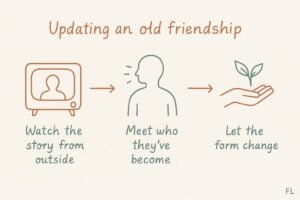
This practice is about releasing the grip of a fixed past and finding a way to update the friendship toward what it can actually be now.
STEP 1: Watch the nostalgia story from outside
When the feeling surfaces — we used to be so close, it was so different then — pause before accepting it as a verdict on the present relationship.
“My mind is replaying a story about a friendship frozen at its peak.”
Receive that story as a nostalgic film playing in the background — real, meaningful, but not a description of what the relationship is required to be right now. The shift from being inside the story to watching it is the first movement toward the present.
STEP 2: Meet the person they’ve become
When spending time with an old friend, hold lightly the version of them you carry from before — and try to encounter the person in front of you with fresh curiosity.
Instead of how have you been, try: what’s changed the most in how you think over the last few years? Or: what are you genuinely absorbed in right now? Listen to what they say without immediately connecting it back to what you remember. Their current life, even where it has become unfamiliar, is a person’s story — and it deserves the same attention as any story worth hearing.
This shifts the basis of the friendship from shared past to mutual present curiosity. That shift is what allows the relationship to keep moving.
STEP 3: Let the form of closeness change
Not every friendship can maintain its highest intensity across a lifetime. The person who once knew everything about your daily life may now be someone you see once a year and speak to honestly for two hours. That is not a diminished friendship. It is a friendship that has found a form appropriate to where two lives have gone.
This person and I will mark each other’s significant moments. We’ll know the shape of each other’s lives without needing to be inside them. That quiet reorientation — from daily closeness to a different kind of care — releases the pressure of maintenance and allows something genuine to remain.
Session 3: Your Old Friend Is Witnessing a Self You’ve Moved On From
Why the discomfort carries a particular weight
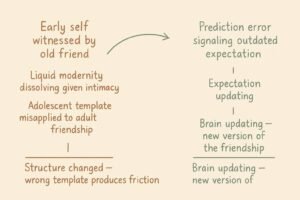
Developmental psychologist Dan McAdams’ research on narrative identity showed that the self is constructed and maintained as a story — a coherent account of who we have been and who we are becoming. Within that story, the people who were present during formative periods function as witnesses to earlier versions of ourselves. An old friend doesn’t just remember a relationship. They remember a you. When that friendship becomes strained or distant, what is at stake is not only the relationship itself — it is the chapter of your self-story that the friendship contains. The discomfort is not simply grief that the other person has changed. It is the more complex experience of sitting with someone who holds an earlier draft of you, a version you may have grown beyond, revised, or quietly left behind.
Liquid modernity didn’t design this for stability
Sociologist Zygmunt Bauman’s concept of liquid modernity describes a social condition in which employment, values, and living arrangements are in continuous flux, producing life trajectories that are highly individualized and difficult to predict. Earlier forms of friendship were built substantially on given intimacy — the closeness that forms through shared physical proximity, the same school, the same neighborhood. Liquid modernity dismantles the conditions that sustained given intimacy, and pushes friendship toward chosen intimacy — closeness built on actively shared values, interests, and life orientation. This shift is structural, not personal. The difficulty of maintaining older friendships across significant life divergence is not a failure of care or effort. It is the experience of a social arrangement that was always going to require renegotiation.
Adult friendship was always going to feel different
Developmental psychology research consistently distinguishes between the friendship structures of adolescence and those of adulthood. Adolescent friendship is built on proximity and time — the closeness that accumulates naturally from being in the same place repeatedly. Adult friendship is built on values and deliberate investment — the closeness that requires choosing to prioritize the relationship against competing demands. This is not a deterioration. It is a developmental transition in what friendship is and how it works. Attempting to sustain adult friendships using the structures of adolescent ones — expecting the same frequency, the same automatic availability, the same undifferentiated sharing — creates a structural mismatch. The friendship hasn’t failed. The template being applied to it has become the wrong size.
The brain expected the old version — and got someone new
Neuroscience research on social prediction shows that the brain forms reward expectations for familiar social interactions — anticipating, based on past experience, the quality of connection, the ease of understanding, the particular pleasure of a specific relationship. When the actual interaction diverges significantly from those expectations, the reward circuit registers a prediction error — a signal that the anticipated outcome did not arrive. The experience of conversations that feel slightly off, of jokes that don’t land the way they once did, of silences that used to be comfortable and now aren’t: these are prediction errors. They are not evidence that the friendship is broken. They are evidence that the brain is still running expectations formed years ago, and that those expectations need updating — which is exactly what the practice of meeting the person as they are now begins to do.
Conclusion: Friendship Doesn’t End When It Changes

None of this is personal failure. All of it is the experience of two people who kept living.
The question who have you become? — asked with genuine curiosity rather than comparison — is available at any reunion, any catch-up, any quiet moment of wondering whether the friendship still has somewhere to go.
Friendship doesn’t end when it changes. It ends when you stop being curious about who the other person has become.
KEY TERMS
Narrative Identity
A concept from developmental psychologist Dan McAdams describing the self as constructed and maintained through story — a coherent account of past and present that gives continuity to experience. Old friends function as witnesses to earlier versions of that story. When those friendships become strained, what is at stake is not only the relationship but the chapter of self-narrative those friendships contain — which is why the discomfort carries a weight beyond simple social awkwardness.
Liquid Modernity
Zygmunt Bauman’s term for the contemporary social condition in which employment, values, and living arrangements are in continuous flux. The structural consequence for friendship is a shift from given intimacy — closeness formed through shared proximity — toward chosen intimacy — closeness requiring active, value-based investment. The difficulty of maintaining older friendships across diverging life paths is a structural feature of this social arrangement, not a personal failing.
Adult Friendship Development
The developmental psychology finding that friendship structures change significantly between adolescence and adulthood. Adolescent friendship is built on proximity and shared time; adult friendship on values and deliberate investment. Applying adolescent friendship structures to adult relationships creates a mismatch — not because the friendship has deteriorated, but because the template has become the wrong size for where two lives have gone.
Prediction Error
The neuroscientific signal generated when a social interaction diverges from the reward expectations the brain has formed based on past experience. When conversations with old friends feel subtly off — less connected, less easy — the brain is registering a prediction error: the anticipated experience didn’t arrive. Not a verdict on the friendship, but information that the expectations need updating.
Defusion
The capacity to notice the fusion between a nostalgic story — we used to be so close, it should still feel like that — and one’s reading of the present relationship, and to create observational distance from it. Watching the nostalgia story as a film rather than living inside it as a demand is the first step toward meeting the actual person rather than the remembered version.