
Introduction: Why Switching Faster Leads Nowhere Deeper

Checking email during a meeting. Scrolling through a feed over lunch. Glancing at a notification mid-conversation. There is a version of this that feels like competence — managing multiple streams at once, staying on top of everything. But the end of the day tends to tell a different story: the sense of having touched many things and gone deep into none of them.
This is not a focus problem. The switching itself has a cost that doesn’t show up until later.
Session 1: After the Switch, the Brain Is Still Back There

What gets called multitasking is not simultaneous processing. The brain handles one thing at a time, and what feels like managing several things at once is rapid alternation between them. The cost of that alternation is less visible than it might seem.
When attention moves from one task to another, it doesn’t move cleanly. Some portion of the processing directed at the previous task continues running — a background thread that persists after the conscious switch has already happened. The new task receives attention in name, but a portion of the cognitive resources available for it are still occupied elsewhere. The thinking that results is thinner than it would otherwise be, not because of insufficient effort, but because the attention available for the present task has been structurally reduced before the work even begins.
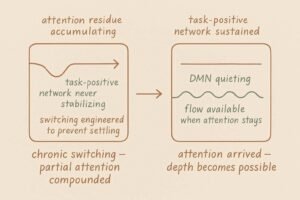
The environment compounds this. Each notification triggers a switch. Each switch generates residue. As switching accumulates across the day, the brain is chronically distributed across multiple locations simultaneously — not fully present anywhere. The exhaustion that arrives by evening is not only the product of what was done. It is the accumulated weight of what never quite landed.
Session 2: Practice — Catching the Switch Before It Happens
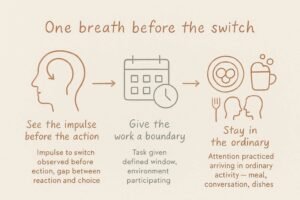
This practice is not about eliminating task-switching. It is about noticing the moment a switch is about to occur — and inserting a single breath of choice before it does.
STEP 1: See the Impulse Before the Action
Mid-email, the hand moves toward the browser. Mid-reading, the fingers reach for the phone. In the instant before the motion completes — pause.
My attention is about to leave. I can feel the pull.
Observing the impulse rather than acting on it immediately shifts the position from automatic to aware. The switch doesn’t need to be refused. It only needs to be seen before it happens. That single beat of observation is the gap between reaction and choice.
STEP 2: Give the Work a Boundary Before You Begin
Attention cannot be sustained by willpower alone. The environment needs to participate. Before starting a task, decide on one thing and give it a defined window of time. Put the phone out of reach. Close the unrelated tabs. Say to yourself — not as a rule but as an intention — this is what I’m doing for the next twenty-five minutes.
When the time ends, leave it completely for a few minutes before returning. The deliberate boundary between focus and release makes it easier for attention to settle inside the work rather than hovering above it.
STEP 3: Practice Staying in the Ordinary
The capacity to let attention arrive and remain doesn’t require dedicated focus sessions. It can be trained in the texture of ordinary activity. For the first three bites of a meal, bring full attention to color, temperature, and the specific quality of the taste. In conversation, stop composing a response while the other person is still speaking, and direct attention entirely to what is actually being said. While washing dishes, feel the temperature of the water and the resistance of the surface — only that.
These are not relaxation techniques. They are the simplest available practice of what it feels like when attention has actually arrived somewhere — rather than passing through on its way to the next thing.
Session 3: The Brain Never Actually Left
The Cost That Doesn’t Show on the Clock
Psychologist Sophie Leroy’s research on attention residue demonstrated that switching from one task to another does not produce a clean transfer of focus. Cognitive processing of the previous task continues after the switch — running in parallel with whatever the new task is nominally receiving. The result is that the new task never gets the full cognitive resources theoretically available to it. The more frequently switching occurs, the more residue accumulates, and the more consistently every task is processed with less than full capacity. What feels like a productivity strategy — handling more by moving faster — produces the opposite of what it promises. Each task receives a diminished version of the attention that could have been brought to it. The thinness of thinking that accumulates across a day of switching is not a motivation problem. It is arithmetic: partial attention, compounded.
The Interruption Was the Product
Media historian Tim Wu’s account of the attention economy traces the logic backward from contemporary social media to the earliest mass-market newspapers — a continuous thread in which human attention, being finite and therefore valuable, became the primary commodity of the media and advertising industries. Notifications, autoplay, infinite scroll, and the ambient pressure of always-available communication are not neutral features of modern technology. They are mechanisms for generating switching, because switching produces engagement, and engagement is what gets sold. The difficulty concentrating that so many people experience as a personal failing is the predictable cognitive state produced by an environment engineered to prevent attention from settling anywhere for long. The residue is not incidental. The residue is the point.
What Flow Actually Requires
Neuroscience research on attentional networks describes two systems that operate in opposition: the task-positive network, which activates during focused, goal-directed work, and the default mode network, which activates during mind-wandering and self-referential thought. These two networks suppress each other — when one is active, the other recedes. In a state of chronic task-switching, the task-positive network never stabilizes long enough to fully suppress the default mode. The mind drifts. Attention fractures. The work proceeds, but at the surface. Psychologist Mihaly Csikszentmihalyi’s description of flow — the state of deep absorption in which self-consciousness recedes, time distorts, and processing becomes unusually fluid — maps directly onto what happens when the task-positive network is allowed to sustain itself without interruption. Flow is not a technique and cannot be directly produced. It is what becomes available when attention has remained in one place long enough for the competing network to quiet. What multitasking takes is not processing speed. It is the time attention needs to go somewhere real.
Conclusion: Attention Only Arrives When It Stays

The notifications will keep coming. The switching architecture of the attention economy will keep generating interruptions. Residue will keep accumulating with each redirect. The structure does not change.
But the question where is my attention right now can be asked in the middle of any task, any conversation, any afternoon. Noticing the pull toward the next thing — before acting on it — is the interval in which attention can choose to remain. That choice doesn’t require a perfect environment. It only requires the moment of noticing.
The environment was built to scatter attention. Noticing the pull is how it stays yours.
KEY TERMS
Attention Residue
Psychologist Sophie Leroy’s finding that switching from one task to another does not produce a clean transfer of focus — cognitive processing of the previous task continues running after the switch, reducing the resources available to the current one. Residue accumulates with switching frequency, meaning that a day of multitasking is a day in which every task received partial attention. The psychological mechanism behind the thinness of thinking that characterizes high-switching cognitive states.
Attention Economy
Tim Wu’s historical account of the industry built around the insight that human attention, being finite, has economic value. From early mass-market newspapers through contemporary social media, the business model has remained consistent: capture attention, hold it, and sell access to it. Notifications, autoplay, and infinite scroll are mechanisms for generating switching because switching produces engagement. The structural explanation for why difficulty concentrating is experienced as a personal failing in an environment engineered to prevent attention from settling.
DMN / TPN Conflict
The neuroscientific finding that the brain’s task-positive network and default mode network operate in mutual suppression — when one is active, the other recedes. Chronic task-switching prevents the task-positive network from stabilizing long enough to suppress the default mode, leaving the mind in a state of partial engagement with everything and full engagement with nothing. The neural architecture underlying why depth requires sustained, uninterrupted attention rather than efficient switching.
Flow
Mihaly Csikszentmihalyi’s term for the state of deep absorption in which self-consciousness recedes, time distorts, and cognitive processing becomes unusually fluid. Neurologically, flow corresponds to sustained activation of the task-positive network with corresponding suppression of the default mode. It cannot be produced directly — it becomes available when attention has remained in one place long enough for the competing network to quiet. What multitasking forecloses is not processing speed but the time attention needs to reach this state.
Defusion
The capacity to notice the switching impulse — I need to check something else right now — as an observable event rather than an automatic instruction, creating an interval between the pull and the action. Observing the impulse before acting on it shifts the position from automatic response to conscious choice, making the decision to remain with the current task available in a way it isn’t when the switch happens without notice.