
Introduction: Why the Next Deadline Is Already There Before the Last One Ends

The big project is finished. There is barely a breath before the calendar shows the next one in red. On a weekend morning, the first thought on waking is the list of things that need to be done before the day ends. Time feels perpetually scarce. The sense of being chased has become the default.
This is not a time management failure. It has a source — and that source is not you.
Session 1: When the Deadline Gets Inside

The exhaustion produced by deadline-driven life is not simply a function of how many deadlines there are. It comes from the state in which the deadline — an external fact about a calendar — becomes fused with the internal sense of whether you are doing enough, being enough, keeping up.
When the feeling of I have to make it in time arrives, it is not a pure calculation about hours remaining. Underneath it is the sense that meeting the deadline is the evidence that you are managing, that you are adequate. The deadline has shifted from a scheduling tool to a device for producing self-evaluation. And self-evaluation that depends on future achievement is structurally anxious — because the achievement is always somewhere ahead.
In this state, the present moment is never experienced as itself. Today exists as preparation for next week’s presentation, as a staging point for next month’s target. The current moment is processed as a means to a future end, and the self living in it is perpetually measured against a standard that hasn’t arrived yet.
The chronic chain of deadlines also normalizes urgency as a baseline state. When the pressure of being chased becomes constant, the tension itself starts to feel like evidence of importance — proof that what you’re doing matters. When that pressure briefly lifts, the quiet can feel strange, empty, vaguely wrong. That inversion — where stillness produces unease rather than relief — is a signal that the urgency has moved from something experienced to something inhabited.
Session 2: Practice — Finding the Gap Before the Rush
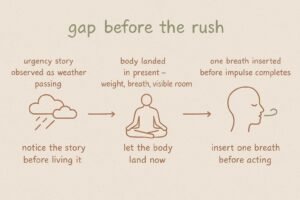
This practice is not about eliminating deadlines. It is about finding a moment of choice before being swept into the automatic response — a small interval between the pressure and the reaction.
STEP 1: Notice the Story Before Living Inside It
When the urgency arrives — there isn’t enough time, I won’t make it — pause before receiving it as a complete account of reality.
My mind is generating the story that time is the enemy and I am being chased.
Observe that thought as a weather system passing through rather than a permanent condition. The shift from being inside the feeling to watching it from just outside doesn’t make the deadline disappear. It makes a gap — and the gap is where choice becomes available.
STEP 2: Let the Body Land in the Present
When attention has already traveled to next week’s meeting or next month’s review, a few seconds is enough to bring it back. Feel the weight of the body in the chair. Notice how the breath is moving right now. Name three things visible in the immediate environment, without evaluation.
I am here. This is where I am.
This is not a technique for solving the future problem. It is a way of letting awareness touch down in the present — not to escape the deadline, but to briefly reclaim the ground beneath it.
STEP 3: Insert One Breath Between the Impulse and the Action
Before moving immediately in response to deadline pressure, insert a deliberate pause between the impulse and the first action — a few seconds, nothing more.
Is what I need right now to move faster? Or to clarify what I should be moving toward?
The question doesn’t require an answer. It requires only a beat of interruption — enough to step out of pure reaction and make the next move as a choice rather than a reflex.
Session 3: The Urgency Had a Manufacturer
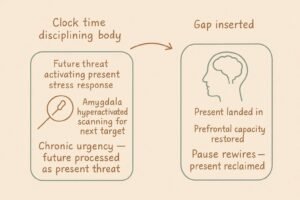
The Clock Disciplined the Body
Historian E.P. Thompson documented a fundamental transformation in how human beings experience time — a transformation that coincides with industrialization. Before factory production, time was largely task-oriented: it moved with the season, the tide, the progress of the work itself. The spread of clock time as the primary instrument of labor management changed this at the level of the body. Factory clocks disciplined workers into synchronized schedules; lateness became a moral failure rather than a practical inconvenience. Time was reframed as a capital resource — something to be saved, invested, and maximized rather than inhabited. The felt sense of being perpetually behind, of time running out, of needing to move faster — these are not features of human experience that have always existed. They were produced by a specific historical arrangement and then internalized across generations until they stopped feeling like a social construction and started feeling like reality.
Why the Future Deadline Becomes a Present Threat
The human sense of self has a particular quality: it extends across time. The person who failed last year, the person sitting here now, and the person who might miss the deadline next week are all experienced as the same continuous self. This temporal continuity is what makes planning, learning, and long-term commitment possible. But in a deadline-saturated environment, it generates a specific problem. An event that hasn’t happened yet — the presentation that might go badly, the target that might not be reached — is processed by the brain not as a future abstraction but as a present threat to the self that exists right now. The mind rehearses the failure in advance, running the scenario with sufficient neurological reality that the stress response activates before the event has occurred. The exhaustion that arrives before anything has gone wrong is not anticipatory in the casual sense. The brain is already there, already responding, already consuming resources on an outcome that exists only in projection.
The Brain Was Already at the Next Deadline
Neuroscientist Robert Sapolsky’s research on chronic stress describes what happens when the stress response — designed for acute, time-limited threats — is activated continuously. Under chronic conditions, the amygdala, which detects and responds to threat, becomes hyperactivated. The prefrontal cortex, which manages present-focused attention, deliberate judgment, and the capacity to distinguish real from imagined threats, loses functional ground. The brain shifts into a mode that prioritizes future threat detection over present engagement. This is why finishing one deadline does not produce the relief that seems like it should follow. The neural system has been trained to scan for the next target before the current one has cleared. The urgency that persists after the work is done is not ingratitude or anxiety as a personality trait. It is a nervous system that has been configured, by chronic activation, to treat the absence of a threat as merely the interval before the next one arrives.
Conclusion: The Gap Is Always Available

The clock-time structure will keep running tomorrow. Temporal self-continuity will keep pulling future threats into the present. The amygdala will keep scanning for the next target. The structure does not change.
But the question where is my attention right now can be asked in the middle of any deadline, any morning, any moment of urgency. The weight of the body in the chair — one point of contact with the present — is available inside any pressure. That contact doesn’t resolve the deadline. It restores the interval between the urgency and the response.
The deadline is a recent invention. The urgency it produces feels ancient because it was built into the body, not the clock.
KEY TERMS
Clock-Time Discipline
E.P. Thompson’s account of the historical transformation through which clock time became the primary instrument of labor management during industrialization, reframing time as a capital resource to be saved, invested, and maximized. Lateness became a moral failure; the sense of time running out became internalized across generations. The structural origin of the urgency that feels personal — the historical manufacture of the feeling of being perpetually behind.
Temporal Self-Continuity
The cognitive quality of selfhood that extends across time — past, present, and future experienced as the same continuous person. What makes planning and learning possible also makes deadline environments specifically exhausting: future failures that haven’t occurred are processed as present threats to the self that exists now. The mechanism by which the mind is already consuming resources on outcomes that exist only in projection.
Chronic Stress and Neural Entrenchment
Robert Sapolsky’s research finding that chronic activation of the stress response hyperactivates the amygdala while reducing prefrontal cortex function, configuring the brain toward future threat detection at the expense of present engagement. The structural explanation for why completing a deadline does not produce lasting relief — the nervous system has been trained to locate the next target before the current one has cleared. Urgency as a neural default rather than a situational response.
Urgency Mode Dependency
The state produced by chronic deadline-driven pressure in which the tension of being chased becomes fused with the sense of doing something that matters. When the pressure briefly lifts, the resulting quiet registers as emptiness or unease rather than relief. Stillness becomes the anomaly; urgency becomes the baseline. The inversion in which the absence of pressure produces more discomfort than its presence.
Defusion
The capacity to notice that the story — time is the enemy and I am being chased — has fused with one’s experience of reality, and to observe it as a passing weather system rather than a permanent condition. Creating distance from the urgency narrative before acting on it is the interval in which the next move becomes a choice rather than a reflex.