
Introduction: When the Past and Future Crowd Out the Present

A decision from yesterday surfaces again — if only I had done it differently — and the chest tightens. Thinking about next month’s presentation makes the stomach uneasy before sleep. Awareness moves constantly between a past that can’t be changed and a future that hasn’t arrived, and the present keeps narrowing.
This is not weakness. Regret and anxiety have a neurological origin that exists independently of willpower.
Session 1: Why Regret and Anxiety Arrive Together

Regret and anxiety appear to point in opposite directions — one toward the past, one toward the future. But they arise from the same cognitive foundation.
Both occur when the brain is processing a reality that isn’t currently present. Regret repeatedly simulates the possibility that a past event could have unfolded differently. Anxiety simulates the negative outcomes of events that haven’t happened yet. The brain processes both simulations without cleanly distinguishing them from actual events. When a past failure is recalled, the body responds as if the failure is occurring again. When an upcoming deadline is imagined, the body responds as if the deadline is already here.
This is why the response is difficult to interrupt through reasoning alone. The emotional reaction activates faster than the thought. Knowing intellectually that the worry is disproportionate doesn’t stop the body from having already responded. When regret and anxiety arrive together, it isn’t a sign of insufficient emotional control. It’s the same circuit running in both temporal directions at once.
Session 2: Practice — Coming Back From Where You Aren’t
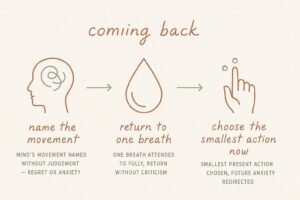
This practice is not about eliminating regret or anxiety. It is about noticing when awareness has traveled away from the present moment and finding a way back — not once, but repeatedly, across as many ordinary moments as arise.
STEP 1: Name the Movement
When the mind has moved into the past or future, name what is happening quietly and without judgment.
My mind is running the regret replay right now.
My mind is running the anxiety simulation right now.
The shift from being inside the thought to observing that the thought is occurring creates a small distance. When the regret narrative or the anxiety scenario becomes visible as something the mind is generating — rather than a direct transmission of reality — a gap appears. That gap is where a different response becomes available.
STEP 2: Return to One Breath
After naming the movement, bring full attention to the next single breath. The faint coolness of the inhale as it passes through the nose. The slight warmth of the exhale. Only this breath.
The mind will move again. When it does, return without criticism to the next breath. The breath is always in the present — it belongs to neither past nor future. This return doesn’t need to be sustained for long. One breath, genuinely attended to, is enough to reestablish contact with the present moment.
STEP 3: Choose the Smallest Available Action
When anxiety is dominating the experience of the future, the most practical response is not to continue simulating it but to redirect attention toward the smallest action available right now that moves in the direction of something that matters.
For the next twenty-five minutes, only this one thing.
The action doesn’t need to solve the problem. It needs only to be real, present, and connected to something the person actually values. That connection converts the formless pressure of future anxiety into a specific, contained engagement with the present.
Session 3: The Learning Circuit That Couldn’t Stop
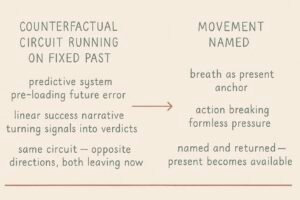
When the Circuit Runs on What Can’t Be Changed
Psychologist Neal Roese’s research on counterfactual thinking established that the capacity to imagine how things could have gone differently — the cognitive move underlying all regret — is a learning mechanism. The ability to construct alternative versions of past events allows the brain to extract lessons and refine future decision-making. In this sense, regret is not a flaw. It is the learning system doing what it was designed to do. The problem is that the circuit operates on past events regardless of whether those events can be acted upon. When counterfactual thinking is applied to a situation that can still be influenced, it generates useful information. When it runs repeatedly on outcomes that are fixed and unreachable, the same learning mechanism becomes rumination — a loop that consumes cognitive resources without producing anything new. The weight of regret is not evidence of weakness. It is the experience of a circuit built for learning being applied to something that learning can no longer reach.
Anxiety as Pre-Loaded Error
Neuroscientist Karl Friston’s predictive processing framework describes the brain as a system that continuously generates predictions about incoming experience and works to minimize the discrepancy between those predictions and what actually arrives. Within this framework, anxiety is not an excess of concern about the future — it is the brain’s threat-tagged interpretation of anticipated prediction error. When the outcome of an uncertain situation is predicted as negative, the stress response activates in the present, treating the future error as already partially real. What becomes visible here is the structural connection between regret and anxiety. Regret is fixation on past prediction error — the gap between what was expected or hoped and what actually occurred. Anxiety is the anticipatory loading of future prediction error — the gap between what is hoped and what might arrive. Both are the same predictive system running in opposite temporal directions. The mind’s tendency to leave the present is, in this light, the predictive system continuously allocating resources to error-processing in both directions simultaneously.
The Narrative That Turned Signals Into Verdicts
The brain’s counterfactual circuit and predictive error system do not operate in a cultural vacuum. The framework offered by contemporary society — that a life is a linear success narrative, in which each decision either advances or sets back a coherent trajectory — provides the interpretive structure that amplifies both. Within this framework, past choices become entries in a ledger of self-responsibility, and their consequences become evidence of the quality of the self that made them. Future uncertainties become potential failures of optimization, threats not just to outcomes but to the narrative coherence of the life being built. This is distinct from the moral pressure to be productive, or the clock-time discipline that industrialization installed in the body. What operates here is the compulsion of the linear story itself — the pressure to experience a life as a directed sequence with a legible arc. When that pressure is in place, the learning circuit’s errors become indictments, and the predictive system’s anticipations become verdicts. Regret and anxiety were always neurologically available. The story made them feel permanent.
Conclusion: The Circuit Runs. The Present Remains

The counterfactual circuit will keep simulating alternative pasts tomorrow. The predictive system will keep pre-loading future errors. The linear narrative will keep framing both as personal failures. The structure does not change.
But the question where is my mind right now can be asked inside any wave of regret, on any sleepless night. One breath, attended to completely, is the smallest available return to the present — not a solution to the circuit, but a reminder that the present was here the entire time the mind was elsewhere.
The mind was built to learn from the past. It was never designed to live there.
KEY TERMS
Counterfactual Thinking
Psychologist Neal Roese’s term for the cognitive capacity to imagine how past events could have unfolded differently — the mechanism underlying all regret. Designed as a learning system that extracts lessons from past outcomes to improve future decisions, it becomes rumination when applied repeatedly to outcomes that are fixed and unreachable. The weight of regret reframed not as weakness but as a learning circuit running on material that learning can no longer act upon.
Predictive Processing
Karl Friston’s framework describing the brain as a prediction-minimization system that continuously generates expectations about incoming experience and works to reduce discrepancy between prediction and reality. Anxiety, within this framework, is the threat-tagged anticipation of future prediction error — the stress response activating in the present in response to a gap that hasn’t arrived yet. The structural link between regret (past error fixation) and anxiety (future error anticipation) as opposite expressions of the same underlying system.
Linear Narrative Compulsion
The social framework that positions a life as a directed success sequence, in which past choices become entries in a ledger of self-responsibility and future uncertainties become threats to narrative coherence. Distinct from the moral pressure to be productive or the clock-time discipline that industrialization installed in the body: what operates here is the pressure of the story structure itself, which amplifies the brain’s counterfactual and predictive circuits by framing their outputs as personal verdicts rather than neurological events.
Rumination
The state produced when counterfactual thinking is applied repeatedly to outcomes that are fixed and cannot be acted upon, converting a functional learning process into a loop that consumes cognitive resources without generating usable information. The experience of regret becoming heavier over time rather than resolving is not a sign of insufficient processing — it is the circuit continuing to run on material that the learning system cannot update.
Defusion
The capacity to notice that the regret replay or the anxiety simulation has fused with one’s experience of reality — and to observe it as something the mind is generating rather than a direct account of what is true. Naming the movement — my mind is running the regret replay — creates the observational distance in which the thought becomes visible as a thought, opening the gap between stimulus and response.