
Introduction: The Thought We Avoid Most Produces the Sharpest Sense of Being Alive

Returning from a funeral. Receiving difficult medical news about someone close. Lying awake alone in the middle of the night. The fact of one’s own death — certain, distant, usually abstract — arrives sometimes with a sudden physical weight in the chest. The habitual response is to redirect attention quickly toward something else.
That redirection has a cost that rarely gets examined.
Session 1: What the Avoidance of Death Removes From Life

The widespread avoidance of death is not a personal failing or a feature of individual temperament. It is the result of a systematic removal of death from ordinary life — a process that modern societies built into their architecture over several centuries.
Before industrialization, death was a household event. The dying were surrounded by family. The body remained in familiar spaces. Death was woven into the rhythm of community life as something witnessed, participated in, and gradually understood. The shift toward institutional medicine relocated death to hospitals, where it was managed by specialists and shielded from ordinary view. The practical benefits of this transition were real. The cultural consequences were less examined.
When death is removed from daily life, the capacity to imagine it concretely diminishes. And when the imagination of death diminishes, so does the felt sense of life’s finitude. The sense that there is still plenty of time expands. Important decisions get deferred. Deeper engagements get postponed.
What the avoidance keeps out is not only death. It keeps out the quality of attention that death’s proximity tends to return.
Session 2: Practice — Bringing the Edge of Ending Into the Ordinary
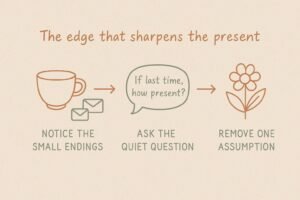
This practice does not ask for sustained contemplation of death. It introduces the feeling of ending into ordinary moments in small doses — enough to slightly sharpen the present without producing anxiety.
STEP 1: Notice the Small Endings
The moment the coffee cup empties. The moment the send button is pressed. The moment the train arrives at the destination. These small completions pass almost entirely unnoticed. Pause at one of them today.
This just ended.
Before moving immediately to the next thing, register the ending for a moment. Noticing that something ended also means noticing that it existed. When the cup is empty, the time spent drinking it becomes briefly visible. This practice builds, incrementally, the felt sense that every experience has a beginning and an end — and that the end is part of what gives it shape.
STEP 2: Ask the Quiet Question
Before a conversation, before beginning something, bring a quiet and unhurried question inward.
If this were the last time, how would I want to be present for it?
Not as a source of dread — as a lens. A child’s bedtime. A meal with a friend. A single task at work. The hypothetical of last time interrupts the automatic mode and returns a moment of genuine choice about how to engage. The question doesn’t require an answer. It requires only the pause.
STEP 3: Remove One Assumption About What Is Given
Take one thing that is currently being treated as a given and consider, briefly, its contingency.
Breathing is happening right now. This requires lungs that function, air that is available, a body that is currently intact. None of this is self-evident.
This is not a gratitude practice in the conventional sense. It is a brief contact with the accidental quality of what exists — the person beside you, the day currently unfolding, this particular body. When the contingency is touched, even lightly, what was invisible as background becomes briefly present as foreground.
Session 3: Death Was Something Modern Life Learned to Hide
The Historical Removal
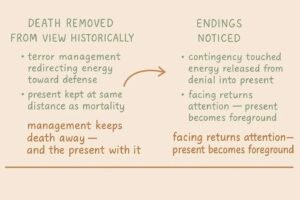
Historian Philippe Ariès traced the transformation of death in Western culture from what he described as the tame death — familiar, public, woven into communal life — to what he called the forbidden death of modernity: hidden in institutions, managed by specialists, and excluded from ordinary social space. Before industrialization, the deathbed was a social gathering. The dying person presided over their own departure, surrounded by neighbors and family. The transition to hospital death, which accelerated through the nineteenth and twentieth centuries, was driven by genuine improvements in medical care. But it produced a cultural side effect: a population progressively less practiced at witnessing death, less equipped to imagine it personally, and less sensitized to the finitude it implies. The avoidance of death is not a natural feature of human psychology. It is a historically constructed condition — one that modern societies built into their spatial arrangements, professional structures, and cultural norms. The denial is not personal weakness. It is the learned behavior of people raised inside a system that removed death from view.
The Cost of the Management
Psychologists Jeff Greenberg and Sheldon Solomon developed terror management theory to describe how human beings respond to the existential anxiety produced by awareness of their own mortality. The theory’s central finding is that when death awareness becomes salient, people tend to manage the resulting anxiety through two primary mechanisms: intensified investment in cultural worldviews — the belief systems and group identities that provide a sense of meaning and permanence — and pursuit of self-esteem, the subjective sense of being a person of value. The pursuit of social media approval, the attachment to career achievement, the accumulation of material markers of success — these behaviors can function, in part, as unconscious mechanisms for managing the terror of mortality. The management works, in the sense that it reduces the conscious experience of death anxiety. But it carries a cost that terror management theory makes visible: the energy redirected toward managing death awareness is energy redirected away from present experience. The defense keeps death at a distance. It keeps the present at the same distance.
What Facing It Returned
Existential psychotherapist Irvin Yalom’s clinical observations of patients confronting terminal diagnosis produced a consistent and striking finding: a significant proportion of people who face death directly report a fundamental reorganization of their priorities and a deepening of present experience. Petty concerns lose their grip. What had been deferred as background becomes foreground. Yalom describes this shift as an awakening experience — the recognition, made visceral rather than merely intellectual, that the life being deferred is the only life available. What is released is precisely what the historical removal and the psychological management had been consuming. The energy that had been allocated to denial becomes available for the present. The Theravāda Buddhist tradition’s practice of death awareness — Maraṇasati, the deliberate and repeated recollection of one’s own mortality — is not a morbid exercise. It is a method for producing, through sustained practice, what Yalom observed emerging in crisis: the return of attention to what is actually here.
Conclusion: The Contrast Was Always the Point

The social invisibilization of death will continue tomorrow. The terror management circuit will keep redirecting mortality anxiety toward approval and achievement. The structure does not change.
But the question what is actually here right now can be asked on any morning, at any ending, in any ordinary moment that would otherwise pass without being registered. The small ending noticed — the cup empty, the conversation finished, the day closing — is the nearest available entrance to what the avoidance had been keeping out.
Death doesn’t diminish the present. It’s the only thing that can make it fully visible.
KEY TERMS
Invisibilization of Death
Philippe Ariès’s account of the historical transformation through which death moved from a familiar, public, communally witnessed event to something hidden in institutions and managed by specialists — excluded from ordinary social life. The cultural consequence was a progressive loss of the capacity to imagine death personally and a corresponding loss of sensitivity to life’s finitude. The avoidance of death reframed not as psychological weakness but as the learned behavior of people raised inside a system that removed death from view.
Terror Management Theory
Jeff Greenberg and Sheldon Solomon’s framework describing how awareness of mortality produces existential anxiety that is managed through investment in cultural worldviews and the pursuit of self-esteem. Social approval-seeking, career attachment, and material accumulation can function as unconscious mortality management strategies. The cost of this management — energy redirected away from present experience toward the maintenance of symbolic immortality — is the mechanism through which death denial thins the quality of the life it claims to protect.
Mortality Salience Effect
Irvin Yalom’s clinical finding that direct confrontation with mortality tends to produce a fundamental reorganization of priorities and a deepening of present experience — petty concerns losing their grip, meaningful engagements intensifying, sensory and relational experience gaining qualities previously absent. The reversal of what both invisibilization and terror management produce: when the denial is interrupted, what had been allocated to managing death becomes available for the present.
Maraṇasati
The Theravāda Buddhist practice of deliberate and repeated recollection of one’s own mortality — not as morbid exercise but as a method for returning sustained attention to present experience by keeping the fact of death practically available rather than abstractly acknowledged. The traditional practice whose psychological mechanism Yalom’s clinical observations describe in contemporary terms: mortality awareness as a route back to the present rather than away from it.
Defusion
The capacity to notice that the story — death is a forbidden subject that darkens life — has fused with one’s habitual relationship to mortality, and to create observational distance from it. The small practices of noticing endings and asking the quiet question introduce gaps in the automatic avoidance, making it possible to bring death into ordinary awareness without being overtaken by it.