
Introduction: Why the Mirror Is So Exhausting

The number on the scale. The outline in the mirror. The face in a photo. A habit of checking, several times a day, each check producing a small assessment. A little more. Still not enough. Better before. The repetition is so embedded it barely registers as a choice — and the fatigue it produces is easy to mistake for something else.
The exhaustion has a cognitive origin that is separate from vanity or weakness.
Session 1: How Watching Yourself Empties You

When appearance and self-worth become fused, the body stops being a place to inhabit and becomes an object under continuous evaluation. This shift happens quietly, but it changes the relationship with the body in ways that accumulate.
Chronic attention to appearance consumes cognitive resources. When the background question how do I look right now is always running, the processing it requires is drawn from the same pool that supports everything else. Concentration, emotional regulation, creative thinking — these degrade in proportion to the intensity of appearance monitoring. Watching yourself from the outside looks like nothing. It costs like something.
The monitoring also displaces the signals that come from inside. How the body actually feels today, where tension is accumulating, what it needs — when attention is occupied with external evaluation, these questions fall behind. Looking at the body from outside and feeling the body from inside compete for the same attentional resource. The more thoroughly one runs, the less the other gets through.
The exhaustion in front of the mirror is not self-management failing. It is attention being spent.
Session 2: Practice — From Evaluation to Appreciation
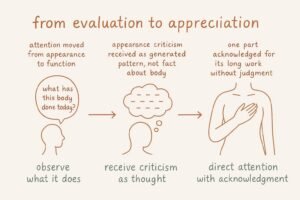
This practice is not about replacing negative body thoughts with positive ones. It is about gradually shifting the habitual direction of attention — from external evaluation toward the body’s function and sensation.
STEP 1: Observe the Body as Something That Does Things
When appearance-based criticism arrives, deliberately move the focus toward function.
What has this body done today?
Walked somewhere. Breathed continuously. Digested food. Heard someone’s voice. These seem unremarkable until the coordination required for each of them is considered. The shift from evaluating appearance to observing function moves the body from object under judgment to participant in the day — a different relationship, available in any moment.
STEP 2: Receive the Criticism as a Thought, Not a Verdict
When the self-critical thought arrives — too much, too old, that part is wrong — pause before being pulled into its content.
My mind is running the appearance criticism right now.
Observe it as a pattern the mind is generating rather than a fact the body is reporting. Appearance criticism is not an objective assessment of the body. It is an interpretation produced by comparison to a particular standard. Creating a small distance between that interpretation and the self opens the first gap in the automatic chain.
STEP 3: Direct Attention Toward One Part With Acknowledgment
Bring attention to a part of the body that has been the subject of criticism or concern — not to evaluate it, but to acknowledge it.
This part has been working for a long time.
Consider briefly what it has done — the distance the feet have covered, the things the hands have touched and made and held. Confirming its existence without judgment is the beginning of a different kind of relationship with it.
Session 3: The Audit Had a Cost All Along
What the Monitoring Was Spending
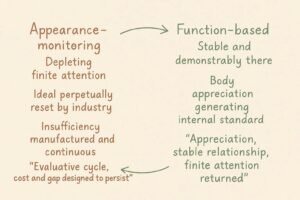
Research on appearance monitoring — the habitual behavior of observing and evaluating one’s own appearance from an external perspective — consistently shows correlation with increased cognitive load, reduced emotional regulation capacity, and difficulty processing internal body signals. Crucially, these costs are independent of what the person actually looks like. The burden is generated by the frequency and intensity of the evaluative behavior itself, not by the appearance it evaluates. Attention is a finite resource, and attention directed toward appearance assessment is drawn from the same pool that supports focused work, emotional stability, and the reception of interoceptive signals. This is distinct from the state of experiencing oneself as an object to be observed — self-objectification. What operates here is the cumulative cost of the evaluative behavior’s repetition: the drain produced not by the state of being observed but by the ongoing act of observing. The fatigue in front of the mirror is not evidence of insufficient effort or excessive vanity. It is the accumulated cognitive cost of an activity that runs continuously without resolution.
The Insufficiency Was Always the Product
The beauty industry, the fitness industry, the fashion industry — each operates on the premise that the current appearance is improvable and that the right product or practice will close the gap. This shares structural features with the wellness optimization cycle and the moralization of health — but the target is specific: the visual body. What distinguishes the appearance industry from those parallel structures is the nature of its primary product. The insufficiency being sold is not about health outcomes or moral status — it is about falling short of a visual standard that is continuously reset. New trends emerge, old ideals are replaced by new ones, and the gap between current appearance and current ideal is perpetually maintained. The industry requires that the ideal remain slightly out of reach. When it is reached, a new one is introduced. The compulsion toward appearance improvement is not vanity. It is the internalized logic of a market that requires the continuous feeling of not yet being there.
Gratitude for Function Replaced the Audit
Psychologist Tracy Tylka’s research on body appreciation — defined as a positive orientation toward the body focused on its functions, capacities, and sensations rather than its appearance — has repeatedly found positive correlations with psychological wellbeing, emotional regulation, and healthier eating behaviors. The concept is not satisfaction with appearance. It does not require meeting any particular standard of how the body looks. What it describes is a relationship with the body grounded in what the body does rather than how it appears — a relationship that generates stability rather than the continuous assessment cycle that appearance monitoring produces. Body appreciation functions as an alternative standard: not the externally supplied ideal that the appearance industry continuously repositions, but an internally generated recognition of what the body is already doing. Where appearance monitoring draws from a finite attentional resource and returns a judgment, body appreciation directs attention toward something that is consistently and demonstrably there — the ongoing, unremarkable, indispensable work the body performs every day regardless of how it looks while performing it.
Conclusion: The Audit Was What Needed to Stop

The appearance industry will keep introducing new standards tomorrow. The appearance monitoring habit will keep running at every mirror, consuming cognitive resources with each pass. The structure does not change.
But the question what has this body done today can be asked at any mirror, on any morning. When the criticism starts, labeling it as a thought rather than a verdict — and redirecting attention briefly toward function — is the move from the audit toward something that doesn’t deplete what it touches.
The body was never the problem. The audit was.
KEY TERMS
Appearance Monitoring
The habitual behavior of observing and evaluating one’s own appearance from an external perspective — correlating with increased cognitive load, reduced emotional regulation, and impaired processing of internal body signals. The cost is independent of actual appearance: it is generated by the frequency and intensity of the evaluative behavior itself. Distinct from self-objectification as a state: what operates here is the cumulative drain produced by the ongoing repetition of the evaluative act.
Industrial Production of Beauty Insufficiency
The mechanism by which the beauty, fitness, and fashion industries maintain the premise that current appearance is improvable — requiring that the visual ideal remain slightly out of reach so that when one standard is met, a new one can be introduced. Shares structural features with the wellness optimization cycle and the moralization of health but targets the visual body specifically. The compulsion toward appearance improvement reframed as the internalized logic of a market that requires the continuous feeling of not yet being there.
Body Appreciation
Tracy Tylka’s term for a positive orientation toward the body focused on its functions, capacities, and sensations rather than its appearance — correlating positively with psychological wellbeing, emotional regulation, and healthier eating behaviors. Not satisfaction with how the body looks but a relationship grounded in what the body does. Functions as an alternative standard to the appearance industry’s continuously repositioned ideal: internally generated, stable, and based on what the body is already and consistently doing.
Cognitive Resource Depletion
The process by which appearance monitoring, as a repetitive evaluative behavior directed at a finite attentional resource, reduces the cognitive capacity available for concentration, emotional regulation, and creative thinking. Attention directed toward external appearance assessment is drawn from the same pool that supports internal body signal processing. Parallels the attentional depletion produced by digital labor and screen environments, but specific here to the repetitive cost of self-directed appearance evaluation.
Defusion
The capacity to notice that the appearance criticism — this part is wrong, this is too much, this has changed — is a thought the mind is generating rather than a fact the body is reporting, and to create observational distance from it before being drawn into its content. Receiving the criticism as an interpretation produced by comparison to a particular standard, rather than as a verdict, opens the first interval in the automatic evaluation chain.