
Introduction: Why Saying “I Don’t Know” Is So Hard

In a meeting, an unfamiliar concept comes up and the instinct is to stay quiet rather than ask. A book everyone seems to have read comes into conversation and something close to shame arrives. On social media, the people who are rewarded are those who always have the analysis ready, the opinion formed, the reference at hand.
The discomfort of not knowing is not a personal failing. It comes from a structure in which not knowing has become a risk.
Session 1: When Not Knowing Becomes Dangerous

Intellectual pressure doesn’t come from a genuine desire to understand. It comes from the fear that being seen not to know will cost something — status, credibility, belonging.
Inside that fear, the motivation for learning quietly shifts. The internal pull of I want to understand this recedes, and the external pressure of I need to appear as though I already do moves forward. The result is the performance of knowledge — energy directed toward looking informed rather than becoming informed. Preparation substitutes for inquiry. Assertion substitutes for exploration.
In this state, the tolerance for not-knowing drops. When a complex question arises, the discomfort of sitting with genuine uncertainty becomes harder to stay inside. The mind reaches for a conclusion — any conclusion — to close the gap. But deep understanding requires exactly what the pressure forecloses: the willingness to remain in the unresolved state long enough for something real to form. The most significant thing intellectual pressure takes is not confidence. It is the time inside the question.
Session 2: Practice — Making Not-Knowing the Starting Point
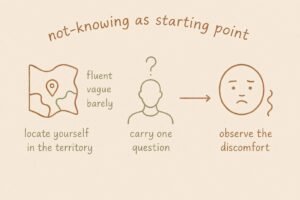
This practice is not about becoming comfortable with ignorance. It is about changing the relationship with the state of not-yet-knowing — from something to be concealed toward the most honest and productive position from which learning can actually begin.
STEP 1: Locate Yourself in the Territory
When encountering a new field or concept, take a moment to identify where you actually are.
How much do I actually know about this — fluently, vaguely, or barely at all?
This is not self-criticism. It is orientation. Knowing where you are makes it possible to move from a defensive position to an exploratory one. The acknowledgment of not-knowing is the first move from performing to learning.
STEP 2: Carry One Question Rather Than Reaching for a Conclusion
When something doesn’t make sense, or when expert opinions seem to contradict each other, resist the pull toward a quick resolution. Instead, hold one question.
Why is this the case? What assumption am I missing that would make this make sense?
Questions outlast answers. Keeping the uncertainty open rather than closing it with a premature conclusion allows later information and experience to connect to it. Understanding tends to arrive not at the moment of encounter but sometime after — when something else provides the missing piece.
STEP 3: Observe the Discomfort Rather Than Acting on It
When the anxiety or embarrassment of not-knowing surfaces, bring a moment of observation to it before responding.
I’m noticing resistance to the feeling of not understanding this.
Receiving that feeling as a signal that learning is actively in process — rather than as evidence of a deficit — creates a small distance from the automatic defensive response. The discomfort arrives precisely because genuine engagement is happening. That reframe, held lightly, is enough to keep the inquiry open.
Session 3: Not Knowing Became a Risk
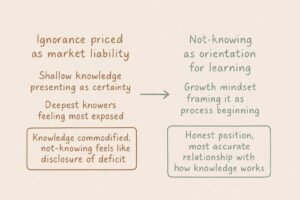
How Knowledge Got Priced
The human capital framework that became central to twentieth-century economics positioned knowledge and skill as investments generating future returns — and education as the primary vehicle for making those investments. Within this framework, not knowing is not simply an occasion for learning. It is a gap in market value. Academic credentials, professional certifications, fluency in current trends: these function as competitive differentiators, and their absence signals relative disadvantage. This is distinct from attention commodification in attention economy critiques: what operates here is more foundational — when knowledge itself is economically valued, admitting ignorance feels like disclosing a liability. Social media extended this logic into daily life. When intellectual output became a form of personal branding — opinions, analysis, and references functioning as visible markers of value — the performance of knowledge acquired economic rationale. Knowing, or appearing to know, became something with consequences attached to it.
Shallow Knowledge Felt Like Certainty
Psychologists David Dunning and Justin Kruger identified a counterintuitive pattern in how people assess their own competence: in domains where knowledge is limited, people tend to overestimate their ability, while in domains where knowledge is deep, people tend to underestimate it. The mechanism is structural. To accurately assess the limits of one’s knowledge in a given area, one needs enough knowledge to recognize what is missing. Without that foundation, the gaps are invisible — the map looks complete because the territory beyond its edges hasn’t been encountered yet. A commodified knowledge environment reinforces this pattern. Where the incentive is to appear informed, shallow knowledge presents as confidence and deep knowledge presents as doubt. The atmosphere in which *I don’t know* is hardest to say is precisely the atmosphere in which those who know the least feel most certain, and those who know the most feel most exposed.
The Admission Was the Deepest Position
Psychologist Pauline Clance’s research on impostor syndrome — the persistent sense that one’s competence is fraudulent and will eventually be exposed — found that this experience is disproportionately common among genuinely capable people. The connection to the Dunning-Kruger pattern is direct: as knowledge deepens, awareness of its limits deepens with it. The person who has learned the most in a field is most likely to feel that what they know is insufficient — because they can most clearly see what remains unknown. Psychologist Carol Dweck’s research on growth mindset offers a framework for understanding what changes when this dynamic is recognized. When ability is understood as fixed, not-knowing is evidence of a permanent deficit. When ability is understood as developing through learning and effort, not-knowing is the beginning of a process rather than the revelation of a ceiling. The person who says I don’t know in a room full of performed certainty is not the least informed person in the room. They are the one whose relationship with knowledge most closely matches how knowledge actually works.
Conclusion: Not Knowing Was Always the Beginning

The commodification of knowledge will keep making not-knowing feel like a liability tomorrow. The Dunning-Kruger pattern will keep making shallow knowledge feel like certainty. Impostor syndrome will keep pressing hardest on the people who have learned the most. The structure does not change. But the question where am I actually in this territory can be asked before any meeting, before any conversation, at any moment when the pressure to appear informed arrives. That question moves the position from performance to inquiry — which is the only position from which anything real gets learned.
The most honest person in the room was always the one who said they didn’t know.
Key Terms
Commodification of Knowledge
The process through which the human capital framework positioned knowledge as an investment generating future economic returns — making not-knowing a gap in market value rather than simply an occasion for learning. Distinct from attention commodification in attention economy critiques: what operates here is the economic valuation of knowledge itself, which makes admitting ignorance feel like disclosing a liability. Social media extended this logic by making intellectual output a form of personal branding, giving the performance of knowledge economic rationale.
Dunning-Kruger Effect
David Dunning and Justin Kruger’s finding that in domains where knowledge is limited, people tend to overestimate their competence, while in domains where knowledge is deep, they tend to underestimate it. The mechanism is structural: accurate self-assessment requires enough knowledge to recognize what is missing. In a commodified knowledge environment, this pattern is reinforced — shallow knowledge presents as confidence, deep knowledge presents as doubt, and the atmosphere in which *I don’t know* is hardest to say is precisely the one where those who know least feel most certain.
Impostor Syndrome
Pauline Clance’s finding that the persistent sense of fraudulent competence — the fear of eventual exposure — is disproportionately experienced by genuinely capable people. As knowledge deepens, awareness of its limits deepens with it, producing the feeling of insufficiency in those who have learned the most. Combined with the Dunning-Kruger pattern, this means the person most likely to feel they don’t know enough is often the person who actually knows the most about what remains unknown.
Growth Mindset
Carol Dweck’s framework distinguishing between viewing ability as fixed — in which not-knowing is evidence of a permanent ceiling — and viewing it as developing through learning and effort — in which not-knowing is the beginning of a process. When ability is understood as developing, the admission of ignorance shifts from a liability to a starting point. The framework that allows the honest acknowledgment of not-knowing to function as the most productive position rather than the most dangerous one.
Defusion
The capacity to notice that the thought — not knowing this is evidence of a deficiency — has fused with the experience of not understanding, and to observe it as a signal that learning is actively in process rather than as a verdict on capability. Receiving the discomfort of not-knowing as information rather than threat creates the interval in which the inquiry can remain open long enough for understanding to arrive.