
Introduction: The Feeling That Arrives After the Ballot Box

You vote, and return to daily life. In that moment, a faint sense of having done something arrives alongside a quieter question — was this enough to change anything?
Until the next election, there is nothing left to do. Large social problems belong to specialists and politicians; daily life is somewhere else. This feeling does not come from apathy or indifference. It is the predictable result of a message that has been quietly built into the structure of modern society: the citizen’s role is to select a representative, and the selection is the participation.
Session 1: Where the Sense That “Politics Is Far Away” Comes From

When political helplessness becomes a settled part of daily life, what is operating is not personal passivity. It is a structure.
Most people move through the day as consumers making decisions. Which brand, which service, which option — and if dissatisfied, switching to another. This logic of choice and exit is the organizing principle of consumer society. And this same logic migrates quietly into the domain of social engagement. A politician who disappoints can be replaced at the next election. A policy that fails can be rejected at the next vote. When participation is organized as selection and exit, the sense that daily action and speech shape society begins to dissolve.
The scale of social problems reinforces this. Climate, inequality, conflict — presented at this magnitude, individual daily choices appear as grains of sand. The sense of nothing I do changes this is not produced by pessimism. It accumulates through repeated experience of acting without visible result, until it becomes a learned state rather than a passing thought.
Helplessness is not a character problem. It is a mind functioning honestly inside an environment designed to make it the natural response.
Session 2: Practice — From Exit to Voice
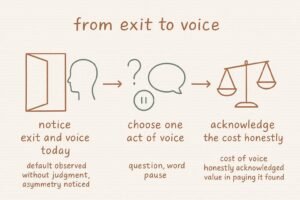
This practice supports the daily shift from the consumer logic of exit — moving away from what disappoints — toward the civic logic of voice: staying and working on it.
STEP 1: Notice Exit and Voice in Today’s Choices
At some point during the day, when dissatisfaction or friction arises, observe what response follows.
Did I move away — or did I stay and engage in some form?
Neither is automatically correct. The point is to observe which tends to be the default, and to notice the asymmetry: when exit consistently feels easier and voice consistently feels costly, that asymmetry itself is worth examining. It did not arise from personal preference alone.
STEP 2: Choose One Minimum Act of Voice
Voice does not require a speech or a demonstration. Within today’s life, find the smallest available act of engagement rather than withdrawal.
When something at work feels wrong, ask one question rather than absorbing it in silence. When a neighborhood issue becomes visible, say one thing to one person. When a habitual consumption choice comes up, pause once and ask whether it reflects what you actually value.
Small is the right scale. Sustainable is more important than significant. The habit of voice is built through small repetition, not single large acts.
STEP 3: Honestly Acknowledge the Cost of Voice
Voice feels harder than exit because it actually is harder. Friction, time, uncertainty, occasional tension in relationships — these are real costs, not imagined ones. Underestimating them produces cycles of overcommitment and withdrawal.
What did today’s act of voice cost? Where was the value in that cost, for me specifically?
Holding this question makes voice sustainable as a practice grounded in personal values rather than obligation. The cost is real. So is the reason for paying it.
Session 3: Where Agency Was Taken and Where It Can Return

How the Citizen Became a Consumer
Sociologist Zygmunt Bauman’s analysis of liquid modernity traced the process by which civic identity is quietly replaced by consumer identity in late modern society. The organizing logic of consumer society is choice and exit — there is no obligation to remain, no requirement to work on what disappoints. When this logic migrates into the domain of social and political engagement, civic voice and active participation come to feel like poor investments of energy: high cost, uncertain return, no guarantee of outcome. The sense that voting is sufficient is not the product of individual disengagement. It is the predictable output of a structure that redesigned social participation in the grammar of product selection. The citizen who feels politically helpless is not failing at democracy. They are responding accurately to a design that has made consumer behavior the path of least resistance.
“Nothing Changes” Was a Learned State
Psychologist Martin Seligman’s foundational research on learned helplessness demonstrated that repeated exposure to uncontrollable negative outcomes produces a generalized cessation of action — not only in the original context but across situations where action would actually be effective. The critical insight is that this is a learned state, not a fixed trait. The accumulation of experiences in which action produced no visible result teaches the system, at a neural level, to stop initiating action. In political contexts, the repeated experience of voting without perceivable change, of speaking without being heard, of engaging without visible effect, produces exactly this pattern. The conviction that nothing changes is not pessimism or laziness. It is the honest residue of experience — and because it is learned, it is also something that different experiences can begin to alter.
Making Exit Easy Was What Suppressed Voice
Economist Albert Hirschman’s Exit/Voice/Loyalty framework organized the responses available to members of an organization or society when things go wrong: exit — leaving — voice — working to change things from within — and loyalty — remaining without either. The crucial asymmetry Hirschman identified is that when exit is made readily available, voice is suppressed. Investing effort in changing something requires believing that exit is not the better option. Consumer society made exit frictionless — scroll past, switch brands, change the channel, move to the next option. As frictionless exit became the texture of daily life, the relative cost of voice increased. Engagement came to feel inefficient by comparison. But what Hirschman’s framework clarifies is that exit, however immediately relieving, leaves the situation unchanged. Voice costs more. And that cost is precisely what makes it the route through which situations actually change.
Conclusion: Agency Doesn’t Return All at Once

The consumer logic keeps making exit the easier choice. Learned helplessness keeps suppressing the impulse to act. The structure does not change.
But the question is there one act of voice available to me today? can be brought into any moment of dissatisfaction, before the default toward exit takes over. Agency is not recovered in a single decision. It is rebuilt each time voice is chosen over exit — slowly, at the scale of what is actually sustainable.
The vote was never the whole of it. It was the one part that had been officially scheduled.
KEY TERMS
Learned Helplessness
Martin Seligman’s finding that repeated exposure to uncontrollable negative outcomes produces a generalized cessation of action — extending beyond the original context to situations where action would be effective. The political conviction that nothing changes is not pessimism but the honest residue of accumulated experience. Because it is a learned state rather than a fixed trait, different experiences can begin to alter it.
Consumerization of Citizenship
Based on Zygmunt Bauman’s analysis of liquid modernity. The process by which civic identity is replaced by consumer identity in late modern society — social participation redesigned in the grammar of product selection, where choice and exit replace voice and engagement as the default modes of relation. The structural origin of the sense that voting completes the citizen’s role.
Exit / Voice / Loyalty
Albert Hirschman’s framework for the responses available when organizations or social arrangements disappoint. Exit means leaving; voice means working to change from within; loyalty means remaining. The key asymmetry: the easier exit becomes, the more voice is suppressed. Consumer society made exit frictionless — and in doing so, structurally raised the cost of voice relative to withdrawal.
Everyday Agency
The capacity to shape social conditions through daily choices, speech, and engagement — not limited to voting or formal political participation. Understood as the shift from consumer logic (exit) to civic logic (voice). Built through small repetition rather than single large acts, and grounded in personal values rather than obligation.
Political Alienation
The experience of being structurally separated from political processes, accompanied by the sense that individual action has no effect on social outcomes. Produced by the compound operation of citizenship’s consumerization and learned helplessness — a structurally manufactured state, not a personal failing or character trait.