
Introduction: Why the Anger Lands Somewhere Else

A difficult day at work — someone treated unfairly, something that stung — and then, that evening, a sharp word aimed at someone at home who had nothing to do with it. A cruel comment online absorbed, and then an unrelated post met with harsher criticism than it deserved. The hurt from one place appearing as an attack somewhere entirely different.
The self-reproach that follows is familiar. Why did I do that?
This is not a failure of willpower or a character flaw. It is the structural result of how hurt produces anger, and how anger, when it cannot reach its original source, moves toward whatever target is available.
Session 1: Why the Target Is Never the Source

When the chain of blame operates, what is moving is not deliberate cruelty. It is a specific cognitive mechanism.
Being hurt generates anger. That anger belongs, in some sense, to whoever or whatever caused the hurt. But when the original source holds more power, when the relationship is one that cannot afford to absorb the conflict, when the source is no longer accessible — the energy of the anger has nowhere to go in that direction. So it moves toward what is available.
This is not a conscious choice. It is the automatic behavior of an energy that is looking for an exit. Family members become available. Colleagues, strangers online, people in positions of less power — these become available. The person who receives the displaced anger had nothing to do with the original wound. The logic of displacement is not organized around who caused this but around where this can go.
That the chain’s victims are unrelated to its origin is not coincidental. It is built into the mechanism.
Session 2: Practice — Stopping the Chain at Yourself
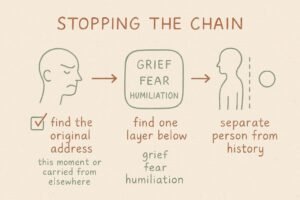
This practice is not about suppressing anger. It is about building the capacity to notice when displacement is about to happen, and to choose where the anger goes next.
STEP 1: Find the Original Address of the Anger
When a strong reaction toward someone begins to rise, ask once:
Is this anger a response to what this person just did — or is it something carried in from somewhere else?
Recognizing that the anger has a different origin is enough to create a gap. The gap is small — a few seconds at most. But in that gap, the automatic transfer from original wound to available target can be interrupted. Checking whether the anger belongs to this moment or was brought here from another one is the first movement in stopping the chain.
STEP 2: Find One Layer Below the Anger
Anger frequently functions as a surface over more vulnerable feelings. When the intensity is high, turn inward once:
What is underneath this anger? Grief? Fear? Helplessness? Humiliation?
Name one of those feelings, even briefly — I am hurt right now. This does not resolve anything. But it redirects the energy of the anger from an external target toward the actual pain it is covering. That redirection is the first contact between the anger and what it is actually about.
STEP 3: Separate the Present Person From the Past Wound
When the person in front of you seems to be producing a reaction that feels disproportionate, ask once:
Is my response to this person — or to someone else, arriving through this person?
Keeping the present person distinct from the history that a reaction is drawing on is not easy. But the question, held even lightly, gradually reduces the frequency with which past wounds take the present relationship hostage.
Session 3: Where the Chain Is Made and Where It Can Stop

The Anger Was Looking for an Exit, Not a Cause
Social psychologist Leonard Berkowitz’s development of frustration-aggression theory demonstrated that the experience of being blocked, hurt, or treated unjustly generates an impulse toward aggression — and that this impulse does not necessarily travel back toward its source. It travels toward what is available. When the original source of frustration is a figure of authority, a family member becomes the available target. When the wound came from an online exchange, an unrelated comment section becomes the outlet. This displacement is not a moral failure. It is the automatic behavior of aggressive energy moving toward an accessible exit when the original direction is blocked. The chain of blame produces victims who are unrelated to the original harm for this reason — the logic of displacement has nothing to do with who deserves the anger and everything to do with where it can go.
The World Started Looking More Dangerous — and It Wasn’t Wrong
Cognitive developmental psychologist Kenneth Dodge’s research on hostile attribution bias showed that as experiences of being hurt accumulate, the tendency to interpret neutral or ambiguous actions by others as evidence of hostile intent strengthens. A message that goes unanswered. A colleague’s brief response. These become readable as aggression — and the attack that follows is experienced as a legitimate response to a real threat, even when the threat was not there. Clinical psychologist Ronnie Janoff-Bulman’s work on shattered assumptions identified the deeper architecture of this change. Being hurt — particularly in ways that feel unjust or unexpected — does not only produce pain. It dismantles the basic cognitive frameworks through which the world was being perceived: that the world is fundamentally safe, that effort and goodness offer some protection, that the self is not simply vulnerable to arbitrary harm. When these frameworks are broken, the world does not look the same. Everything reads through a different lens. When hostile attribution bias and this collapse of basic assumptions operate together, the chain of blame runs automatically — no conscious decision required to keep it moving.
Recovery Was Never Going Back to Before
Janoff-Bulman’s research also identified what the path out looks like — and it is not a return to the assumptions that were shattered. The belief that the world is fundamentally safe does not reassemble in its original form after it has been broken. Recovery takes a different route: a gradual re-adaptation to a more complex picture of the world — one that includes vulnerability, uncertainty, and the coexistence of harm and worth. The world is not entirely safe, and it is still worth engaging with. People are capable of causing harm and of providing support. This is a harder framework to hold than the simpler one it replaces. But it is more honest — and it is the one that allows the chain to be interrupted. The internal condition that makes this re-adaptation possible is the capacity to receive one’s own pain without treating it as evidence of failure or weakness. When hurt is allowed to be what it actually is — an experience, not a verdict on the self — it becomes material for understanding rather than fuel for displacement. The quality of attention directed inward with that kind of steadiness is not what removes the anger. It is what makes it possible to stay with the pain long enough for it to stop needing somewhere else to go.
Conclusion: The Target Was Almost Never the Source

The displacement mechanism keeps operating. Hostile attribution bias keeps reading neutral acts as threats. The broken world-view keeps making everything look more dangerous until it is rebuilt. The structure does not change. But the question where does this anger actually come from? can be brought to any moment when a strong reaction is rising. That question is the gap — the small space between the original wound and the available target where the chain can be interrupted.
The target of the anger was almost never its source. That gap was where the chain could be broken.
Key Terms
Frustration-Aggression Displacement
Leonard Berkowitz’s theory that the experience of being hurt or blocked generates an aggressive impulse that does not necessarily travel back toward its source — it moves toward available targets. The social psychological explanation for why the victims of the blame chain are typically unrelated to the original harm. Not a moral failure, but the automatic behavior of aggressive energy seeking an accessible exit.
Hostile Attribution Bias
Kenneth Dodge’s finding that accumulated experiences of being hurt strengthen the tendency to interpret neutral or ambiguous actions as evidence of hostile intent. Creates the experience of responding legitimately to a real threat that was not actually present — and in doing so, keeps the chain of displacement running without conscious decision-making.
Shattered Assumptions
Ronnie Janoff-Bulman’s theory that experiences of harm — particularly those that feel unjust or unexpected — dismantle the basic cognitive frameworks through which the world was previously perceived: that the world is fundamentally safe, that good behavior offers protection, that the self is not simply vulnerable to arbitrary harm. The collapse of these frameworks creates the lens through which hostile attribution bias reads the world.
Assumptive World Rebuilding
Janoff-Bulman’s account of recovery from harm. The shattered frameworks do not reassemble in their original form — recovery is a re-adaptation to a more complex picture that includes vulnerability, uncertainty, and the coexistence of harm and worth. The more honest framework that emerges is what makes it possible for the chain to be interrupted rather than automatically continued.
Automatization of Displaced Aggression
The state produced when hostile attribution bias and shattered world-view assumptions compound each other — in which displaced aggression continues without conscious choice. The mechanism through which hurt people become hurting people without intending to. Recognizing that this automatization is operating is the precondition for introducing the gap in which choice becomes possible.