
Introduction: Where Were You During That Walk?

On the way to work, on the way home from the grocery store — walking while replaying yesterday’s conversation, building tomorrow’s to-do list, or pulling out the phone to fill the gap. Arriving at the destination with almost no memory of the journey between.
The body was on the pavement. The mind was somewhere else.
There is a way to use this travel time as practice, without adding anything to the schedule. It is the opposite of walking while scrolling — an awareness that starts at the soles of the feet.
Session 1: Why Walking Becomes a Practice

Mind wandering happens most automatically during habitual actions. Walking is sufficiently practiced that it requires almost no conscious attention — and into that gap, the brain automatically imports past regrets, future worries, unresolved tensions. The walk proceeds, but the walker isn’t really there for it.
The body, however — especially the soles of the feet in direct contact with the ground — is always in the present moment. Directing attention to physical sensation is one of the most direct available interruptions of automatic mind wandering. Not to arrive faster. To actually be present for the walking that is already happening.
Session 2: Three Steps for the Urban Walk
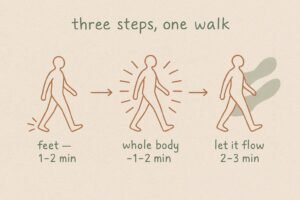
Eyes open. No need to slow down or look unusual. The shift is entirely internal — a change in where attention is directed, not in how the walk looks.
STEP 1: Settle attention in the feet (1–2 minutes)
As walking begins, bring all attention to the soles of the feet. The pressure as weight transfers. The sensation of the foot lifting. The small movements of the toes inside the shoes.
Right foot down, left foot lifts — this internal noting can help at first.
When thoughts arrive — and they will — return to the feet without friction.
STEP 2: Expand to the whole body in motion (1–2 minutes)
From the feet, widen awareness to include the whole body moving through space. The contraction and extension of the leg muscles. The subtle sway of the hips. The natural swing of the arms. The body as a single coordinated system, continuously adjusting, continuously moving forward — felt from the inside.
STEP 3: Let the environment flow through (2–3 minutes)
Rather than fixing on any particular thing, let everything in the visual field simply pass through. The glint of light on glass. The colors of passing coats. Leaves moving in wind.
Receive it without labeling it good or bad, interesting or dull. Let it arrive and pass.
The same applies to sound — traffic, voices, construction, heard as sound events that arise and dissolve rather than as noise to be endured or evaluated.
Session 3: What the Urban Pavement Does to the Brain
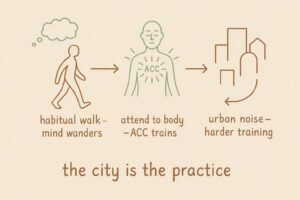
Jonathan Smallwood and Jonathan Schooler’s comprehensive review in Psychological Bulletin (2006) established that mind wandering arises most frequently and most automatically during habitual tasks — conditions in which the brain’s demand on conscious attention is low enough to allow internally-generated thought to activate without intention. Walking is an ideal case: the mechanics of locomotion are sufficiently practiced that they bypass the prefrontal cortex almost entirely, and the neural space this creates is where the wandering begins. The experience of being several blocks from where the thinking started, with no memory of what the feet were doing, is not inattentiveness. It is the predictable outcome of a habitual action offering a neural vacancy.
Yi-Yuan Tang and colleagues, publishing in PNAS (2007), showed that this vacancy can be directly interrupted by training that integrates bodily sensation with conscious attention. Five days of integrative body-mind training — twenty minutes per day, with deliberate attention to physical sensation at its core — produced measurable increases in anterior cingulate cortex (ACC) and insula activity, alongside improvements in attention control and autonomic regulation. Tang and colleagues’ subsequent work (PNAS, 2010) found that similar training produced structural changes in the white matter connections linking the ACC to other brain regions — the training effect was not limited to functional activation but extended to the architecture of the attention circuit itself. Deliberate attention to bodily sensation during walking is the everyday implementation of the same mechanism.
The urban environment gives this practice a specific character that quieter settings do not. In a forest, sustaining sensory attention is relatively easy. In a city, stimulation arrives continuously and unpredictably — a sudden sound, an unexpected image, someone stepping close. Each time one of these pulls attention away from the feet and the body, and attention returns, the anterior cingulate cortex is being trained in precisely the operation Tang’s research identified: the noticing-and-returning cycle that builds attentional control. The noise and the crowds are not obstacles to this practice. They are what makes it a more demanding training environment. This is the insight that the Theravāda tradition formalized as Cankama — walking meditation, considered a full equivalent to seated practice — in which the ordinary movement of walking, attended to fully, becomes a complete field of awareness.
Conclusion

One minute of feeling the feet is enough. Thirty seconds of letting the visual field flow through without evaluation is also the complete practice.
Thoughts will arrive. That is not failure — it is the training condition. Each time the drift is noticed and attention returns, the circuit moves.
The mind had been traveling the whole time. The body was always on the pavement. The moment that gap became visible was the only moment the walk was actually a walk.
KEY TERMS
Mind Wandering
Smallwood and Schooler’s term for the automatic, unintentional activation of task-unrelated thought — occurring most frequently during habitual actions that require minimal conscious attention. Walking provides ideal conditions for mind wandering, which is why the gap between where the body is and where the mind has gone is such a common experience during commutes.
Anterior Cingulate Cortex (ACC)
The brain region central to attention control, error detection, and autonomic regulation. Tang and colleagues’ research (PNAS, 2007, 2010) showed that body-mind training increases both ACC activity and the structural integrity of its white matter connections — the neural substrate of the noticing-and-returning operation that walking meditation trains.
Integrative Body-Mind Training (IBMT)
The training method studied by Tang et al. (PNAS, 2007), placing deliberate attention to bodily sensation at its core. Five days of twenty-minute sessions produced measurable improvements in ACC activity, attention control, and autonomic regulation. Walking meditation functions as an everyday implementation of the same mechanism across a longer timeline.
Default Mode Network (DMN)
The brain’s automatic background processing circuit, active during mind wandering. The neural vacancy created by habitual walking allows the DMN to activate without intention — which deliberate attention to physical sensation directly interrupts.
Cankama
The Theravāda tradition of walking meditation, practiced as a full equivalent to seated meditation. Its core insight — that ordinary movement, attended to fully, becomes a complete field of awareness — describes the same neural operation that Tang’s research measured and that Smallwood and Schooler’s work identified as the process being interrupted.