
Introduction: Do You Remember the Last Time a Step Wasn’t There?

The moment when the foot expected a surface and found nothing — the instant full-body response, the sudden sharp return to the present.
That reaction is the brain’s precision stair-navigation system revealing itself by failing. When the prediction holds, the whole process runs invisibly. When it doesn’t, everything surfaces at once.
This happens on every staircase, every time — a continuous conversation between prediction and surface that most people have never once been present for. Today’s practice is about being conscious while the prediction holds: present for the machinery that usually runs without an audience.
Session 1: Why Stairs
Stair climbing is neurologically distinct from walking on flat ground.
On a level surface, gait is largely maintained by spinal-level central pattern generators — rhythmic, automatic, requiring minimal cortical input. Stairs change this. The brain must continuously read each step’s geometry — height, depth, surface angle — from visual input and proprioceptive feedback, and update the muscle recruitment pattern for the next footfall before it happens. This is anticipatory postural control: the cerebellum and supplementary motor area working in coordination to prepare the body for what’s coming rather than reacting to what’s arrived.
With repetition, this predictive process becomes a refined automatic program. Which is why a familiar staircase requires almost no conscious attention. And why an unfamiliar one — or a darkened one — brings the whole system back into awareness.
Stairs also create conditions for a second phenomenon. Under the increased metabolic demand of climbing, the respiratory system adjusts its output, and the rhythmic movement of the legs begins to pull the breath into synchrony. Two steps per breath, or three — the ratio shifts with effort and pace. This locomotor-respiratory coupling happens without instruction, driven by neural connections between the brainstem’s respiratory centers and the spinal cord’s locomotor rhythm generators. Most people have felt it without having a name for it.
Both of these processes — predictive postural control and breath-movement coupling — are running every time the stairs are climbed. This practice is simply about being there while they do.
Session 2: Three Steps
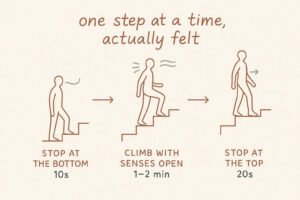
STEP 1: Stop at the bottom (10 seconds)
Before the first step, pause. Take in the staircase — the number of steps, the height, the angle. The brain is already reading this geometry and beginning to prepare. One breath, and a light internal intention: one step at a time, actually felt.
STEP 2: Climb with the sensory channels open (1–2 minutes)
With each step, stay with what’s available.
The feet — the contact of the sole with the surface, the weight transferring from the back foot to the front, the subtle shift in center of gravity before each step begins
The breath — how many steps per breath, whether that ratio is stable or changing, how effort and rhythm are negotiating with each other
The body as a whole — the muscle recruitment in the legs and hips, the adjustments the torso makes for balance, the continuous small corrections happening below conscious direction
When “just get there” arrives as a thought, note it and return to the feet.
STEP 3: Stop at the top (20 seconds)
After the last step, pause before moving on. Check the breath — how has it changed? The legs — what do they feel like now? The body temperature? Compare the state of the body now to what it was at the bottom. The difference is the record of what just happened.
Session 3: What the Brain Prepares Before the Foot Leaves the Ground
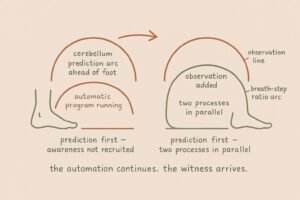
Before the foot leaves the ground, the cerebellum and supplementary motor area have already calculated the expected geometry of the next surface and pre-configured the muscle activation pattern to meet it. The response to a missing step isn’t a reaction — it’s the collision between a prepared movement and an absent target. This is anticipatory postural control operating at the edge of its tolerance.
Under normal conditions, on a familiar staircase, the predictions are accurate and the process runs entirely below awareness. The more practiced the route, the more thoroughly the system is automated, and the less any of it surfaces. Consciousness is only recruited when the prediction fails. Every successful step is, in a sense, a prediction that was never noticed because it was never wrong.
Attending to foot contact and weight transfer introduces something different from simply disrupting automation. The predictive program continues running — the cerebellum doesn’t pause because attention has arrived. What changes is that a second process runs alongside it: the conscious observation of a system that ordinarily operates without an observer. This is distinct from the interruption of sensory cancellation in a familiar hand motion, where attention disrupts the suppression of expected feedback. Here, the automatic program and conscious awareness run simultaneously — not in competition, but in parallel. The automation continues. The observation is added.
The breath dimension adds a separate layer. Walking and breathing are physiologically independent systems, but during rhythmic locomotion they tend to synchronize — a phenomenon produced by neural connections between the medial medullary respiratory centers and the spinal locomotor rhythm generators. Stair climbing makes this coupling more pronounced because the increased oxygen demand requires active respiratory adjustment. The breath is no longer just cycling passively; it is negotiating with the movement. The question of how many steps per breath — and whether that ratio is stable or shifting — is an invitation to observe this negotiation in real time rather than let it run unwitnessed.
The body after climbing is measurably different from the body before: elevated heart rate, changed breathing pattern, thermal shift, residual muscular load. These are the traces of the predictive and metabolic work the brain and body just completed. Receiving them consciously through interoceptive attention — rather than moving immediately to whatever comes next — turns the ending of the climb into information rather than just a transition.
Conclusion: The Stairs Were Always This Precise
Once today. Any staircase. Pause at the bottom, stay with the feet and the breath on the way up, pause at the top and let the body’s changed state register before moving on.
The system was running at full precision the entire time. The only thing that changed today was that someone was there to notice.
The brain was precise the whole way up. The attention was the only thing that wasn’t.
KEY TERMS
Anticipatory Postural Control
The brain’s pre-configuration of muscle recruitment patterns before a movement is executed, based on predicted sensory requirements. In stair climbing, updated step by step through integration of visual and proprioceptive input in the cerebellum and supplementary motor area. The missing-step response — the whole-body reaction when a predicted surface isn’t there — is this system’s precision made suddenly visible.
Locomotor-Respiratory Coupling
The synchronization of breathing rhythm with locomotor rhythm during repetitive movement, produced by neural connections between the brainstem’s respiratory centers and the spinal cord’s locomotor pattern generators. More pronounced during loaded movement like stair climbing, where oxygen demand requires active respiratory adjustment. The ratio of steps to breaths — and its changes — is the observable surface of this coupling.
Dynamic Body Schema Update
The continuous step-by-step revision of the brain’s three-dimensional spatial model of the body during movement through variable terrain. Stair climbing requires this updating under conditions of three-dimensional weight shift and surface adaptation — a more demanding operational mode than proprioceptive awareness in stillness, where the model is maintained rather than continuously revised.
Defusion
A core skill in Acceptance and Commitment Therapy (ACT): the capacity to observe thoughts and impulses as passing mental events rather than directives. When just get there already arrives mid-climb, recognizing it as a thought rather than a command — and returning to the sensation of the foot meeting the next step — is defusion applied to the specific impatience of vertical movement.