
Introduction: The Queue Isn’t Going Anywhere. Neither Are You

The checkout line. The elevator lobby. The waiting room. These moments arrive uninvited, scatter through the day, and reliably produce the same low-grade friction: why is this taking so long?
But the frustration isn’t really about the time. Five minutes in a queue isn’t inherently long. It feels long because of what the mind does with it — and the mind, left to its own devices, does something very specific: it monitors. It watches the line. It calculates. It generates urgency with nowhere to go.
That’s the thing worth examining — and changing.
Session 1: Why Waiting Feels Worse Than It Should

Two things happen when we’re forced to stop.
The first is familiar: the brain reads unstructured, unproductive time as a threat to efficiency, and registers something that feels like urgency without a clear outlet. The body prepares to act. There’s nothing to act on. The resulting tension has nowhere to discharge, so it turns inward.
The second is less obvious. The moment attention fixes on the wait itself — is this moving? how much longer? — the brain’s time-processing circuits go into overdrive. Time, under that kind of scrutiny, stretches. The frustration doesn’t just make the wait feel unpleasant. It makes it feel longer than it is. The monitoring is the problem, not the minutes.
The exit isn’t patience. It’s redirection.
Session 2: Three Steps for Turning a Wait into a Practice
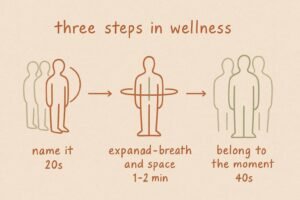
STEP 1: Name what’s happening (20 seconds)
When the irritation arrives, don’t suppress it or follow it. Just observe it. *There’s the impatience.* Where does it live in the body — the chest, the jaw, the legs that want to move? What has the breath done in response? Note it without judgment, the way you’d observe weather through a window. The irritation doesn’t need to be resolved. It needs to be seen.
STEP 2: Expand attention in two directions simultaneously (1–2 minutes)
Let awareness move along two axes at once.
Vertical: the breath moving through the body — the rise and fall of the chest, the temperature of the air coming in, the small release of each exhale.
Horizontal: the space around you — sounds at different distances, the movement of people, the quality of the light, the particular atmosphere of this specific place at this specific moment.
Both at once. Not alternating — simultaneous. This may feel difficult at first, like trying to watch two things at the same time. That difficulty is the practice. It takes just enough attention to crowd out the time-monitoring loop, and not so much that it becomes another task.
STEP 3: Let yourself belong to the moment (40 seconds)
Everyone in this queue is waiting. The space has its own temperature, its own sounds, its own rhythm — a texture that exists whether or not anyone is paying attention to it. You are part of it, not trapped in it. Let that distinction settle.
Notice what happens to the sense of urgency when you stop being a person waiting for the line to move and become, for a moment, simply a person standing in a space. The line is still there. The clock is still running. Something in the experience has changed anyway.
Session 3: Why the Watched Pot Is Doing Something Precise to the Brain
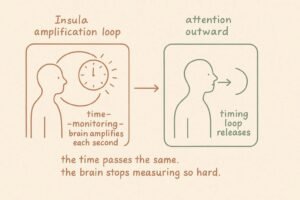
The experience of time stretching during a wait isn’t subjective in the loose sense. It reflects a measurable shift in how the brain processes temporal information.
Research in time perception consistently demonstrates what’s sometimes called the watched-pot effect: the more attention is directed toward time’s passage, the longer that passage feels. This isn’t metaphorical. Studies using both behavioral measures and neuroimaging show that self-monitoring of time activates time-processing circuits in ways that amplify the subjective duration of the interval being monitored. The act of watching the clock doesn’t just feel like it slows time. It does slow the experience of time — through a specific neural mechanism.
Two regions are central to this mechanism. The insular cortex integrates bodily sensation, emotional state, and temporal awareness; in states of discomfort or frustration, it amplifies the brain’s time signals, making each passing second more salient than it would otherwise be. The basal ganglia, operating through dopamine pathways, function as the brain’s internal metronome — setting the subjective tempo of experience. In low-engagement, low-reward states like waiting, dopamine activity decreases, and the internal metronome slows. Time appears to drag not because the clock slows, but because the brain’s timing system becomes hypersensitive to its own ticking.
Redirecting attention from time-monitoring to simultaneous sensory observation — breath moving through the body, space unfolding around it — reduces insular amplification of time signals and interrupts the watched-pot loop. The wait doesn’t shorten. The brain simply stops measuring it so aggressively. What had been a closed loop of self-referential monitoring opens into something with more texture and less friction.
The shift from I am waiting to I am part of this space engages a further mechanism. Reducing self-referential processing — the same internal narrative mode that fuels both rumination and time-monitoring — changes the quality of attention in a way that has been studied in the context of flow states. Psychologist Mihaly Csikszentmihalyi identified the dissolution of self-consciousness as a defining feature of flow, in which time perception changes dramatically. A queue won’t produce flow. But the underlying principle holds at smaller scales: when attention moves outward from the self, the self-monitoring that makes time feel heavy begins to release.
The time passes at the same rate either way. What changes is how much of the brain is occupied with measuring it.
Conclusion: Same Wait. Different Experience

This practice doesn’t ask the irritation to disappear or the line to move faster. It asks for one deliberate redirect — from monitoring the wait to inhabiting it. The frustration can stay. What changes is its relationship to the next two minutes: whether they pass as evidence of time wasted, or as something that was actually there to be noticed. That distinction is smaller than it sounds, and more consequential than it appears.
The clock was never the problem. The brain’s decision to watch it was.
KEY TERMS
Watched-Pot Effect
The consistent finding that directing attention toward time’s passage amplifies its subjective duration. The mental act of monitoring a wait — *is this moving? how much longer?* — activates time-processing circuits in ways that make the interval feel measurably longer than equivalent unmonitored time. The primary mechanism behind waiting-related frustration, and the reason redirection is more effective than patience.
Time Perception
The brain’s construction of subjective temporal experience, distinct from objective clock time. Governed by the insular cortex and the basal ganglia dopamine system; highly sensitive to attentional state, emotional valence, and degree of environmental engagement. Time passes at the same objective rate regardless of attentional state — but the brain’s experience of that passage varies substantially.
Insular Cortex
A region of the cerebral cortex that integrates bodily sensation, emotional state, and temporal awareness. In states of discomfort or frustration, the insula amplifies the brain’s time signals — increasing the salience of each passing second and contributing to the subjective stretching of the wait. The same region also supports interoceptive awareness, which is why redirecting attention to bodily sensation can interrupt the time-monitoring loop it was amplifying.
Basal Ganglia
A set of subcortical structures that regulate motor control, habit formation, and — through dopamine pathways — the brain’s internal sense of timing. In low-reward, low-engagement states like enforced waiting, dopamine activity decreases and the basal ganglia’s internal metronome slows, making time feel as though it is dragging. Increased environmental engagement partially restores dopamine activity and normalizes the subjective tempo of experience.
Flow
Mihaly Csikszentmihalyi’s term for states of complete task engagement in which self-consciousness recedes and time perception changes dramatically — typically experienced as time passing faster than expected. The relevant mechanism for this practice is not flow itself but its underlying principle: outward attentional orientation reduces self-referential monitoring, which is the same processing mode that amplifies the subjective duration of a wait.
Defusion
A core skill in Acceptance and Commitment Therapy (ACT). The capacity to observe thoughts as passing mental events rather than facts requiring immediate response. When *this is taking forever* arrives, recognizing it as a thought rather than a measurement — and returning attention to breath and space — is defusion applied to the specific irritation of enforced waiting. The thought is present. The line is also present. Neither of them is the whole of what’s happening.