
Introduction: The Handoff That Everyone Rushes

It happens in seconds. Cards out, cards exchanged, a nod, move on. The whole sequence is so practiced it barely registers — which is exactly the problem.
The first moments with a new person set something in motion that’s difficult to undo. What gets transmitted in those seconds isn’t just your name and title. It’s whether you were actually there.
One breath, placed deliberately, changes what those seconds feel like — for both people. Not the content of the exchange. The quality of it. That difference is smaller than it sounds and more consequential than it appears.
Session 1: Why This Particular Moment Creates Tension

Meeting someone new activates the brain’s threat-detection circuitry in a specific way. Unfamiliar faces, uncertain impressions, the awareness of being evaluated — these don’t trigger the same response as physical danger, but they engage something close to it.
Psychologists call it social evaluative threat: the nervous system’s response to situations where social standing or competence might be judged. The result is predictable. Movements speed up. Attention narrows. The part of you that’s genuinely curious about the other person gets crowded out by the part that’s managing the impression you’re making.
This happens to experienced professionals as readily as to anyone else. The circuitry doesn’t check credentials. It responds to social uncertainty, and a first meeting is among the purest forms of social uncertainty there is.
A single deliberate breath interrupts this. Not by eliminating the tension, but by changing what the tension is doing.
Session 2: Three Steps to an Intentional Exchange
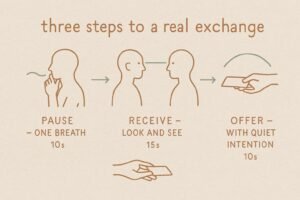
STEP 1: Pause before reaching for the card (10 seconds)
Before the exchange begins, stop the automatic motion for just a moment. One breath — in through the nose, slow out. Internally: *I’m about to meet this person.* That’s the whole of it. The breath resets the autopilot. The thought reorients the attention.
STEP 2: Receive the card like it means something (15 seconds)
Slow the receiving motion slightly — not ceremonially, just enough to break the automatic grab-and-pocket reflex. Take a moment to actually look at it: the name, the company, the design. What does it suggest about who this person is? Make brief, genuine eye contact before moving on.
This may feel unnecessarily deliberate at first. Most card exchanges in Western professional settings move at the speed of habit. Slowing down by two seconds isn’t conspicuous — it just looks like attention. And attention, in a context where almost nobody is paying it, is noticed.
STEP 3: Offer yours with a quiet intention (10 seconds)
As you extend your card, hold a light thought: I hope this turns into something good. Unhurried. Present.
This isn’t performance. It’s a small shift in what you’re doing internally — and that shift is legible to the person receiving it, even when neither of you could name what changed.
Session 3: Why the First Breath Changes Who Is in Charge of the Next Ten Seconds
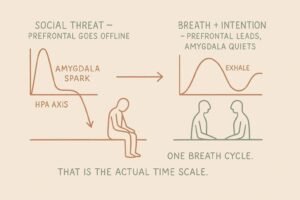
The anxiety that surfaces during first meetings isn’t generic stress. Research by Mark Leary and colleagues identified social evaluative threat as a physiologically distinct response — one that produces measurably higher cortisol output than non-social stressors of equivalent intensity. The mechanism involves the amygdala flagging social uncertainty as threat-relevant, activating the HPA axis, and initiating the hormonal cascade associated with defensive vigilance.
In practical terms: the prefrontal cortex — the part of the brain responsible for genuine curiosity, warmth, and considered response — gets partially offline. What remains in charge is a system optimized for threat management, not human connection. This is why people who are perfectly comfortable in other settings can feel wooden and automatic during introductions. The problem isn’t social skill. It’s neural sequencing.
STEP 1’s breath intervenes at this level. Deliberate slow exhalation stimulates the vagus nerve, which counteracts HPA axis activation and begins restoring prefrontal engagement. The internal declaration — *I’m about to meet this person* — functions as a prospective intention: a brief, forward-oriented mental statement that primes the prefrontal cortex to lead rather than follow. The transition from amygdala-driven automatic response to prefrontal-mediated conscious engagement takes approximately one breath cycle to initiate. That is not a metaphor. It is the actual time scale of the neurological shift.
STEP 3’s quiet intention operates through a separate but complementary mechanism. Orienting attention toward the other person’s wellbeing — even lightly, even briefly — shifts the brain’s processing from self-focused threat monitoring to other-focused social engagement. This activates the brain’s affiliative circuitry, associated with oxytocin release, which directly suppresses the amygdala’s evaluative alarm. Research into the neuroscience of social bonding consistently finds that the direction of attention — toward the self or toward the other — is one of the primary variables determining whether a social interaction feels like a threat or an opportunity. STEP 3 changes that direction before the exchange is complete.
The tension doesn’t disappear. But it stops being about survival and starts being about meeting someone.
Conclusion: You Were Always Going to Meet This Person

This practice doesn’t ask for a script or a performance. It asks for one breath before the card leaves your hand, a moment of actual attention as it arrives in theirs, and a light wish that something good might come of it. The entire sequence takes less time than the exchange itself. What it changes isn’t the duration of the interaction. It’s the neural state you bring to it — and the quality of presence the other person encounters on the other side.
The threat detection was automatic. The decision to meet someone instead was the one breath that wasn’t.
KEY TERMS
Social Evaluative Threat
A physiologically distinct stress response triggered by situations where social standing or competence may be judged. Produces measurably higher cortisol output than non-social stressors of equivalent intensity, as documented in Leary and colleagues’ research. The neurological basis for the specific discomfort of first meetings — and the reason professional experience doesn’t reliably reduce it.
HPA Axis (Hypothalamic-Pituitary-Adrenal Axis)
The primary neuroendocrine pathway governing stress response. Activated by social evaluative threat; produces cortisol and initiates the cascade of physiological changes associated with defensive vigilance. Deliberate slow exhalation via vagal stimulation counteracts this activation — which is why the breath in STEP 1 has a neurological effect rather than merely a psychological one.
Prospective Intention
A brief, forward-oriented mental statement that primes the brain for a specific mode of engagement before an event begins. STEP 1’s internal declaration — I’m about to meet this person — functions as a prospective intention, shifting neural leadership from the amygdala to the prefrontal cortex before the exchange begins. Distinct from goal intention, which specifies what is wanted; prospective intention specifies the mental orientation brought to what’s about to happen.
Affiliative Circuitry
The neural systems associated with social bonding, trust, and connection — distinct from the threat-detection circuitry that dominates during social evaluative threat. Activated by attention oriented toward another person’s wellbeing. Associated with oxytocin release, which directly suppresses amygdala reactivity. STEP 3’s quiet intention is a minimal but functional activation of this system.
Vagus Nerve
The primary pathway of the parasympathetic nervous system, running from the brainstem through the chest and abdomen. Stimulated by deliberate slow exhalation; counteracts HPA axis activation and supports the shift from defensive self-monitoring to open social engagement. In first-meeting contexts, vagal stimulation does double work: reducing cortisol-driven vigilance while restoring the prefrontal engagement that genuine curiosity requires.
Defusion
A core skill in Acceptance and Commitment Therapy (ACT). The capacity to observe thoughts as passing mental events rather than directives requiring immediate compliance. When I need to make a good impression arrives just before the exchange, noticing it as a thought — rather than treating it as an instruction — and returning attention to the breath is defusion applied to the specific pressure of social performance. The thought is present. It does not have to be in charge.