
Introduction: When the World in Thirty Years Weighs More Than Tonight

Reading about climate change and feeling the chest tighten at the thought of what the planet will look like after you are gone. Watching friends with children and feeling an unexplained accountability — will the world these kids grow up in be okay? Scrolling through a feed and having the words our generation is ruining the future land like an accusation, producing a guilt that positions you as an accomplice.
This sense of owing something to the future is not a product of excessive sensitivity or overthinking. It was manufactured — through specific social language, operating in specific ways, on the ethical concern you genuinely hold.
Session 1: What the Feeling of “Owing the Future” Actually Is

When the sense of future debt becomes chronic, what is operating is not a personal failing. It is a structure.
Climate change, inequality, political instability — these problems are real. But when they are framed as the debt your generation must repay, something is happening to the framing itself. Structural responsibility — the kind that belongs to corporations, governments, and institutions — is being transferred to individual emotion and individual daily choice.
The specifically long time-lag of these crises compounds the problem. When the consequences of today’s actions appear decades later, the structure of the situation projects the responsibility into the present while keeping the resolution permanently out of reach. The experience of an unpayable debt follows naturally from this structure.
The problem is not that you care about the future. It is that the caring has been captured by the language of debt — and that language was placed there.
Session 2: Practice — From Debt to Link in a Chain
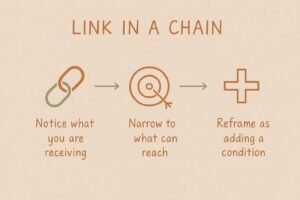
This practice moves the diffuse sense of future debt toward specific, grounded engagement in the present.
STEP 1: Notice What You Are Currently Receiving
Before attending to future responsibility, turn once toward what is already being received in the present.
Safe water today. Medical knowledge. A language to think in. A degree of social stability. These are all the accumulated result of someone else’s past actions.
This is not an instruction to feel grateful. It is a reorientation — from the sense of a one-directional debt to the sense of being inside a chain that runs both ways. Not only a borrower. A recipient, and a passer-forward.
STEP 2: Narrow to What Can Actually Reach
Set aside the diffuse responsibility toward the whole future and turn toward what can actually be affected today.
What is within honest reach today — in the relationships and choices that are actually present?
Not the planet in thirty years, but today’s choices. Not future generations in the abstract, but the people being encountered now. Narrowing the scope is not abandoning responsibility. It is returning energy to the place where action can actually land.
STEP 3: Reframe From Repayment to Condition-Adding
Reframe future engagement from repaying an unpayable debt to adding a condition to an ongoing chain.
Today’s honest choice doesn’t guarantee a result. But it becomes a condition for whoever comes next.
A farmer cannot control the weather, but can plant the best available seed. What happens after the planting depends on conditions beyond any individual’s reach. What is within reach is the quality of the seed and the honesty of the planting. That is enough — and it is the whole of what is being asked.
Session 3: Where the Debt Feeling Was Made and Where the Exit Is
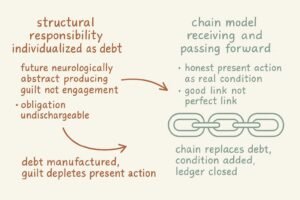
The Language of Individual Debt Was Manufactured
Research on how structural crises are progressively individualized in public discourse illuminates the mechanism at work in the feeling of future debt. Climate change, inequality, and technological risk arise substantially from corporate decisions, government policy failures, and institutional breakdowns. But when these crises are framed as your generation’s problem to solve, the structural accountability that belongs to institutions is transferred to individual emotion and individual choice. This transfer does not happen accidentally — it is a consistent feature of how these crises have been narrated in public language, and it uses genuine ethical concern as the material through which responsibility gets redistributed downward. The sense of owing something to the future is not a feeling that arose spontaneously from your own concern about the world. It is a feeling that was structured. That the feeling is real and that its origin is structural are not contradictions. Both are true simultaneously.
The Future Was Always Neurologically Distant
Psychologist Hal Hershfield’s research on temporal self-continuity demonstrated that even our future selves are processed neurologically in ways that more closely resemble how we process other people than how we process our current selves. The further into the future the projection, the more abstract the neural representation becomes. Future generations decades away are more abstract still — genuine objects of concern, but not objects of the kind of concrete, embodied empathy that close relationships produce. This is not evidence of moral failure. It is a description of how temporal cognition operates. But here the paradox emerges: when the discourse of responsibility runs well ahead of the neurological capacity for concrete identification with its object, what accumulates is not engagement but chronic guilt. The sense of nothing I do will ever be enough is what this gap produces. And chronic guilt does not increase contribution to the future — it depletes the capacity for present action.
The Relationship Was Never Debt and Repayment
Organizational behavior researcher Kimberly Wade-Benzoni’s work on intergenerational reciprocity proposed a reframe of how the relationship between generations is understood. The debt-and-repayment model positions each generation as owing something to a future that cannot yet reciprocate, producing the structure of an obligation that can never be discharged. Wade-Benzoni’s alternative is the chain model: receive from what past generations built — imperfectly, incompletely, but genuinely — engage honestly in the present with what is within reach, and pass something forward. In this model, no single link in the chain carries the whole. The question changes from have I repaid what I owe? to am I a good link? A good link is not a perfect one. It is one that receives honestly, engages with what is reachable, and passes something forward rather than absorbing everything in guilt. The future is not a ledger. It is an open process, and what today’s honest action adds to it is a condition — not a guarantee, but a real contribution to what becomes possible.
Conclusion: The Debt Was Manufactured. The Chain Is Real

The individualized discourse of structural responsibility continues. The neurological limits on concrete identification with distant future generations remain. The guilt keeps accumulating. The structure does not change.
But the question what is within honest reach today? can be brought into any moment when the weight of future debt arrives. That question moves from the unpayable obligation toward the chain — and being a good link in a chain is the whole of what is actually being asked.
The debt was manufactured to be unpayable. The chain only ever asked for an honest link.
KEY TERMS
Individualization of Structural Risk
The mechanism through which structural crises — climate change, inequality, technological risk — originating in corporate and institutional decisions are progressively reframed in public discourse as problems of individual choice and individual guilt. The structural origin of the sense of owing something to the future. Functions by using genuine ethical concern as the material through which institutional responsibility is redistributed to individual emotion and daily decision-making. That the resulting feeling is real and that its manufacture is structural are not contradictions.
Temporal Self-Continuity
Hal Hershfield’s finding that even one’s future self is processed neurologically more like another person than like the current self — and that this abstraction increases with temporal distance. The neurological basis for the structural difficulty of concrete empathy with distant future generations. When the discourse of responsibility runs ahead of this neurological capacity, what accumulates is chronic guilt rather than engaged action — the gap between obligation and the capacity for identification with its object.
Intergenerational Reciprocity
Kimberly Wade-Benzoni’s framework reframing the relationship between generations from debt-and-repayment to a chain of receive, engage, and pass forward. No single link carries the whole chain. The question shifts from whether the debt has been repaid to whether honest engagement in the present is contributing a condition to what becomes possible next. The basis for understanding present action as adding to an open process rather than servicing an obligation.
Chronic Ethical Debt Feeling
The state produced when the individualized discourse of structural responsibility combines with the neurological limits of temporal self-continuity. The gap between the abstract obligation and the concrete capacity for identification with its object generates ongoing guilt rather than action. Chronic guilt does not increase future contribution — it depletes the capacity for present engagement, which is the only actual source of any contribution.
Re-grounding in the Present
The shift from diffuse responsibility toward the whole future to focused, honest engagement with what is actually within reach today. Not the abandonment of responsibility but the return of energy to the place where action can land. Combined with the intergenerational reciprocity frame, this reorients the relationship to the future from unpayable debt toward honest participation in a chain that is already running — and that runs through the quality of present attention.