
Introduction: What “I Know Better But Can’t Change” Actually Means

It’s 11pm, and somehow the same hour has disappeared into the same place it always does. The app opens again without a decision to open it. The same escape route appears under the same kind of stress. The same stopping point arrives at the same place it always has.
This is not a willpower problem. A habit doesn’t change because the context that created it hasn’t changed. What needs redesigning is not the self — it is the conditions that keep producing the same behavior.
Session 1: What a Habit Actually Is

When a behavioral pattern keeps repeating despite the intention to stop it, what is running is not a failure of character. It is a process in which specific contexts automatically trigger specific actions — before thinking begins.
A particular time of day, a particular emotional state, a particular sequence of events — when these conditions assemble, the behavior that has run in that context before begins running again. Reaching for the phone the moment boredom arrives. A hand moving toward food the instant a meeting ends. Shoulders rising at the sight of a particular name. None of this is happening because of weakness. It is happening because repetition has worn a path between context and action, and the path runs whether or not it was chosen.
Between forty and forty-five percent of daily behavior consists of habits — automatic actions that repeat in stable contexts, as social psychologist Wendy Wood’s research demonstrated. What maintains these behaviors is not motivation or intention. It is the stability of the context itself. Same place, same time, same emotional conditions — as long as the context holds, the behavior tends to hold with it.
The difficulty of changing habits through willpower is not a personal failure. Willpower operates on the intention circuit. Habits run on a separate one.
Session 2: Practice — Redesigning the Context
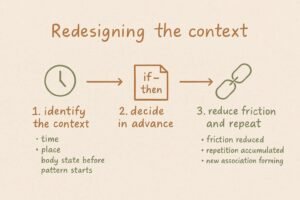
This practice is not about using willpower to break a habit. It is about changing the conditions in which the habit runs — in advance — so that a different behavior becomes the easier thing to do.
STEP 1: Identify the context
When a pattern repeats, write down what was present just before it started.
What time was it. Where was I. What was happening in the body — a feeling, a tension, a shift in energy.
Habits are powerful partly because they run unobserved. Putting the context into words creates the first gap in that automatic process — a shift from it happened again to I can see where it starts.
STEP 2: Decide in advance
For the identified context, choose one small new action and write it down in this form:
If specific context, then I will specific small action.
If I feel the pull toward the phone, I’ll drink a sip of water first. If the meeting ends and the familiar reach begins, I’ll look out the window for thirty seconds.
The size of the action is not what matters. What matters is that the decision was made before the context arrived — not inside it.
STEP 3: Reduce the friction and repeat
Lower every obstacle to the new action that can be lowered.
Move the water bottle to within reach. Remove one notification. After the new action, take one moment to notice that something different just happened.
Change comes from accumulated repetition, not from a single large effort. A small action tied reliably to a context and repeated is a more effective intervention into the habit circuit than a large action attempted once.
Session 3: The Habit Didn’t Change Because the Context Didn’t
The urban rhythm had been designing the habit’s context from outside
Research on time scarcity and decision fatigue describes how the structure of contemporary urban life generates chronic cognitive depletion as a baseline condition rather than a temporary state. In an environment where time is consistently short, cognitive resources are consistently depleted, and immediate relief is consistently available in the form of a feed, a snack, or a distraction, the path of least resistance gets walked again and again. Each repetition deepens the association. The habits that form under these conditions are not failures of character. They are the most efficient available responses to an environment that keeps producing the same pressures in the same contexts. The habit was rational, given its conditions. It persists because those conditions have not changed.
Context stability had placed the habit beyond the reach of intention
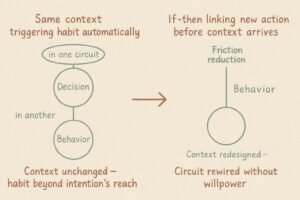
Wendy Wood’s research on habit formation demonstrated that habitual behavior is processed through neural pathways that operate independently of goal-directed thinking. A habit is not a weakly held intention — it is a direct association between a context and an action, encoded separately from the circuits that carry motivation and deliberate choice. Every time the same context appears and the same behavior follows, that association strengthens. This is why deciding to change is not sufficient: the decision lives in one circuit, and the habit runs in another. The experience of having genuinely meant to stop and finding the behavior running anyway is not evidence of self-deception. It is an accurate description of two independent systems responding to the same context at the same time.
Designing the context in advance had been updating the circuit without willpower
Motivational psychologist Peter Gollwitzer’s implementation intention research demonstrated that specifying in advance the exact situation and exact action — if this context, then this behavior — produces substantially higher rates of follow-through than general goal-setting alone. The mechanism connects directly to the Hebbian learning principle: neurons that fire together wire together. By linking a specific context to a new specific action before that context arrives, the implementation intention begins building a direct association between them — the same structural process that created the original habit, now redirected. Wood’s friction reduction research adds the complementary piece: lowering the physical and cognitive barriers to the new action increases the probability that it gets chosen when the context arrives. Neither component requires willpower. Both work by changing what the context points toward.
Conclusion: The Context Was the Design. The Redesign Was Always Available

The cognitive depletion and immediate-reward structure of urban life continues. The old context-action associations run today as they did yesterday. The habit circuit remains intact alongside any new one being built.
But what the context will point toward can be decided before it arrives. That decision is the redesign — and it was always within reach, because it was never about changing the self. It was about changing what the context points toward.
The habit was never a character flaw. It was the most efficient response to a context that hadn’t changed yet.
KEY TERMS
Context-Dependent Habit Formation
Wendy Wood’s finding that forty to forty-five percent of daily behavior consists of automatic actions that repeat in stable contexts — processed through neural pathways independent of intention and motivation. What maintains a habit is not weak willpower but context stability. Changing the context is a more structurally effective intervention than attempting to override the habit through deliberate effort.
Implementation Intention
Peter Gollwitzer’s if-then planning format — specifying in advance the exact situation and exact action to be taken when it arrives. Produces substantially higher follow-through rates than general goal-setting. Works by creating a direct association between a specific context and a new specific action before that context occurs — the same Hebbian process that built the original habit, now applied to building a new one.
Time Poverty and Cognitive Overload
Research on chronic time scarcity and decision fatigue as structural features of contemporary urban life. Under these conditions, the path of least resistance is taken repeatedly, and the associations it builds become habits. Frames persistent unwanted habits not as personal failures but as rational adaptations to an environment that consistently produces the same pressures — and that has not yet been redesigned.
Hebbian Learning
The neural principle that neurons which fire together wire together. The mechanism underlying both habit formation and habit change. When a context and a new action are repeatedly activated together — as happens through consistent implementation intention practice — their association strengthens physically over time. The structural basis for understanding why small repeated actions in stable contexts produce lasting behavioral change.
Friction Reduction
Wendy Wood’s complementary finding that lowering the physical and cognitive barriers to a new behavior substantially increases the probability of that behavior occurring when the relevant context arrives. Works alongside implementation intention: the if-then plan creates the association; friction reduction increases the likelihood that the new path is actually taken. Together they constitute the practical core of context redesign.