
Introduction: Full All Day, and Nothing Left by Morning

Somewhere around 11pm, the third video ended and a fourth started without a decision to let it. Something was being watched all day. Listened to. Read. After getting home, more scrolling, a video running in the background, something consuming attention right up until sleep.
And yet the next morning, everything feels thin. What was thought about yesterday, what moved something — it’s there, but vaguely. The head is working, but nothing seems to have accumulated.
This is not a concentration problem. The processing simply didn’t finish.
Session 1: Why Nothing Accumulates

The experience of consuming a large amount of information and finding that little of it stayed is not a failure of memory or attention. It is a structural problem: input and processing are running in the wrong order.
The brain does not process information at the same moment it receives it. After receiving something, the brain needs time — to cross-reference with existing memory, assign emotional significance, and integrate the new material with what was already known. This integration happens during time when no new input is arriving. When the next piece of information comes in, the integration stops.
The problem is that the contemporary information environment is designed to provide this interruption continuously. Notifications, autoplay, infinite scroll — each of these inserts the next input before the previous one has been processed. Experience accumulates. What gets consolidated into meaning does not keep up.
The feeling of I was engaged all day and nothing stayed is an accurate description of this structure. The information genuinely arrived. There simply was no time in which it could finish becoming something.
Session 2: Practice — Making Time for Processing
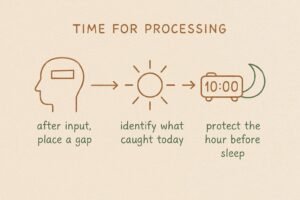
This practice is not about consuming less information. It is about deliberately placing processing time between input and the next input — so that what arrived has somewhere to go.
STEP 1: After input, place a gap
After reading something, hearing something, or having a conversation — before reaching for the next thing — pause for roughly the same amount of time the input took.
Leave what just came in where it is. Don’t open the next thing yet. Just be in the presence of what arrived.
Nothing active needs to happen during this gap. Processing happens without direction. The only requirement is that it not be interrupted by what comes next.
STEP 2: Once a day, identify one thing that caught
Retrieve one thing from the day that left an impression — a conversation, an article, a feeling, a moment of unexpected reaction.
What caught today? Why did it catch?
An answer is not required. Asking the question is the act of beginning conscious processing. Something that was moving along the surface starts to find depth.
STEP 3: Protect the hour before sleep from new input
In the thirty to sixty minutes before sleep, stop introducing new information. Put the screen down. Turn off the audio.
Let today’s material process here. This is the time that turns what was received into something available tomorrow.
The memory consolidation that happens during sleep uses as its material whatever arrived just before it. Continuing to introduce new input until the moment of sleep means continuously adding unprocessed material to a queue that is already full.
Session 3: When Input Outran Processing, Nothing Remained
Continuous input had been framed as productive use of time
Philosopher and cultural critic Matthew Crawford’s concept of attention as cognitive labor illuminates how sustained attentiveness has come to function as a form of productivity in contemporary life. Listening to a podcast during the commute, reading during transit, running a video through a meal — these are culturally validated as the intelligent use of available time, as the opposite of waste. Jonathan Crary’s analysis of twenty-four-seven capitalism extends the frame: time that was once protected as rest or leisure — the commute, the meal, the space before sleep — has been progressively incorporated into the hours available for consumption and, implicitly, for production. The compulsion to keep something coming in is not personal greed. It is the product of a cultural framework that has fused information consumption with the feeling of not falling behind — and that has made the unoccupied moment feel like a loss rather than a resource.
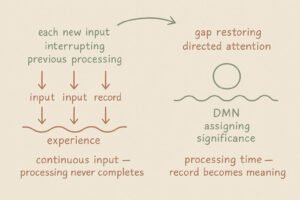
Each new input had been interrupting the processing of the last
Environmental psychologist Rachel Kaplan’s attention restoration theory established that directed attention — the kind required to follow content, process language, and track information — has a finite recovery curve, and that recovery requires time in which that directed demand is removed. What Kaplan called soft fascination — attention that holds lightly rather than effortfully — is the condition under which restoration begins. Cognitive psychologist Sophie Leroy’s attention residue research adds a complementary finding: when a previous task or piece of information has not been fully processed before the next input arrives, the unresolved material persists as background cognitive noise. Continuous information consumption means this noise accumulates with each cycle. The neurological description of I was engaged all day and nothing stayed is this: the inputs genuinely arrived, but each new one interrupted the processing of the previous one before it could complete. What registered as experience never finished becoming memory.
Processing time was what turned experience into meaning
Neuroscientist Mary Helen Immordino-Yang’s research on the brain’s default mode network reframes what is actually happening when input stops. The default mode is not rest in any passive sense. It is the system through which the brain assigns meaning to experience — integrating what happened with what is already known about the self and the world, generating the sense that something was significant and understanding why. Immordino-Yang’s key finding is that without this processing, experience remains as record rather than becoming meaning. The moment of being moved by something read and then finding it faint by the next morning is not a memory failure. It is the accurate result of the next input arriving before the significance of the first had been integrated. Making time for processing is not a reduction of input. It is the restoration of the only step that converts what was received into something that can actually be used.
Conclusion: What Wasn’t Processed Didn’t Accumulate

The cultural framework that equates continuous consumption with productive use of time continues. The platforms designed to deliver the next input before the last one finishes processing are running today as they were yesterday. Processing time does not appear on its own.
But the choice to leave what just arrived where it is — before reaching for the next thing — is available at any moment. That choice is the first step of the only process that turns input into something that stays.
The mind wasn’t empty when it was quiet. It was finall doing the work the noise had been interrupting.
KEY TERMS
Cognitive Processing Saturation
The state produced when continuous new input repeatedly interrupts the processing of previous information, causing unresolved material to accumulate as background cognitive noise. The neurological basis for the experience of having consumed a great deal and retained little. Described through Leroy’s attention residue research and Kaplan’s attention restoration theory. Not a problem of input volume but of structural processing-time deficit.
Attention as Cognitive Labor
Matthew Crawford’s concept describing how sustained attentiveness functions as a form of productivity in contemporary life. The cultural validation of continuous information consumption — podcasts during transit, reading during meals — has progressively eliminated the unoccupied time in which processing naturally occurs. The compulsion to keep something coming in is not a personal failure of discipline. It is the product of a framework that has made the quiet moment feel like waste.
Attention Residue
Sophie Leroy’s finding that when a previous task or piece of information has not been fully processed before the next input arrives, the unresolved material persists as background cognitive noise that reduces the quality of subsequent processing. Continuous consumption compounds this residue with each cycle. Placing a gap between inputs allows the residue from each one to clear before the next arrives.
Attention Restoration Theory
Rachel Kaplan’s framework establishing that directed attention has a finite recovery curve and that recovery requires conditions of low directed demand — what Kaplan called soft fascination. The cognitive science basis for understanding processing gaps not as idle time but as the restoration phase without which directed attention degrades. Input-zero time is a functional requirement, not an indulgence.
Default Mode Processing and Meaning-Making
Mary Helen Immordino-Yang’s research demonstrating that the brain’s default mode network performs active meaning-generation — integrating experience with existing self-knowledge and assigning significance — during periods when external input has stopped. Without this processing, experience remains as record rather than becoming meaning. The restoration of processing time is the restoration of the only step that converts received information into something integrated, retrievable, and usable.