
Introduction: Thirty Minutes of Scrolling, Nothing Chosen

It’s Sunday evening, and somehow an hour has passed inside a streaming app without anything chosen. Open the streaming app, scroll for half an hour, close it without watching anything. Read review after review of nearly identical products, buy nothing. Start thinking about weekend plans, exhaust the energy needed to make them, end up with nothing decided.
I’m just indecisive, the thought arrives. But this exhaustion is not a problem with decision-making capacity. The situation in which so many choices feel so heavy was designed to feel that way.
Session 1: What “I Can’t Decide” Actually Is

When choice becomes exhausting and decisions stop coming, what is operating is not a failure of will. It is a structure.
The cognitive cost of comparison rises with the number of options — and not proportionally. Evaluating ten options costs more than three times what it costs to evaluate three, because each additional option reactivates the comparison against everything already considered. The sense that there might be something better grows stronger the more options are present. This is not weakness. It is the brain’s accurate response to an oversupplied choice environment.
What makes this more complicated is that in contemporary life, choosing has become something more than selecting between things. What to eat, what to wear, what to watch — when these choices function as expressions of who someone is, every selection carries self-evaluation alongside it. A poor choice stops being just a poor choice. It begins to feel like evidence about the person making it.
The experience of being unable to decide is not a character problem. It is the result of two structural conditions operating simultaneously: an environment that supplies choices in excess of what can be processed, and a cultural frame that turns every choice into a question of identity.
Session 2: Practice — Reducing the Weight of Choice Structurally
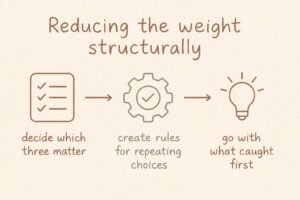
This practice is not about building stronger decision-making willpower. It is about changing the conditions under which choices happen — in advance — so that the cognitive cost is structurally lower before any particular decision arrives.
STEP 1: Decide in the morning which three things are actually worth deciding today
At the start of the day, identify the decisions that genuinely warrant attention and energy — no more than three.
What actually needs to be thought through today? Everything else can go to whichever option appears first.
Stopping the practice of bringing full attention to every choice is not laziness. It is the appropriate allocation of a limited resource toward the decisions where that resource actually makes a difference.
STEP 2: Create rules for choices that repeat
For decisions that recur daily — clothing, lunch, commute — establish a rule in advance.
Monday and Wednesday follow a fixed combination. Lunch rotates between two options, one for each half of the week.
The rule is not designed to guarantee the best possible choice. It is designed to eliminate the need to construct a choice from scratch each time a familiar situation arrives. Reducing options does not necessarily reduce quality. It reduces the cost of accessing whatever quality is already available.
STEP 3: When stuck, go with whatever caught attention first
When standing in front of options without a clear direction, choose whichever one the eye landed on first.
The first response already processed the available information. Continuing to compare may simply be repeating that processing at increasing cost.
The sense that something better is available grows stronger the longer comparison continues. Following the first response is the decision to stop paying for a process that has already completed.
Session 3: The Weight Was Never in the Deciding. It Was in the Design
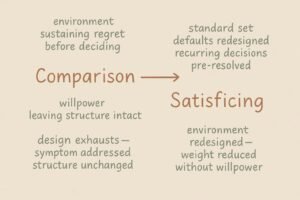
The feeling that more options meant more freedom was itself designed
The choice environment was never neutral. Behavioral economists Richard Thaler and Cass Sunstein’s concept of choice architecture established that the number of options, their arrangement, and the default settings of any decision environment all systematically influence behavior — and that this influence is always the result of deliberate design choices, whether or not those choices are visible to the person making the selection. Streaming services that autoplay continuously and retail platforms that surface endless near-identical alternatives do so because comparison behavior generates engagement, and engagement generates revenue. The sense that a larger number of options represents greater freedom is not a neutral observation. It is an adaptation to an environment designed by parties who benefit from the comparison process continuing. The experience of being unable to decide is not a malfunction. It is the expected output of a system that was built to produce exactly this — a person still searching, still engaged, still inside the choice environment.
When choosing became self-expression, regret arrived before the decision did
Cultural sociologist Mike Featherstone’s analysis of consumer culture and identity describes how, in contemporary consumer society, the act of selecting between goods has come to function as a primary means of constructing and expressing selfhood. What is eaten, worn, watched, and read becomes a vocabulary for who one is. When this is the frame, a poor selection is no longer simply an inconvenient outcome. It registers as information about the self — as a small failure of identity. The psychological mechanism of anticipated regret, the experience of forecasting how a choice will feel in retrospect before it has even been made, combines with this identity-laden context to produce paralysis before the decision point. The more options available, the greater the surface area for potential regret. The greater the potential regret, the heavier the anticipatory weight of the decision. The inability to choose is not the absence of preferences. It is the result of preferences being asked to carry more than the act of choosing was ever designed to support.
Satisficing and environmental redesign reduced the weight without requiring more willpower
Economist Herbert Simon’s concept of satisficing — selecting the first option that meets a sufficient standard rather than continuing to search for the optimal one — is among the oldest structural prescriptions for reducing the cognitive cost of choice. Thaler’s nudge framework extends this into environmental design: by changing defaults, restructuring how options are presented, and removing the need to reconstruct recurring decisions from scratch, the conditions under which choice happens can be redesigned in ways that preserve decision quality while reducing the cost of accessing it. The demand to develop stronger decision-making capacity is a misdirected intervention. Strengthening willpower within an environment designed to exhaust it addresses the symptom while leaving the structure intact. The difficulty was always in the design. The redesign was always the more honest response.
Conclusion: The Design Made It Heavy. The Redesign Can Make It Lighter

The commercial structure that benefits from supplying choices in excess of what can be easily processed continues. The cultural pressure that makes choosing feel like self-expression remains. Anticipated regret will keep arriving before the decision point.
But the decision about which three things are genuinely worth deciding today can be made before any of those choices arrive. That prior decision is the redesign — and it was always available, because the weight was never in the deciding itself.
The options were never designed to run out. Knowing that was always the first decision worth making.
KEY TERMS
Choice Architecture
Richard Thaler and Cass Sunstein’s concept establishing that the number of options, their arrangement, and the default settings of any decision environment systematically influence behavior — always as the result of deliberate design. The sense that more options represent more freedom is itself an adaptation to an environment designed by parties who benefit from the comparison process continuing. The experience of being unable to decide is the expected output of this system, not a personal failing.
Consumer Culture and Identity
Mike Featherstone’s analysis of how, in contemporary consumer society, the act of selecting between goods functions as a primary means of constructing and expressing selfhood. When choosing becomes self-expression, a poor selection registers as information about the self rather than simply an inconvenient outcome. The structural background for understanding why choice feels heavier than the act of selecting between things should warrant.
Anticipated Regret
The experience of forecasting how a choice will feel in retrospect before the decision has been made. Combines with identity-laden choice contexts to produce paralysis before the decision point: the more options available, the greater the surface area for potential regret, and the heavier the anticipatory weight of the decision. The psychological mechanism that explains why the difficulty of choosing grows with the number of options rather than diminishing with it.
Satisficing
Herbert Simon’s concept of selecting the first option that meets a sufficient standard rather than continuing to search for the optimal one. Structurally reduces the cognitive cost of choice without requiring willpower. People who satisfice tend to report higher satisfaction and less regret than those who maximize. The practical basis for the Session 2 practices: establishing rules, following first responses, and identifying in advance which decisions actually warrant full attention.
Nudge
Richard Thaler’s framework for redesigning the conditions under which choices happen — through changes to defaults, option presentation, and the removal of recurring decisions from active evaluation — in ways that preserve decision quality while reducing cognitive cost. The basis for understanding environmental redesign as a more structurally honest intervention than willpower development. The difficulty was in the design; the nudge addresses the design.