
Introduction: Something Was Happening While Waiting for Motivation

It’s Thursday evening, and the document has been open in the background for four days. I’ll start when I’m in the right headspace. Days pass. The deadline approaches, and there is suddenly a great deal of interest in reorganizing the desk, answering low-priority messages, doing anything adjacent to the task but not the task itself. If I really wanted to do this, I’d just be doing it.
The inability to begin is not a character flaw. It is because something is at stake in the beginning.
Session 1: What Procrastination Actually Is

When a task sits undone despite the intention to do it, what is operating is not laziness or a deficit of focus. It is a specific psychological structure.
When the body doesn’t move toward a task, the obstacle is usually not the task itself. It is the feeling that the outcome of engaging with the task will say something about who the person doing it is. If it goes badly, something about capability is confirmed. If it never begins, the possibility that it could have gone well — that the capacity was there — is preserved.
Inside this structure, not beginning is a rational choice.
The problem is compounded by how procrastination is culturally framed. It is treated as a moral failure — laziness, weakness of will, a character defect. Internalizing this framing adds self-criticism to the already-present resistance. The discomfort of the task and the self-judgment for avoiding it layer on top of each other, and the task becomes harder to approach, not easier.
The center of the experience of not being able to begin is not the difficulty of the task. It is the sense that beginning will make something real that was, until now, still possible.
Session 2: Practice — Making the Beginning as Small as Possible
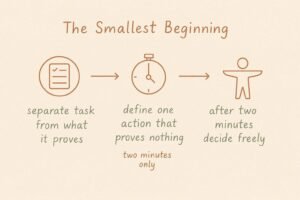
This practice is not about generating motivation before starting. It is about making the beginning small enough that the defensive structure doesn’t engage before the first action is already complete.
STEP 1: Separate the task from what it would prove
Before attempting to begin, identify once what beginning this task feels like it would confirm.
What would starting this today say about me — and what would not finishing it say?
This question is not asked in order to produce an answer. It is asked in order to notice that the obstacle is not the task’s difficulty but the emotional weight attached to its outcome. A small distance opens between the task and the self-evaluation that has been fused to it.
STEP 2: Define one action where failure doesn’t prove anything
Identify the smallest possible action related to the task — one where the outcome carries no evidence about capability.
Just open the file. Write only the title. Read the first paragraph. Two minutes, nothing more.
The standard for this action is not doing it well. It is only that it happened. The quality of the output is not the point. The existence of a beginning is.
STEP 3: After two minutes, decide freely whether to continue
Spend two minutes on the identified action. When the two minutes are up, the decision about whether to continue is completely open.
Two minutes are done. Continuing is fine. Stopping is fine. Either way, the fact of having started today remains.
The freedom to stop is not incidental — it is structural. The goal is not to complete the task. It is to create the fact of a beginning. That fact is what the defense was preventing. Once it exists, the next beginning requires slightly less protection against it.
Session 3: Not Beginning Was Never Laziness. It Was Defense
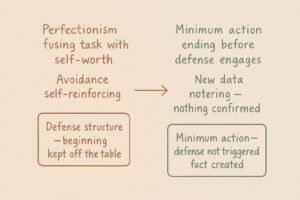
Perfectionism had fused with self-worth — and made beginning unsafe
Psychologists Paul Hewitt and Gordon Flett’s research on perfectionism established a distinction that reframes what procrastination is protecting against. Perfectionism, in its most psychologically costly form, is not the holding of high standards. It is the condition in which failure is experienced as a loss of self-worth rather than as information about a specific outcome. When this fusion is in place, engaging with a task transforms it into an evaluation of the person attempting it. A good outcome preserves self-worth; a poor outcome damages it. Inside this structure, not beginning is the only available option that keeps self-worth off the table — because a task that was never seriously attempted can never produce evidence of inadequacy. The cultural framing of procrastination as laziness adds a second layer: internalizing the moral criticism produces self-directed judgment that increases the aversiveness of the task, which deepens the avoidance, which produces more self-criticism. The loop is self-reinforcing precisely because the framing misidentifies what is happening.
Self-handicapping and automatic avoidance locked the not-beginning in place
Social psychologists Edward Jones and Steven Berglas described self-handicapping as the unconscious strategy of placing obstacles between oneself and a task in advance — not as deliberate excuse-making, but as a protective mechanism that reduces the informational value of failure before it occurs. I haven’t had enough time to prepare. I’m not in the right state today. These are not lies. They are the mind’s way of ensuring that, if the outcome is poor, the self-worth implications remain ambiguous. Psychologist Fuschia Sirois’s temporal self-regulation theory adds the mechanism by which this becomes automatic: when procrastinating, the discomfort of the present moment and the cost to the future self are processed through neurologically separated systems. The calculation that produces I’ll do it later maximizes present-moment relief while underweighting the future cost — not because the future is unknown, but because it is processed at a different register than the immediate feeling. Each repetition of this pattern deepens the automaticity. The task becomes more aversive, the avoidance more automatic, and the gap between intention and action wider.
Behavioral activation bypassed the defense by ending before it engaged
Clinical psychologist Christopher Martell’s work on behavioral activation demonstrated that in the treatment of depression and low motivation, the sequence wait until the feeling is right, then act is reliably ineffective — and that beginning with the smallest available action, independent of mood state, produces changes in affect that the waiting never does. The mechanism is not motivational. It is structural: the minimum action ends before the perfectionism-based defense has time to fully engage. A two-minute action whose outcome carries no self-worth implications does not trigger the evaluation structure — because there is nothing to evaluate. When the action completes, what remains is only the fact of having begun. That fact introduces new data into the system that had been calculating beginning as dangerous: beginning happened, and nothing was confirmed or disconfirmed about me.
Conclusion: The Defense Was Real. The Minimum Action Ends Before It Engages

The fusion of perfectionism and self-worth continues. The self-handicapping mechanism keeps running its protective calculations. The temporal separation that makes present avoidance feel more rational than future cost remains a feature of how the system processes time.
But the one action small enough that failure proves nothing can be identified before any of that engages. That action ends before the defense starts. And the fact that it happened is all that was needed to make the next beginning slightly less defended against.
The task was never the problem. It was the feeling the task arrived with — and the assumption that the feeling had to go first.
KEY TERMS
Perfectionism and Self-Worth Contingency
Paul Hewitt and Gordon Flett’s finding that perfectionism in its most psychologically costly form is not the holding of high standards but the condition in which failure is experienced as a loss of self-worth. When this fusion is active, engaging with a task becomes an evaluation of the self rather than an attempt at a task. Not beginning preserves the possibility that it could have gone well — which is the only option available when the alternative is confirmed inadequacy. The psychological basis for understanding procrastination as defense rather than laziness.
Self-Handicapping
Edward Jones and Steven Berglas’s concept describing the unconscious strategy of placing obstacles between oneself and a task before attempting it — reducing the informational value of any failure in advance. Not deliberate excuse-making but a protective mechanism that keeps self-worth implications ambiguous. Combined with the cultural framing of procrastination as a moral failure, produces a self-reinforcing loop in which self-criticism increases the task’s aversiveness, which deepens avoidance, which produces more self-criticism.
Temporal Self-Regulation and Discomfort Avoidance
Fuschia Sirois’s framework describing how, when procrastinating, present discomfort and future self-cost are processed through neurologically separated systems. The calculation that produces I’ll do it later maximizes present-moment relief while underweighting future cost — not from ignorance of the consequence but because the two are registered at different levels of immediacy. Each repetition of this pattern deepens the automaticity of avoidance and widens the gap between intention and action.
Behavioral Activation
Christopher Martell’s clinical approach demonstrating that the sequence of waiting for the right feeling before acting is reliably ineffective, and that beginning with the smallest available action — independent of mood state — produces changes in affect that waiting does not. The mechanism is structural: the minimum action ends before the perfectionism-based defense fully engages, because a two-minute action with no self-worth implications does not activate the evaluation structure. What remains afterward is only the fact of having begun.
Minimum Intervention and Bypassing Defense
The practical principle underlying the Session 2 practice. An action small enough that failure proves nothing does not trigger the self-worth evaluation that makes beginning feel dangerous. When the action completes before the defense engages, the fact of having begun introduces new data — beginning happened, and nothing was confirmed about me — that gradually updates what beginning means. The repeated accumulation of this data is the mechanism through which the defensive structure loosens over time.