
Introduction: What the Emptiness After Closing the Screen Actually Is

On the commute, between tasks, just before sleep — the hand reaches for the phone without deciding to. Likes accumulate, someone’s post appears, content flows. And then the screen closes, and what remains is not satisfaction but something closer to a deepened hollowness.
I just don’t have enough willpower, the thought arrives. But the inability to stop is not a willpower problem. It is what happens when attention gets caught in a place that was designed not to release it.
Session 1: What Digital Dependence Actually Is

When pulling away from a feed or a notification stream feels genuinely difficult, what is operating is not weakness. It is a design.
Most platforms generate revenue by maximizing the time users spend inside them. This creates a direct financial incentive to make continuing as frictionless as possible and leaving as friction-laden as possible. Pull-to-refresh — the gesture of dragging the screen down to see if something new has arrived — implements intermittent reinforcement: the uncertainty about what might appear is precisely what keeps the gesture repeating. Notifications interrupt attention from outside and draw it back. Infinite scroll removes the endpoint that would naturally prompt a decision to stop.
What makes this more complicated is that this design operates on a genuine motivation. The reach for the phone is powered by a real need — the brain’s requirement for social connection. The sense that something warm might be found in the next update is not irrational. The problem is structural: what is being sought and what that environment is capable of delivering are not the same thing.
The inability to stop is not a personal failing. It is attention staying in a place where it has been looking for something the design was never built to provide.
Session 2: Practice — Reclaiming the Attention
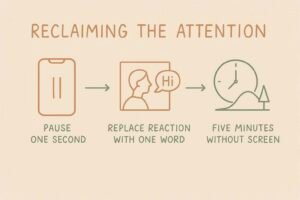
This practice is not about removing digital devices from daily life. It is about noticing when attention is being held by design — and creating the conditions to redirect it intentionally.
STEP 1: Pause for one second before opening
When the hand reaches for the phone, stop for one second before the app opens.
What is being reached for right now?
An answer is not required. The only purpose is to register that the motion was beginning automatically. Creating one second of gap in an automatic gesture is the first intervention into the designed hold.
STEP 2: Replace one reaction with one word
When responding to someone’s post, replace the symbol with a single line of language.
The light in this photograph. That resonates. I’ve been curious about that too — any length, any register.
This is the shift from consuming someone’s post to recognizing it as something a person made. The word is not the point. The recognition is.
STEP 3: Create five screen-free minutes once a day
Somewhere in the day, create five minutes with no screen — not as a productivity exercise but as a condition for attention to return to its own location.
The window. The temperature of the coffee. The movement outside.
When external input stops, attention has somewhere to go that isn’t organized by someone else’s design.
Session 3: The Scroll Was Never Designed to End — and the Connection Could Never Carry What the Nervous System Was Waiting For
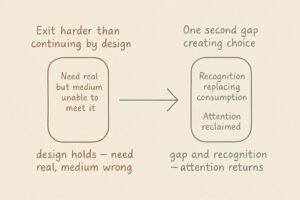
The inability to stop was a design problem, not a willpower problem
Technology ethicist Tristan Harris and persuasive technology researcher BJ Fogg independently documented the systematic way contemporary digital platforms apply human behavioral and cognitive patterns to maximize engagement. The friction architecture is asymmetric by design: entry is a single tap, continuation is automatic, and the feed has no natural endpoint. Exit, by contrast, requires active decision in the presence of unread counts, the possibility of having missed something, and the social cost of leaving a conversation incomplete. This asymmetry is not accidental. It is the direct expression of a business model that generates revenue from time spent inside the platform. Cultural critic Jenny Odell framed the implication precisely: within this structure, choosing not to engage — choosing to reclaim where attention goes — is not passive withdrawal. It is a refusal to donate attention to a system built to extract it. The inability to stop was never about insufficient self-discipline. It was about operating inside a friction architecture specifically engineered to make stopping harder than continuing.
Digital connection could not carry what the nervous system was actually looking for
Social neuroscientist Hans IJzerman’s research on social thermoregulation demonstrated that the human social bonding system is neurologically integrated with thermoregulation: physical proximity to others, bodily warmth, and the non-verbal channels of facial expression, vocal tone, and touch are directly involved in generating the sense of social safety in the brain. These channels cannot be transmitted through a screen. Digital connection can convey information, signal presence, and coordinate activity. What it structurally cannot carry is the non-verbal, embodied, synchronous input through which the nervous system produces the felt experience of being with another person. This is the neurological description of the paradox of being connected and lonely simultaneously. The reach for the phone is motivated by something the brain genuinely needs. The design captures that motivation and offers something in response — but what it offers and what the nervous system is waiting for are different things. The hollowness after closing the screen is not a sign of excessive use. It is the accurate signal of a need that the medium was constitutionally unable to meet.
Conclusion: The Design Was Holding the Attention. Noticing Was the First Move Back

The friction asymmetry that makes staying easier than leaving continues to be built into every update. The neurological gap between digital connection and what the social nervous system requires does not close. The scroll will keep running without a designed endpoint.
But the one-second pause before opening — the moment of asking what the reach is actually for — is available at any point the hand moves automatically. That pause is where the attention’s direction becomes a choice. And the choice is where something different becomes possible.
The scroll was never designed to end. Noticing that was the first act of reclaiming the attention it had been built to hold.
KEY TERMS
Exploitative Attention Design and Friction Asymmetry
Tristan Harris and BJ Fogg’s documentation of how digital platforms systematically minimize the friction of continued engagement while maximizing the friction of exit — through automatic continuation, infinite scroll, notification systems, and unread counts. The structural basis for understanding the inability to stop as a design outcome rather than a personal failing. The asymmetry is the direct expression of a business model that generates revenue from time inside the platform.
Social Thermoregulation
Hans IJzerman’s social neuroscience research establishing that the human social bonding system is neurologically integrated with thermoregulation — that physical proximity, bodily warmth, and the non-verbal channels of facial expression, vocal tone, and touch are directly involved in generating social safety in the brain. The neurological basis for understanding why digital connection, which structurally cannot transmit these channels, leaves the social nervous system unsatisfied regardless of how many interactions occur.
Neurological Limits of Digital Connection
The structural gap between what digital connection can deliver — information, presence signals, coordination — and what the social nervous system requires to generate the felt experience of being with another person: embodied, synchronous, non-verbal input. The hollowness after screen use is the accurate signal of this gap, not evidence of excessive consumption. Applies IJzerman’s social thermoregulation framework to explain the paradox of simultaneous connection and loneliness.
Sovereignty of Attention
Jenny Odell’s concept that within a system designed to extract attention as a commodity, choosing not to engage — choosing where attention goes — functions as an intentional withdrawal from the extractive structure rather than passive disengagement. Reframes the one-second pause before opening an app as an act of reclaiming the direction of attention rather than a habit management technique. The cultural criticism basis for understanding attention redirection as a structural response.
Designed Friction and Exit Difficulty
BJ Fogg’s persuasive technology framework applied to the specific architecture of digital platforms: the deliberate reduction of friction on the entry and continuation side, and the deliberate increase of friction on the exit side. Unread notification counts, the possibility of missed content, and the social cost of leaving mid-conversation all function as designed barriers to exit. The mechanism through which platform design produces the experience of being unable to stop without that experience reflecting anything about the user’s capacity for self-regulation.