
Introduction: The Loneliness in the Crowd Is Not a Problem With Anonymity

Rush hour, and everyone is looking at a screen. In a café, someone is sitting two feet away and no words pass between you. The larger the city, the more people surround you, and the more completely anonymous you can feel inside it. The sharpness of not being recognized by anyone can be most acute precisely when the most people are present.
Before concluding that anonymity is the cause of this feeling, one thing is worth examining. Anonymity itself is not what produces urban loneliness. What produces it is the quiet dissolution of the social skills required to make contact within anonymity — and the structural conditions that accelerated that dissolution.
Session 1: What Urban Anonymity Actually Is

When loneliness is most acute in the middle of a crowd, what is operating is not a problem with anonymity. It is a problem with the conditions that have made anonymity’s value inaccessible.
Urban anonymity was, in its original form, a kind of liberation. In a village or close-knit community, a person exists inside a dense web of known history, inherited roles, and ongoing social monitoring. The city offered something different: the possibility of stepping into public space without a fixed identity preceding you. No one knows who your family is, what you failed at last year, what role you are expected to occupy. The anonymity of the city was, and in principle still is, the condition under which a person can simply be present — without assignment.
What has changed is not anonymity itself but the social technology that once made it possible to move through anonymity without complete disconnection. The skills of civil public engagement — the brief nod of recognition, the small acknowledgment that another person is present, the minimal gesture that says I see you as a person — have been used less and less. This is not a problem of introversion. It is the result of a social technique that has been gradually disused, under conditions that made disuse rational.
Anonymity did not produce urban loneliness. The erosion of the technique for engaging civilly within anonymity is what made anonymity feel like isolation.
Session 2: Practice — Returning One Small Act of Public Engagement

This practice is not about starting conversations with strangers or overcoming shyness. It is about restoring the minimum unit of civil public engagement — one small signal at a time — in the ordinary spaces of daily movement.
STEP 1: Notice who the familiar strangers are
In the regular rhythms of daily life, identify the people who appear repeatedly but have never been spoken to.
The person always at the same bus stop at the same time. The staff member at the convenience store every morning. The person who walks the same park route.
Simply registering their existence is sufficient. They occupy a specific social position — not anonymous, not known — and that position has a name and a function that is worth recognizing.
STEP 2: Send one small signal of civility
At the next encounter with a familiar stranger, send one minimal signal of acknowledgment.
A slight nod. A brief eye contact followed by a small expression of recognition. A single word of thanks to someone whose work is usually invisible.
It does not need to be a word. The purpose is to transmit the signal: your presence here has been noticed. Not an invitation to conversation. Not a demand for response. A small restoration of the acknowledgment that public space once carried as a matter of course.
STEP 3: Notice one moment of shared situation
In public space, find one moment when the surrounding people are sharing the same situation.
Rain suddenly intensifying and everyone pausing under the same overhang. A train delay and a platform full of people waiting for the same announcement. A dog doing something absurd in a park and the people nearby all responding at once.
No language is required. Simply registering the feeling — there is a temporary ‘we’ here right now — is sufficient. The shared situation produces a momentary common ground that does not require introduction or continuity.
Session 3: Anonymity Was Never the Problem. The Dissolution of Civility Was
Urban anonymity had been a condition for liberation, not isolation
Sociologist Georg Simmel’s essay on the metropolis and mental life argued that the anonymity of the city was not a deficit in the social environment but a structural feature that enabled a new kind of individual freedom — a public space in which presence was possible without fixed identity, where no history preceded you and no single community held ongoing claim to your behavior. Richard Sennett’s analysis of the fall of public man traced how urban public space had once supported a form of civil engagement among strangers — a repertoire of behaviors that allowed people to be present with each other in public without demanding the intimacy of private relationship. This public civility was the social technology that gave anonymity its livable form: not the absence of relation, but the presence of a light and non-binding acknowledgment that the people around you were people.
The dissolution of public civility had raised the cost of engagement structurally
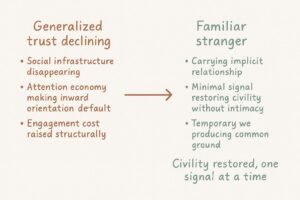
Sociologist Robert Putnam’s documentation of the decline of social capital and Eric Klinenberg’s research on social infrastructure describe, from different angles, the structural erosion of conditions that once supported civic public engagement. As Putnam demonstrated, the weakening of local associational life produces a decline in generalized trust — the background assumption that the strangers around you are not threats. As Klinenberg showed, the disappearance of places where people can simply be present without consuming — libraries, parks, community spaces, the kinds of infrastructure that generate incidental contact — removes the occasions on which civil public engagement naturally occurs. Smartphones added a further layer: a powerful device for turning attention inward, available in every moment of potential contact with a stranger. The reluctance to acknowledge a stranger in a public space is not an expression of individual introversion. It is the accumulated effect of declining trust, reduced social infrastructure, and an attention economy that has made inward orientation the default. The cost of engagement rose structurally, without any individual deciding that it should.
The familiar stranger was where the minimum unit of civility could be restored
Social psychologist Stanley Milgram’s concept of the familiar stranger described a specific social position that is peculiar to urban life: the person seen regularly in the same context — the same commute, the same street, the same café — who has never been spoken to. This person is not anonymous in the full sense and not known in any social sense. They occupy a third position that carries its own implicit relationship: a mutual recognition of repeated co-presence, without the commitment of introduction. Milgram observed that familiar strangers are often the first people sought out in moments of shared crisis or disruption — proof that the relationship, though wordless, contains a social reality.
Conclusion: The Anonymity Was the Freedom. The Erosion of Civility Was What Made It Feel Like Loss

The decline in generalized trust continues. Social infrastructure remains underinvested. Smartphones keep attention turned inward by default. The structural cost of public engagement does not reduce on its own.
But the small nod to the familiar stranger — the one brief signal of acknowledgment that costs almost nothing — is available as a choice in any ordinary morning. That choice is the local reduction of a cost that no individual raised. And the local reduction is where the value of anonymity becomes accessible again.
The anonymity was never the absence of connection. It was the condition under which connection could be chosen rather than assigned.
KEY TERMS
Urban Anonymity and Role Liberation
Georg Simmel’s concept that urban anonymity functions as a structural condition enabling individual freedom from the inherited role structures of close-knit communities — not a deficit in social life but a form of liberation from fixed identity. Combined with Sennett’s analysis of public civility, anonymity is understood not as the absence of relation but as the condition under which connection becomes chosen rather than assigned. The basis for understanding urban anonymity as something whose value can be recovered rather than mourned.
Dissolution of Public Civility
Richard Sennett’s analysis of the decline of the behavioral repertoire that once allowed strangers to be present with each other in urban public space — acknowledging co-presence without demanding intimacy. Its dissolution is what converts anonymity from liberation into isolation: not because anonymity changed, but because the social technology for moving through it civilly stopped being practiced. The structural background for understanding urban loneliness as a civility problem rather than an anonymity problem.
Decline of Social Capital and Social Infrastructure
Robert Putnam’s documentation of how weakening local associational life reduces generalized trust in strangers, and Eric Klinenberg’s research showing how the disappearance of non-transactional public spaces removes the occasions for incidental civil engagement. Together they describe the structural rise in the cost of public engagement — a rise that is collective and environmental rather than personal, and that explains the withdrawal from public contact as rational adaptation rather than individual failing.
Familiar Stranger
Stanley Milgram’s social psychology concept describing the person seen repeatedly in the same context who has never been spoken to — occupying a social position between full anonymity and acquaintance. The familiar stranger carries an implicit relationship of mutual recognition that, though wordless, constitutes a real social fact. Identified here as the minimum available unit for restoring civil public engagement: the nod, the brief recognition, the single acknowledgment that requires no introduction and demands no continuity.
Local Recovery of Public Engagement
The practical principle that the structurally elevated cost of public engagement can be locally reduced through the minimum unit of civil acknowledgment — directed toward familiar strangers in ordinary daily contexts. Not the restoration of community or the reversal of social capital decline, but the locally available act of returning one small signal to a public space from which civil engagement has been gradually withdrawn. The individual-level response to a structural condition, available in any ordinary morning.