
Introduction: You Came Home — But It Doesn’t Feel Like Home
After years abroad, you finally return to the country that is supposed to be yours. And yet everything feels slightly off. The noise of the city grates on you. Social rules you’ve known your whole life suddenly feel constraining. Conversations with friends and family leave you with the sense that your experience is simply not understood — and a quiet, persistent loneliness settles in.
This is reverse culture shock. The deep disorientation that comes from a double gap: you have changed, and home has changed too.
This guide doesn’t treat that disorientation as failure or loss. It introduces a practice for observing it clearly — and using it as an entry point toward a deeper, more expansive understanding of yourself. The place where you feel most lost is often the place where something new begins.
Session 1: Caught Between Two Worlds
Before you’ve even unpacked, the comparisons start. More efficient there. More open there. The queue moves differently here. The waiter’s silence reads as cold. You notice yourself collecting evidence — building a case, without quite meaning to, for why this place no longer fits.
That instinct isn’t a character flaw. It’s a residue of adaptation — the same perceptual sharpness that helped you survive abroad, now turned on home. The problem is that it keeps you processing what’s in front of you as data rather than letting you actually be here.
Underneath the comparisons, something else is running. A frozen image of home — built quietly, over years of being away — is meeting the living reality of a place that kept moving without you. Memory doesn’t store things neutrally. It idealizes. It smooths. And the gap between the home you carried in your mind and the home you’ve returned to can feel, at first, like loss.
Then comes the pressure that compounds everything: I’m back now, so I should fit in the way I used to. The attempt to force a fluid, layered self back into a single fixed frame — to perform a version of yourself that no longer quite exists — generates a strain that’s hard to name, because from the outside, you’re just home.
What all of it shares is a fusion with a belief that feels like reality: home should be a certain way; I should be able to slot back in. When that belief runs unchallenged, the richness and complexity of the present disappears behind the gap.
Session 2: Practice — 3 Steps for Turning Discomfort into Navigation
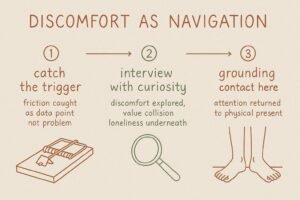
This practice is not about eliminating discomfort. It is about learning to read it — picking up what it is pointing to, and letting it guide you back to the present.
STEP 1: Catch the trigger
In the street, at work, at home — when a moment of friction arises, catch it without judgment. The conversation at the register that felt unnecessarily roundabout. The colleague’s vague response that left you irritated. In that moment, quietly note:
“A data point just registered — cultural friction.”
The shift from “problem” to “observation” is the first move.
STEP 2: Interview with curiosity — explore the layers
Turn toward the discomfort with curiosity rather than judgment. Ask:
“Is this sensation colliding with a value I absorbed abroad?”
“Am I comparing this to a memory of home that no longer exists?”
“Underneath this irritation — is there a loneliness that wants to be understood?”
This turns surface-level friction into a conversation between the different cultural frameworks you are now carrying simultaneously.
STEP 3: Grounding — find small points of contact here
When thought pulls toward comparison or abstraction, bring attention back to the physical present.
Feel the temperature of the passing air. The texture and weight of the cup in your hand. The sensation of your feet meeting the ground.
Then look for small, genuine points of contact with where you are.
“The green of this park settles something in me.”
“That item at the convenience store — I’d forgotten I missed it.”
Not grand declarations of belonging. Small, moment-by-moment contact. A sense of being grounded in presence rather than in abstract identity.
Session 3: Why Coming Home Is Harder Than Arriving
Memory rewrites while you’re away
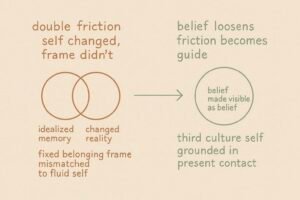
The disorientation of returning often begins with a strong attachment to a fixed image of what home should be — and that image was never quite accurate to begin with. Memory is not a stable recording. It is a reconstruction, quietly colored by distance and longing. While you were abroad, your memories of home were idealizing, freezing into the shape of nostalgia. The moment you return, that frozen image meets a living, changed reality. When you are fully fused with the belief that *home should be a certain way*, every detail of the present gets processed as evidence that something has gone wrong. Making that belief visible as a belief — rather than letting it run as invisible reality — is where the disorientation begins to loosen.
The double friction nobody warns you about
Anthropologists have consistently noted a counterintuitive finding: re-adapting to a familiar environment carries a higher cognitive cost than adapting to an unfamiliar one.
New adaptation comes with a clear task — learn. Re-adaptation comes with something harder.
I should already know this. And yet it isn’t working.
The brain processes updating existing circuits as more demanding than building new ones. The inexplicable tiredness you feel in a place that should feel easy — that’s the cost of that update, surfacing in consciousness.
The self that no longer fits the frame
Sociologists describe people in this position as third culture individuals — those who belong fully to neither their home culture nor their host culture, having internalized both into something that can’t be reduced to either. The estrangement felt after returning isn’t a personal failure of adaptation. It is a structural misalignment between a fluid self and a social framework that still assumes fixed belonging.
In Buddhist terms, both home and self are in continuous change. It is the resistance to that impermanence — Anicca — that generates suffering.
The old map did not fail. The terrain was always moving.
Conclusion
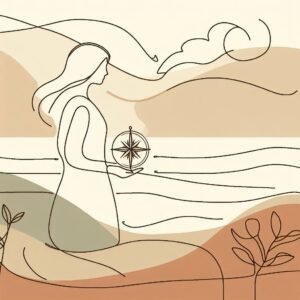
Reverse culture shock is an honest signal: the old map is asking to be updated. The instinct is to draw a new one as quickly as possible — to find a clear definition of who you are now, and where you belong. That effort tends to exhaust before it resolves.
What develops instead, through practice, is navigation — the capacity to observe a changing landscape without needing it to stay still.
The map was never going to survive the return. What returns with you is the capacity to keep reading the terrain.
KEY TERMS
Reverse Culture Shock
The disorientation and estrangement experienced upon returning to one’s home country after an extended period abroad. Produced by a double gap: the self has changed, and so has home. Not a failure of adaptation — the structural friction between a self that has grown and an environment that has moved on independently.
Third Culture Individual
A person who has internalized both their home culture and their host culture without belonging fully to either — developing a distinct perspective that can’t be reduced to either original. The estrangement felt after returning home is not personal failure. It is the misalignment between a fluid identity and a social world that still assumes you’ll slot back in.
Re-socialization
The process of re-adapting to a society one previously belonged to. Carries a higher cognitive cost than adapting to something entirely new, because existing mental frameworks must be updated rather than built from scratch. The source of that specific, hard-to-explain fatigue — the feeling of working hard in a place that should require no effort at all.
Grounding
The practice of returning attention to present physical sensation when thought pulls toward comparison or abstraction. Noticing the feel of the ground underfoot, the texture of what the hands hold, the temperature of the air. Builds a sense of security rooted in concrete presence rather than in abstract belonging.
Anicca
Pāli for impermanence — the recognition that all things, including home and self, are in continuous change. Resistance to this reality generates suffering. Reverse culture shock is a direct encounter with Anicca: an invitation to loosen attachment to a fixed image of home, and to a fixed image of who one used to be.