
Introduction: Most of Life Happens While We’re Not There for It

Office door. Front entrance. Meeting room. We pass through dozens of doorways every day — and almost none of them register.
The body moves through. The mind stays behind, still running the previous room’s content, already composing the next task.
The crossing is already happening. The only question is whether anyone is home for it.
Session 1: Why Doorways? Because the Brain Already Uses Them
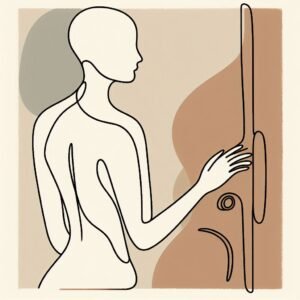
The brain does not experience time as a continuous flow. It segments experience into discrete units — events — and processes them accordingly. Physical boundaries like doorways naturally mark the edges of these events. When one is crossed, the brain updates its event model, which involves clearing or deprioritizing the mental context of the previous event.
This is why walking into a room and forgetting why you came is universal. It is not distraction or aging. It is the brain doing precisely what it is designed to do: filing the previous context and making space for what comes next.
The crossing happens either way — automatically, on autopilot. The difference is what the crossing becomes. Without awareness, the doorway effect means arriving in the new room already absent from it. With awareness, the same neurological mechanism becomes an intentional transition — the brain’s automatic reset, consciously used.
Session 2: How to Actually Cross a Doorway
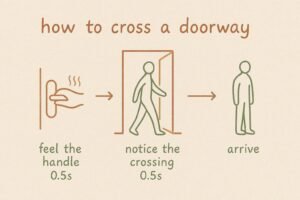
STEP 1: Feel the handle (0.5 seconds)
When the hand reaches the door handle, notice it. The temperature — cool metal, warm plastic, the worn smoothness of a surface touched hundreds of times. The texture. The slight resistance as it turns.
Just this: hand on handle, right now.
This step tends to feel almost insultingly small. That is the point. The practice is not asking for effort. It is asking for half a second of actual contact with what is already in the hand.
STEP 2: Notice the crossing (0.5 seconds)
As the body moves through the doorway, notice that it is moving through it. The shift in air temperature or light quality. The acoustic change between spaces. The sense — however faint — of leaving one place and entering another.
Crossing now. No evaluation required. Just recognition.
STEP 3: Arrive
Once through, let the new space be the new space — not a continuation of the previous one. If something is still running from before, notice it without following it.
That thought arrived with me. I’m in a different room now.
The noticing is enough. Complete release is not required.
Session 3: The Doorway Was Already a Reset
Gabriel Radvansky and colleagues at Notre Dame demonstrated the doorway effect across a series of experiments published in Memory & Cognition (2006) and the Quarterly Journal of Experimental Psychology (2011), conducted in both virtual and real environments. Participants consistently forgot more after crossing a doorway than after traveling the same distance within a single room. Notably, returning to the original room did not restore the lost memory — confirming that the effect is not simply environmental context, but reflects the brain’s event segmentation mechanism operating at the boundary. Radvansky described it this way: entering or exiting through a doorway functions as an event boundary in the mind, separating episodes of activity and filing them away.
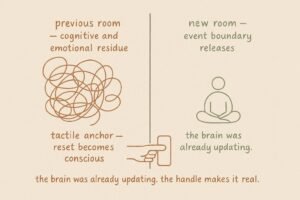
What the reset releases is not only cognitive content — plans, intentions, tasks. Working memory holds emotional residue as well: the tension from a difficult conversation, the low-grade friction of an unresolved exchange, the mental posture of the room just left. Event boundaries clear this too. The experience of stepping out of a difficult meeting and feeling something lighten before the next room has been consciously processed is not imagination. It is the brain’s event segmentation already running its release operation. On autopilot, this release is invisible and incomplete — the crossing happens, something is released, but the person is not present for any of it. With awareness at the threshold, the same process becomes something that can be felt and used.
The tactile attention of Step 1 — hand on handle — is the specific operation that transforms automatic reset into deliberate arrival. Sensory attention activates the circuits responsible for processing current physical contact and body position, redirecting cognitive resources toward present-moment reality at exactly the moment the brain is already processing an event boundary. The brain was running the update. The awareness of the handle gives it a physical anchor — this moment, this hand, this threshold — that completes the transition rather than letting it pass unregistered. What was a feature of cognitive architecture becomes, with one deliberate half-second, a daily practice.
Conclusion

This practice does not require a changed morning or a quieter life. It requires half a second of contact with something the hand is already touching, and another half second of noticing that the body has moved from one place to another.
The brain was already running the reset. Awareness was the only thing that turned it into an arrival.
KEY TERMS
Doorway Effect
The empirically documented tendency for crossing a physical boundary to increase forgetting compared to traveling the same distance within a single room. Established by Gabriel Radvansky and colleagues across multiple experiments in virtual and real environments. Reflects the brain’s event segmentation process rather than ordinary forgetting: when a doorway is crossed, the mental context of the previous event is cleared from working memory.
Event Boundary
The moment the brain marks as the transition point between one event and the next. Physical thresholds — particularly doorways — reliably trigger event boundaries. At an event boundary, working memory undergoes a partial reset: contents associated with the previous event, both cognitive and emotional, are deprioritized to make space for the new context.
Event Segmentation
The brain’s ongoing process of parsing continuous experience into discrete event units. Not a conscious decision but an automatic perceptual and cognitive operation. Radvansky’s doorway research demonstrated one of its most reliably observable behavioral consequences: the location-updating effect in which memory declines when an event boundary is crossed.
Working Memory
The cognitive system that temporarily holds and manipulates information in active use. Working memory is event-contextualized — what it holds at any moment is shaped by the event currently active. At an event boundary, working memory releases its previous-event contents: both the plans and intentions that were being held, and the emotional residue of what was just experienced.