
Introduction: Something Is Already Underway Before the Meeting Begins

Before the meeting starts — walking down the corridor, taking a seat — something is already in motion.
The residue of the previous meeting. Irritation at an unresolved email. The memory of how last time went with this particular group of people. Carrying all of that into the room means the attention filter is already set before the first word is spoken.
This practice is one minute of deliberately resetting that filter. Not trying to change the room. Just settling the internal state, slightly. The same meeting looks different from there.
Session 1: What You Bring In Is Already Shaping What Happens

When people consider what determines the quality of a meeting, the usual candidates are preparation, the clarity of the agenda, the skills of the participants. What tends to go unexamined is the cognitive state each person carries into the room.
The fatigue from the previous meeting. The memory of how a conflict with someone here was left unresolved. A low-level wariness about how this group tends to operate. These are already setting the filters through which other people’s contributions will be received — before the first agenda item is announced. Whether the same remark lands as a constructive suggestion or an implicit criticism depends substantially on the state of the person receiving it. And that state is already present in the room — transmitted through posture, expression, and vocal tone before anyone has spoken.
This is not a question of emotional self-management in the conventional sense. It is a question of sequence: cognitive state shapes the filter, the filter shapes the interaction, the interaction shapes what the meeting becomes. The minute before the meeting is the point in that sequence where intentional adjustment is still possible.
Session 2: The Minute Before
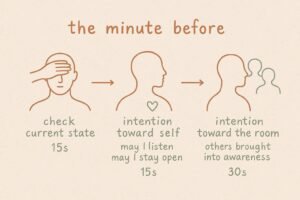
STEP 1: Check the current state (15 seconds)
Before entering the room, or just after sitting down.
Notice whether there is tension somewhere in the body, and what is being brought into this meeting today. Confirm without evaluating.
STEP 2: Direct intention toward yourself (15 seconds)
This part can feel slightly unfamiliar at first — directing intention inward, in the middle of a workday. That’s normal. The words are minimal on purpose.
Quietly, in the mind:
May I be able to listen.
May I stay open.
Words are optional. The direction of the intention is what matters.
STEP 3: Direct intention toward the people in the room (30 seconds)
Bring the other people into awareness — one by one, or as a group.
May each person here be heard.
May this time be worth something.
Minimal words. The practice is in the direction of the intention, not the precision of the phrasing.
Session 3: Priming, Hostile Attribution, and the State That Is Already in the Room
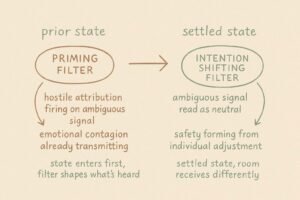
Priming is one of cognitive psychology’s most consistently replicated findings: a prior mental state shapes how subsequent information is processed. Exposure to a concept, an emotional state, or a frame of reference alters the filters through which the next experience is received. The state carried into a meeting room — irritation, wariness, or quiet attention — is already determining how other people’s contributions will be received before anyone has spoken. John Bargh and colleagues demonstrated that this priming operates below the threshold of conscious awareness, shaping judgment and behavior through processes that precede deliberate thought. Intentional settling before a meeting is an intervention at this level — not a performance of calm, but an adjustment to what the subsequent hour will be filtered through.
That filter has its most direct effect on how other people’s words are read. Social psychology has documented hostile attribution bias — the tendency to interpret ambiguous behavior as hostile — across a wide range of contexts. In meetings, the ambiguous material is abundant: a question that could be a genuine inquiry or a challenge, a silence that could be consideration or resistance, pushback that could be engagement or antagonism. Which reading is activated depends substantially on the cognitive state of the person receiving it. Kenneth Dodge, who identified the mechanism in research on children’s aggressive behavior, showed that the same ambiguous action produces different interpretations depending on prior activation. A state of wariness makes hostile readings more available. A state of open attention makes neutral or collaborative readings more available. The filter set before the meeting shapes what becomes visible during it.
What priming and attribution make clear about internal state, emotional contagion extends into the room itself. Psychologist Elaine Hatfield’s research, collected in Emotional Contagion (1994), documented the process by which emotional states transfer between people through nonverbal channels — facial expression, posture, vocal tone, breathing rhythm — via automatic mimicry and physiological entrainment. This transfer is not intentional communication. It is a continuous, background process that does not wait for speech to begin. The emotional state brought into the meeting room is already present in the room — in posture as people settle, in the quality of attention before the agenda item is announced. A shift in internal state before the meeting starts is already exerting influence before anyone has said anything.
Organizational psychologist Amy Edmondson’s research on psychological safety adds a structural layer to what emotional contagion describes at the individual level. A consistent finding in Edmondson’s work — developed across studies of medical teams, corporate groups, and educational settings, and collected in The Fearless Organization (2018) — is that psychological safety is not a condition installed by leadership alone. It is formed bidirectionally, through the cumulative effect of each member’s cognitive state and behavior on the collective environment. One person’s non-defensive presence, one person’s willingness to read ambiguous contributions as neutral rather than hostile — these individual adjustments shift the terrain of the group. The minute of intention before the meeting is not a leadership practice. It is a personal cognitive adjustment whose effects, carried through emotional contagion, are already entering the shared space.
Conclusion: The Meeting Had Not Yet Started

Before the first word was spoken, the attention filter was already set. The emotional state was already in the room.
The minute before the meeting is the time to reset that deliberately. Not to change the room — just to adjust the state slightly.
The room was already reading you. The minute before is when you could still do something about that.
KEY TERMS
Priming
The cognitive psychology finding that a prior mental state shapes how subsequent information is processed — altering the filters through which perception, judgment, and behavior operate. The emotional state carried into a meeting is already determining how contributions will be received before anyone has spoken. John Bargh and colleagues demonstrated that this priming operates below the threshold of conscious awareness, preceding deliberate thought.
Hostile Attribution Bias
The tendency to interpret ambiguous behavior as hostile. Identified by Kenneth Dodge in research on children’s aggressive behavior and consistently observed in adult professional contexts. The same ambiguous contribution — a question, a silence, a challenge — produces different interpretations depending on the receiver’s prior cognitive state. The filter set before the meeting shapes what becomes visible during it.
Emotional Contagion
Elaine Hatfield’s term for the automatic transfer of emotional states between people via nonverbal channels — facial expression, posture, vocal tone, breathing rhythm — through mimicry and physiological entrainment. The process does not wait for speech to begin. Documented in Emotional Contagion (1994). The state carried into the room is already present in the room before the meeting starts.
Psychological Safety
Amy Edmondson’s concept, developed across studies of teams in medical, corporate, and educational settings and collected in The Fearless Organization (2018). A consistent finding is that psychological safety is not installed by leadership alone — it is formed bidirectionally through each member’s cognitive state and behavior. One person’s non-defensive presence shifts the collective terrain. Edmondson’s ongoing research at Harvard Business School continues to examine how the quality of interpersonal risk shapes what becomes possible in any group.