
Introduction: The Story That Was Already Running

Somewhere between waking up and getting out of bed, the verdict had already been delivered. I always fail. I’m not the kind of person people warm to. I should be holding things together better than this. These are not thoughts that get chosen. They are already running by the time they are noticed.
This story is not an accurate description of who you are. It is a prediction the brain is generating from old data — and it has not yet consulted today.
Session 1: What the Self-Story Actually Is

The self-criticism and rumination that loop through the mind are not signs of weakness or excessive sensitivity. They are the output of a process the brain runs continuously: generating an answer to the question of who, exactly, this person is.
There is a neural network that becomes most active during unstructured time — the commute, the shower, the space before sleep. Its function is to integrate past memory, social feedback, and future projection into a coherent ongoing account of the self. This is a system that evolved for social survival: learning from past experience, maintaining a working model of relationships, preparing for what comes next. The automatic processing is not a malfunction.
The problem emerges under sustained stress, when this same system begins converting specific events into fixed attributes. I failed at that becomes I always fail. That person didn’t respond warmly becomes I’m not someone people like. The story stops updating. It loops instead — running the same prediction from the same data, treating the past as a reliable report on the present.
The story is painful not because it is true. It is painful because it keeps running without being given anything new.
Session 2: Practice — Creating Distance Between the Story and the Self
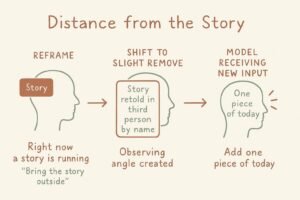
This practice is not about eliminating the self-story. It is about creating a small gap — when the story is running — between the narrative and the person observing it.
STEP 1: Bring the story outside
Write down whatever is looping in the mind. I always — I’m the kind of person who — it will probably go wrong because. The exact words, as they actually appear.
Then add one line at the beginning and read it again:
Right now, there is a story running in me that says —
That single reframe creates the first gap. What was absolute fact becomes an event currently happening in the mind. The distance between those two things is where something changes.
STEP 2: Shift to a slight remove
Take the written story and retell it from a small distance — using your own name, in the third person.
Name is carrying a story right now that says — . When did that story begin? What was happening then?
Referring to oneself by name rather than I reduces the emotional intensity of the experience and creates an angle from which the story can be observed rather than inhabited. The content doesn’t change. The relationship to it does.
STEP 3: Add one piece of today
From that slightly removed position, look for one thing the story is leaving out — something from today that its data doesn’t include.
The story says I always fail. What happened today, even something small, that the story isn’t accounting for?
There is no need to argue with the story or replace it. The only move is to introduce one piece of current information into a model that has been running without it. That is enough for the update to begin.
Session 3: “This Is Who I Am” Was a Prediction Running on Old Data
The self-image was assembled from the outside in
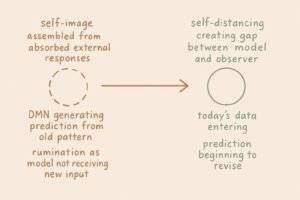
Sociologist Erving Goffman’s concept of impression management reframes where self-image comes from. The sense of this is who I am does not arise organically from the inside. It is assembled from the outside in — through the accumulated experience of performing a self in front of others and absorbing their responses. Workplace evaluations, parental expectations, the texture of social feedback over years: these external gazes, repeated and internalized, eventually sediment into what feels like personal certainty. The story I’m not someone people warm to is not a description generated from the inside. It is a record of absorbed external responses — none of which include today’s context, today’s relationships, or today’s person.
The DMN was running a prediction model on old data
Neuroscientist Marcus Raichle’s research on the default mode network revealed that the brain’s most active processing during unstructured time is self-referential — integrating past experience and social information into an ongoing predictive model of the self. In Karl Friston’s predictive processing framework, the DMN is maintaining and updating a self-model: a working prediction of who this person is and what is likely to happen to them. Rumination is what this model looks like when it stops updating. The thought I always fail is not a conclusion drawn from today’s evidence. It is a prediction the model keeps generating from a pattern it learned earlier — and that pattern keeps being confirmed because the model is not receiving new input. The story feels true not because it reflects the present but because it is the current output of a system that has not been given reason to revise.
Self-distancing was introducing today’s data into the model
Psychologist Ethan Kross’s research on self-distancing demonstrated that a simple shift in perspective — referring to oneself by name rather than I, adopting a slight observational remove — reduces emotional intensity and interrupts the loop of self-critical rumination. In predictive processing terms, this gap between the observer and the model is where current data can re-enter. The story does not need to be argued with or replaced. What the self-distancing creates is a moment in which the model and the present observation of it are no longer completely fused — and in that moment, today’s experience has somewhere to go.
Conclusion: The Story Was Running. Today Hadn’t Been Included Yet
The DMN continues its self-referential processing today, as it will tomorrow. The internalized accumulation that shaped the story stays quietly present inside it. The rumination loop keeps running.
But the moment of noticing there is a story running right now can be brought into any point where the loop begins. That noticing is the first gap — the place where today gets to enter a model that has been working without it.
The story was never a portrait. It was a prediction — assembled from old data, running on a loop the present hadn’t been allowed to interrupt.
KEY TERMS
Default Mode Network (DMN)
Marcus Raichle’s term for the neural network most active during unstructured time — rest, mind-wandering, the commute, the space before sleep. Its primary function is self-referential: integrating past memory, social feedback, and future projection into an ongoing account of who this person is. Under sustained stress, the DMN can stop updating this account and begin looping instead — generating the same self-prediction from the same old data.
Predictive Self-Model
In Karl Friston’s predictive processing framework, the brain maintains a working model of the self — a continuously updated prediction of who this person is and what is likely to happen to them. Rumination is what this model produces when it stops being updated by new input. The story I always fail is not a conclusion. It is the current output of a system that has not been given reason to revise.
Impression Management / Internalized Other-Regard
Erving Goffman’s concept describing how the self is performed in front of others — and how the accumulated responses to those performances eventually sediment into what feels like personal certainty. The self-story is not generated from the inside. It is assembled from absorbed external responses, repeated and internalized over years, none of which necessarily include today’s person.
Self-Distancing
Ethan Kross’s research demonstrating that referring to oneself by name rather than I — adopting a slight observational remove from the self — reduces emotional intensity and interrupts self-critical rumination. In predictive processing terms, the gap created by self-distancing is where current data can re-enter a model that has been running without it. The story doesn’t need to be replaced. It only needs to be held at enough distance for today to get in.
Psychological Flexibility
From Steven Hayes’s ACT framework: the capacity to hold thoughts and self-narratives as observable events rather than as facts, and to act in accordance with current values rather than old predictions. Applied to self-story, psychological flexibility is not the absence of self-criticism. It is the ability to notice the story running and introduce something today didn’t yet contain.