
Introduction: What Comes After “I Shouldn’t Feel This Way”

Anxiety arrives, and immediately: I can’t afford to be anxious. Anger surfaces, and: I should be handling this better. Sadness settles in, and: I need to stop dwelling on this.
Every feeling brings its own criticism with it. The feeling itself is one weight. The judgment about having it is another. The second one is often heavier than the first.
This exhaustion is not the result of feelings that are too strong. It is the result of continuously issuing an instruction — from the inside — that the feeling should not be there.
Session 1: What the Feeling Actually Is

When negative emotion arrives and self-criticism follows immediately, the problem is not the emotion. It is the stance toward it.
Sadness, anger, anxiety — these are part of a signal system that has been functioning across a long evolutionary history. Sadness responds to loss. Anger responds to violation. Anxiety prepares for what hasn’t happened yet. When these feelings arrive, the brain is processing information about something that matters. The content of the feeling points toward what the person actually values.
The problem is what the feeling is asked to be. When the premise is that positive states are correct and negative states are failures, the arrival of a difficult feeling triggers a second layer of response before the first has been attended to. The feeling is there, and then the criticism of having the feeling is there, and the second thing consumes more energy than the first.
Attempting to suppress a feeling does not remove it. What is pushed down returns, and usually with more force. What is being worn down is not the feeling’s intensity. It is the accumulated cost of the ongoing fight against it.
Session 2: Practice — Receiving the Feeling as a Signal
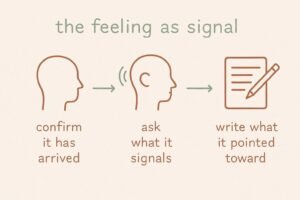
This practice is not about sorting feelings into acceptable and unacceptable categories. It is about meeting a feeling when it arrives — instead of fighting it — and checking what it is signaling.
STEP 1: Confirm that it has arrived
When an uncomfortable feeling appears, before moving to suppress or correct it, confirm it once.
Anxiety is here right now. Anger is here right now. Sadness is here right now.
The phrase is here places the feeling as something happening rather than something that is wrong. A small distance opens between the feeling and the person observing it.
STEP 2: Ask what it is a signal about
After confirming the feeling, look for one thing it might be responding to.
What does this anger feel like it is protecting? What is this anxiety trying to prepare for? What loss is this sadness responding to?
An answer is not required. Asking the question is the act of treating the feeling as information rather than as a problem to be resolved. That shift is the beginning.
STEP 3: Write down one thing the feeling pointed toward
When something becomes slightly clearer, write it down in a word or phrase.
Today’s anger pointed toward: wanting to be heard. Today’s anxiety pointed toward: something that actually matters to me.
Writing turns the experience into information. When it is read again later, what the feeling was signaling becomes slightly more visible — and slightly less threatening.
Session 3: The Feeling Was Never the Problem. The Instruction to Not Have It Was
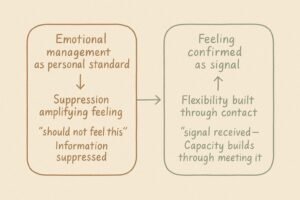
The instruction to stay positive had been installed as a social requirement
Sociologist Arlie Hochschild’s concept of emotional labor describes how the management of feeling — sustaining certain emotions, suppressing others — functions as a form of labor that is socially and professionally required. Maintaining a composed appearance, not showing anger, keeping anxiety out of sight: these are culturally framed as markers of professionalism and maturity, which means they are internalized not as external demands but as personal standards. Barbara Ehrenreich’s analysis of compulsory optimism extends this into a broader cultural structure: within a framework that frames negative feeling as an attitude problem or a thinking failure, the arrival of a difficult emotion immediately triggers self-criticism. The instruction I shouldn’t feel this way was not generated from inside. It was placed there — through professional norms, cultural expectations, and the repeated message that managing one’s emotional presentation is a measure of one’s competence and character.
Suppressing the feeling amplified it — and what was being suppressed was information
Psychologist James Pennebaker’s research on emotional suppression demonstrated that the deliberate effort to push a feeling down generates cognitive cost — occupying processing resources that would otherwise be available — and that suppressed feelings tend to return with greater intensity rather than diminishing over time. Neuroscientist Antonio Damasio’s somatic marker hypothesis introduces a more fundamental finding: emotions are not noise that interferes with rational decision-making. They are an information system integrated into the decision-making process itself, cross-referencing the current situation against past experience and signaling what is currently at stake. The patients Damasio studied who had lost emotional processing capacity through prefrontal damage retained their logical reasoning abilities intact — and consistently failed at ordinary decisions. What was being suppressed, in other words, was not a disturbance in the system. It was part of the system. The exhaustion produced by ongoing suppression was the cost of fighting information that the decision-making process actually needed.
Receiving the feeling as a signal was what built the capacity to work with it
Psychologist Todd Kashdan’s research on psychological flexibility describes the capacity to engage with feelings as signals within their context — rather than sorting them into categories of acceptable and unacceptable — as the foundation of emotional health. Flexibility is not the absence of difficult feeling. It is the ability, when a feeling arrives, to neither fight it nor be taken over by it, but to remain in contact with it long enough to check what it is signaling. This capacity does not develop while feelings continue to be treated as problems to be corrected. The feeling was information from the start. What kept it from being read was the instruction that it should not be there.
Conclusion: The Feelings Will Keep Coming. Without the Instruction, They Become Readable

The cultural framework of compulsory optimism continues. The professional and social demand for emotional management remains. The internal instruction I shouldn’t feel this does not disappear quickly.
But the single act of confirming this is here right now is available in any moment the feeling arrives. That confirmation is the end of the fight — and when the fight stops, the signal becomes readable.
The feeling wasn’t the problem. The instruction to not have it was.
KEY TERMS
Emotional Labor
Arlie Hochschild’s concept describing how the management of feeling — sustaining certain emotions, suppressing others — functions as a form of labor that is socially and professionally required. Internalized as personal standards of professionalism and maturity rather than experienced as external demands. The mechanism through which the instruction to not have certain feelings is installed from outside and becomes an internal critic that activates the moment a difficult feeling arrives.
Compulsory Optimism
Barbara Ehrenreich’s analysis of the cultural framework that frames negative feeling as an attitude problem or a failure of thinking — and therefore as an individual’s responsibility to correct. Combined with emotional labor, produces the structure in which a difficult feeling and a self-critical response arrive together, with the second consuming more energy than the first. Applied here to the specific mechanism of emotional suppression, distinct from its use in Guide 135’s discussion of hope and motivation.
Cost of Emotional Suppression
James Pennebaker’s finding that the deliberate effort to suppress a feeling generates ongoing cognitive cost and that suppressed feelings tend to return with greater intensity rather than diminishing. The exhaustion produced is not the feeling’s intensity but the accumulated cost of the sustained effort to push it down. The practical basis for understanding why the fight against a feeling is more draining than the feeling itself.
Somatic Marker Hypothesis
Antonio Damasio’s theory that emotions are an information system integrated into the decision-making process — cross-referencing current situations against past experience and signaling what is currently at stake — rather than noise that interferes with rational thinking. Supported by the finding that patients who lost emotional processing capacity through prefrontal damage retained logical reasoning but consistently failed at ordinary decisions. What was being suppressed was not a disturbance in the system. It was part of the system.
Psychological Flexibility
Todd Kashdan’s concept describing the capacity to engage with feelings as contextual signals — neither fighting them nor being taken over by them — as the foundation of emotional health. Develops through the practice of confirming a feeling’s presence, asking what it is responding to, and remaining in contact with it long enough to read what it is signaling. Cannot develop while feelings continue to be treated as problems requiring correction. The capacity that makes the feeling readable once the instruction to suppress it has been set aside.