
Introduction: Why “Think Positive” Makes It Heavier

Climate change. An opaque career path. A relationship with no clear way through. When difficulty arrives, the advice follows: stay hopeful, think positive, keep your chin up. The intentions behind the words are clear. And yet each time, something in you gets heavier rather than lighter.
This is because what the advice is asking for is the conviction that good outcomes are on their way. In genuinely uncertain situations, that conviction is not available. And when it isn’t, the next thing that arrives is the judgment of yourself for not having it.
Much of the exhaustion that comes with not being able to stay hopeful is not a problem with hope. It is the exhaustion of reaching for the wrong thing — and being told that not finding it is a personal failure.
Session 1: Can Action Only Continue When the Outcome Looks Promising?

When the sense that I can’t move without hope settles in, a specific structure of motivation is operating.
When the engine of action runs on this is going to work out, every fluctuation in that prediction produces a fluctuation in the action. The more difficult the task, the more uncertain the outcome — and the more uncertain the outcome, the harder it becomes to sustain the prediction. The structure that requires it will probably work in order to act breaks down most completely in exactly the situations where it is most needed.
Layered on top of this is the pressure to perform positivity. In environments where anxiety or grief reads as weakness or inadequate preparation, being honest about what is actually felt carries a social cost. The result is the familiar doubled weight: not being able to feel hopeful, and then judging yourself for that. The second is often more depleting than the first.
That ceiling is not a character problem. It is what outcome-dependent motivation was always going to produce.
Session 2: Practice — Relocating the Source of Motivation
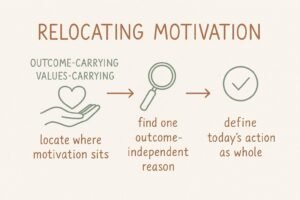
This practice supports the shift from outcome-dependent motivation — I act because this will probably work — toward value-dependent motivation: I act because this matters.
STEP 1: Locate Where the Motivation Currently Sits
When action has stalled, or when continuing feels effortful in a way that seems disproportionate, ask once:
Is what’s trying to move me right now “this looks like it will work” — or “this matters to me”?
Neither is a failure. The purpose of the question is to locate where the weight of motivation is currently resting. When outcome expectation is carrying the motivation, uncertainty becomes an obstacle. When orientation toward what matters is carrying it, uncertainty becomes a condition of the situation rather than a reason to stop.
STEP 2: Find One Reason That Doesn’t Depend on the Outcome
When movement has stopped, set aside the goal and the result for a moment, and turn toward a more fundamental question:
Why am I trying to engage with this? What reason do I have that would still hold regardless of how it turns out?
The answer doesn’t need to be large. Because I care about this person. Because I can’t live as if this problem doesn’t exist. A single reason that stands independently of outcome is enough to shift the center of gravity of motivation.
STEP 3: Define Today’s Action Separately From Its Result
Once the motivation has found a different anchor, define the day’s action as something complete in itself.
Not “stop climate change” but “make this one choice consistent with what I actually value today.” Not “repair this relationship” but “listen to what they’re saying without interrupting, once.”
What that action will produce is uncertain and can stay that way. The action itself — chosen from that grounding — is already the whole thing. It doesn’t need an outcome to be complete.
Session 3: Why “Stay Positive” Produced the Opposite of What It Promised
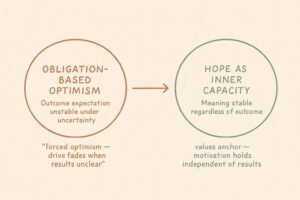
What Compulsory Optimism Manufactures
Journalist and social critic Barbara Ehrenreich’s examination of positive thinking culture documented the mechanisms by which optimism became institutionalized as social obligation in American life. When the belief that positive thinking produces positive outcomes becomes culturally mandated, negative emotions — fear, grief, anger, doubt — are reclassified as personal weakness and liability. Ehrenreich’s finding was that this cultural structure does not merely fail to help; it actively deepens individual suffering while redirecting attention from structural problems toward individual attitudes. The guilt of not being hopeful enough is not a natural response to difficult circumstances. It is manufactured by a culture that treats optimism as a moral requirement. In environments where the cost of admitting negative feeling is high, the difficulty of not being able to stay positive is compounded by self-criticism for the failure — two layers of suffering where one was already present.
Hope Was a Skill, Not a Feeling
Psychologist Charles Snyder’s hope theory defined hope not as an emotional state but as a cognitive capacity composed of three elements: a clear goal, the ability to generate multiple pathways toward that goal when one route is blocked — pathways thinking — and trust in one’s own capacity to actually use those pathways — agency thinking. In this framework, hope and optimism are distinct. Optimism is the expectation that outcomes will be favorable. Hope is the trust that routes can be found and that one is capable of taking them — regardless of what the outcome turns out to be. This separation is consequential. Not being able to feel that things will work out is not the same as not having hope. The capacity to find a route when one closes, and the trust in one’s own ability to navigate — these can be developed independently of whether the outcome looks promising. Hope, in Snyder’s sense, does not require the future’s cooperation. It only requires the present capacity.
“Why” Was Always the More Durable Source
Psychiatrist Viktor Frankl’s development of logotherapy from his experience in Nazi concentration camps identified meaning-orientation as the most fundamental source of sustained action under conditions of extreme uncertainty and uncontrollable outcomes. What Frankl observed was that even when outcomes were not merely uncertain but catastrophically predetermined, orientation toward meaning — a reason that held independently of circumstance — continued to support action and psychological coherence. The implication for ordinary uncertainty is direct. Motivation built on this will probably work is fragile in proportion to how uncertain the outcome is. Motivation built on this matters holds — and holds differently — regardless of what the outcome turns out to be.
Conclusion: Optimism and Hope Were Always Different Things

The culture of compulsory optimism will keep asking for positivity. Outcomes will remain uncertain. The structure does not change. But the question why does this still matter? can be brought into any moment of stalled action, before the judgment about not feeling hopeful enough takes over. When an answer to that question is found, motivation detaches from the outcome. Action becomes possible without optimism.
Optimism needed the future to cooperate. This didn’t.
Key Terms
Compulsory Optimism
Barbara Ehrenreich’s term for the cultural mechanism by which positive thinking is institutionalized as social obligation. Negative emotions are reclassified as personal weakness, structural problems are redirected toward individual attitudes, and the guilt of insufficient hopefulness is manufactured rather than arising naturally. The social origin of the doubled suffering — not being able to stay positive, and then judging yourself for it.
Hope Theory
Charles Snyder’s framework defining hope as a cognitive capacity rather than an emotional state. Composed of goal-directedness, pathways thinking — the ability to generate alternative routes when one is blocked — and agency thinking — trust in one’s capacity to use those routes. Distinct from optimism, which is outcome expectation. Hope in this sense does not require favorable outcome predictions; it requires present capacity and self-trust.
Meaning-Based Motivation
Based on Viktor Frankl’s logotherapy. The most fundamental and durable source of sustained action under uncertain or uncontrollable conditions is orientation toward meaning — a reason that holds independently of outcome. Why I act is a more stable motivational anchor than whether it will work, precisely because it does not depend on the future’s behavior.
Pathways Thinking
A component of Snyder’s hope theory. The cognitive capacity to generate alternative routes toward a goal when the current path is blocked. Distinct from optimism — not the prediction that things will work out, but the flexibility to find a different way when the current one closes. The mechanism through which hope is maintained in the presence of setbacks and uncertainty.
Values-Based Action
The motivational orientation in which action is grounded in what matters rather than in expectations about outcomes. When outcome expectation carries the motivation, uncertainty becomes an obstacle. When orientation toward what matters carries it, uncertainty becomes a feature of the situation rather than a reason to stop. The shift from the first to the second is the structural change that makes action in genuinely uncertain conditions sustainable.