
Introduction: The Real Source of the “Five-Year Plan” Anxiety

Early in a career, it was easy to talk about where you’d be in five years. Somewhere along the way, that certainty quietly disappeared. Looking out from the middle of a career now, there is no clear staircase — only fog. Rapid technological change, industries collapsing and reforming, economic conditions that defy prediction. The linear career path was always a simplified map, and for many people it has stopped corresponding to the territory.
The anxiety that comes with standing in that fog is not a planning failure. Its roots go somewhere deeper.
Session 1: Why Career Uncertainty Feels Like Losing Yourself

The anxiety produced by career uncertainty is not primarily an information problem — a matter of not knowing what comes next. It is experienced as something more fundamental: a threat to the sense of who you are.
In contemporary professional life, job title and occupation have become more than descriptions of work. They are the answers people reach for when asked to introduce themselves. The question what do you do functions, in most professional contexts, as a proxy for who are you. The more tightly these two questions become fused, the more any disruption to the career feels like a disruption to the self. When the job becomes uncertain, the self that was built around it becomes uncertain in the same move.
This is why the experience of career ambiguity — wondering whether to change direction, facing a plateau, questioning whether the current path still fits — can carry an existential weight that seems disproportionate to the practical situation. The weight is not disproportionate. It accurately reflects what is actually at stake when identity and occupation have been fused. The fusion is not a personal choice. It is the product of a cultural framework that has consistently treated professional role as the primary unit of adult identity — absorbed across years of education, socialization, and work before it could be examined.
Session 2: Practice — Navigating by Values When the Map Is Gone
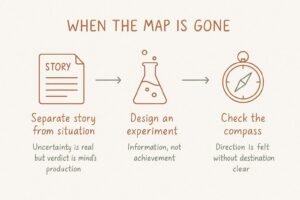
This practice is not about resolving career uncertainty. It is about developing an internal reference point that functions even when the external map doesn’t — so that the next step can be chosen from values rather than from the pressure to have a plan.
STEP 1: Separate the Story From the Situation
When the career narrative arrives — I’m falling behind, I can’t see where this is going, I should have figured this out by now — pause before being drawn into its content.
This reframe can feel dismissive at first — the uncertainty is real, and naming it a story doesn’t make it smaller.
My mind is running the career failure story right now.
The uncertainty is real. The interpretation — this uncertainty is evidence of my failure — is a story the mind is generating, not a fact the situation is reporting. Recognizing the story as a story, rather than as a verdict, creates the first interval in the automatic chain of self-criticism.
STEP 2: Design an Experiment Instead of a Plan
Rather than attempting to construct a five-year plan, design one small experiment. The purpose is information, not achievement.
Take one online course in a field that has been pulling at my attention. The goal is not the certificate. It is to find out whether I feel drawn further in, or whether the pull disappears on closer contact.
Experiments don’t fail — they produce data. Finding out that something isn’t the right direction is as useful as finding out that it is. This reframe reduces the pressure that makes movement difficult and converts a state of paralysis into a state of inquiry.
STEP 3: Check the Compass Regularly
Before a significant decision, or once a quarter as a standing practice, take stock of what is currently most important.
What do I actually care about most right now — depth of expertise, creative work, the people I work with, the problem I’m trying to solve, the impact I want to have?
Map the current direction of daily activity against that answer. Perfect alignment is not the goal. The value of the check is in noticing where the gap is, which makes the next small adjustment visible. Terrain can be invisible. Direction can still be chosen.
Session 3: When the Career Shook, the Self Shook With It
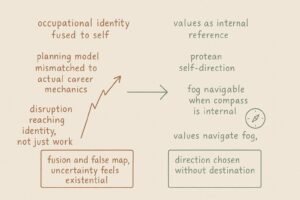
The Fusion That Made Uncertainty Feel Existential
James Marcia’s framework for identity development describes identity as formed through commitment to particular roles and values — a process of exploration followed by consolidation into a stable sense of self. In contemporary professional culture, occupational role has become one of the primary sites of this commitment. When work functions not only as a description of what someone does but as the foundation of who they are, any disruption to the work disrupts the identity structure built on top of it. Career uncertainty stops being a practical problem and becomes an identity threat. The anxiety is not disproportionate. It is accurate — once the identity dimension is visible.
The Careers That Worked Were Mostly Unplanned
Career psychologist John Krumboltz’s research on career development produced a finding that challenges the planning model directly: a large proportion of the career paths that people experience as successful were substantially shaped by unplanned events. Chance encounters, unexpected opportunities, and unintended pivots appear repeatedly as the primary turning points in accounts of career formation. Krumboltz called this phenomenon planned happenstance — not as a prescription for passivity, but as a description of how careers actually work. The gap between the planned career and the lived career is not a sign of insufficient foresight. It is a consistent feature of the territory. The expectation that a career should be plannable is not a neutral standard — it is a specific cultural inheritance, and one that systematically misrepresents the mechanics of how professional lives actually develop. The anxiety produced by not being able to see five years ahead is the anxiety of applying a planning model to a domain where planning has never been the primary operating principle.
Values Were the Only Thing That Worked in the Fog
Organizational psychologist Douglas Hall named his model of career development after Proteus — the shape-shifting figure of Greek mythology capable of transforming in response to circumstances. The protean career is defined not by organizational loyalty or external metrics of advancement but by two internal qualities: self-direction and a commitment to values-based rather than externally defined success. Hall called this psychological success — the sense of achievement that comes from living in alignment with what one actually values, independent of title, income, or social recognition. The vulnerability that vocational identity fusion creates — the sense that career disruption threatens the self — diminishes when the foundation of identity shifts from external role to internal values. The unpredictability that Krumboltz documented becomes less threatening when the reference point is values rather than destination. The fog doesn’t need to clear for the next step to be taken. The direction only needs to be felt.
Conclusion: The Direction Was Always Choosable

The vocational identity fusion will keep making career uncertainty feel like a self-threat tomorrow. The fog will not clear. Happenstance will remain unplannable. The structure does not change.
But the question what do I actually care about right now can be asked at any career crossroads, in any fog. The answer to that question is the one navigational instrument that functions independently of how much of the terrain is visible. The plan was never what was needed. The direction was.
The career you couldn’t plan was never the problem. The belief that you should have been able to was.
KEY TERMS
Vocational Identity
The state, grounded in James Marcia’s identity development framework, in which occupational role functions not only as a description of work but as a foundation of the self — so that career disruption is processed as an identity threat rather than a practical problem. The structural explanation for why career uncertainty produces distress that feels existential rather than merely logistical. The fusion is not a personal failing; it is the product of a cultural framework that has consistently positioned professional role as the primary unit of adult identity.
Planned Happenstance
John Krumboltz’s research finding that a substantial proportion of successful career paths were shaped primarily by unplanned events — chance encounters, unexpected opportunities, unintended pivots. Not a prescription for passivity but a description of how careers actually develop. The expectation that a career should be plannable is a specific cultural inheritance that misrepresents the actual mechanics of professional life. Career uncertainty reframed not as planning failure but as an honest encounter with the territory as it is.
Protean Career
Douglas Hall’s model of career development, named after the shape-shifting figure Proteus, defined by self-direction and values-based rather than externally defined success. The organizing principle is internal — what the person values and finds meaningful — rather than external metrics of advancement or organizational loyalty. In conditions of labor market uncertainty, the protean orientation provides a navigational reference point that functions independently of how much of the terrain is visible.
Psychological Success
Hall’s term for the sense of achievement derived from living in alignment with one’s own values, independent of external markers such as title, income, or social recognition. The alternative foundation for identity that reduces the vulnerability created by vocational identity fusion: when the reference point shifts from external role to internal values, career disruption becomes less threatening to the self. The only success metric that remains stable when the external landscape changes.
Defusion
The capacity to notice that the career failure narrative — this uncertainty is evidence that I have fallen behind — has fused with one’s experience of the situation, and to observe it as a story the mind is generating rather than a report the situation is filing. Creating distance from the narrative opens the interval between the uncertainty and the automatic self-critical response, making a different relationship to the fog available.