
Introduction: Why More Safety Produces More Anxiety

All health markers within range. Insurance covering every contingency. Surveillance cameras on every block. By measurable standards, the current environment is safer than any previous era. And yet the time spent thinking about risk keeps expanding — food additives, data breaches, unknown pathogens, climate tipping points. One threat is addressed and another immediately appears.
The paradox is not accidental. It has a structure.
Session 1: Why Chasing Safety Makes Anxiety Grow

The proliferation of risk awareness is not a reflection of the world becoming more dangerous. It is the product of treating safety as an achievable goal — a standard that, once internalized, ensures that all remaining uncertainty registers as insufficiency.
When zero risk becomes the implicit target, every actual condition of uncertainty is processed as a gap between where things are and where they should be. One threat eliminated doesn’t produce resolution — it produces visibility for the next one. The goal keeps moving. As risk management has shifted to the individual, each newly identified threat arrives as an additional item on a personal management list, widening the scope of what requires vigilance.
The anxiety that grows alongside safety infrastructure is not a personality trait. It is the predictable output of a goal that recedes as it is approached.
Session 2: Practice — Sorting Rather Than Eliminating
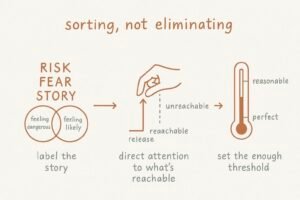
This practice is not about becoming indifferent to risk. It is about developing the capacity to distinguish what warrants attention from what doesn’t.
STEP 1: Label the Story
When a risk-related thought arrives, pause before being drawn into its content.
My mind is running the risk fear story right now.
There is a difference between something feeling dangerous and something being likely to happen. Noticing which one is driving the response is the first separation.
STEP 2: Direct Attention Only to What Is Reachable
For any given risk, identify what is actually within reach and what isn’t.
Of this risk, what part can I meaningfully act on? What part is outside my influence regardless of how much I think about it?
Direct attention and action toward the reachable portion — fastening the seatbelt, maintaining the health habit, taking the practical precaution. Release the rest. Releasing the unreachable portion is not indifference. It is the recognition that vigilance directed at what cannot be changed produces only more vigilance.
STEP 3: Set the “Enough” Threshold Deliberately
Rather than pursuing complete safety, identify the point at which reasonable precautions have been taken.
Have I taken measures proportionate to the actual probability here? Is what remains a genuine gap, or the distance between reasonable and perfect?
Deciding what counts as enough — and stopping there — withdraws from the zero-risk pursuit without requiring the world to become more predictable first. That shift, small and specific as it is, changes the relationship to uncertainty from a problem requiring resolution to a condition requiring nothing in particular.
Session 3: The Anxiety Was Always Part of the Product
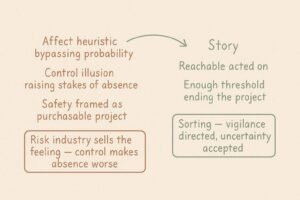
What the Safety Industry Was Actually Selling
Health food markets, insurance products, security services — each operates on a shared premise: that current protection is insufficient and the gap can be closed through the right purchase. New threats are identified, amplified through emotionally effective channels, and resolved through commercial products that restore temporary calm before the next threat arrives. The social distribution of actual risk — how industrial processes produce and allocate harm across populations — is distinct from what operates here. The commodification of risk anxiety is a further step: not the distribution of actual risk but the production and sale of the feeling of being insufficiently protected. The feeling of I am not yet safe enough is not incidental to this market. It is the market’s operating condition.
The Brain That Measured Danger With Feelings
Psychologist Paul Slovic identified the affect heuristic: the tendency to evaluate risk based on emotional response rather than statistical probability. What feels frightening is judged more dangerous regardless of likelihood; what feels familiar is judged less dangerous regardless of likelihood. Commercial air travel is statistically far safer than driving, yet most people feel the reverse. This cognitive characteristic is not a flaw in an otherwise rational system — it is a basic feature of how the brain processes information under uncertainty. The risk industry operates directly on this feature — emotionally weighted language and vivid imagery bypass the probability calculation and reach the fear response first. The difficulty of thinking clearly about risk under alarming conditions is not a failure of intelligence. It is the predictable behavior of a brain built to respond to feeling intensity rather than statistical magnitude.
What the Attempt to Control Made Worse
Psychologist Ellen Langer’s research on the illusion of control found that believing in one’s control over an outcome increases the distress produced when control is absent. The belief in control raises the stakes of its absence. When safety is framed as a manageable project, uncontrollable risk becomes a management failure rather than normal uncertainty. The framework meant to produce security systematically heightens sensitivity to everything outside its reach. The industry supplies the premise that safety is purchasable. The affect heuristic ensures newly identified threats feel urgent. And the control illusion means each new threat registers as a gap in a project that should have been closed. The attempt to control is not the solution to chronic safety anxiety. In the conditions that contemporary risk culture produces, it is one of its primary engines.
Conclusion: The Uncertainty Was Never the Problem

The risk industry will keep generating new insufficiency signals tomorrow. The affect heuristic will keep measuring danger by feeling rather than probability. The control illusion will keep making unmanageable uncertainty feel like a management failure. The structure does not change.
But the question am I responding to a probability or a feeling can be asked before any risk assessment, in front of any alarming headline. Deciding what counts as enough — drawing the line between reasonable precaution and the impossible standard — is the one move that doesn’t require the world to become more predictable first.
The risk was real. The fear was the product, not the warning.Guide 119. Career in the Fog: Why Not Being Able to Plan Was Never the Problem
KEY TERMS
Commodification of Risk
The business model in which safety industries operate on the continuously replenished premise that current protection is insufficient. Distinct from frameworks describing the social distribution of actual risk: what operates here is the production and sale of the feeling of being insufficiently protected. New threats and solutions cycle continuously, maintaining the sense of shortage that makes the next purchase necessary. The feeling of not yet being safe enough is the market’s operating condition, not its side effect.
Affect Heuristic
Paul Slovic’s finding that risk evaluation is driven by emotional response rather than statistical probability. What feels frightening is judged more dangerous regardless of likelihood; what feels familiar is judged less dangerous regardless of likelihood. The cognitive feature that makes commercially amplified risk anxiety effective — emotional presentation bypasses probability assessment and reaches the fear response directly. The difficulty of clear risk thinking under alarming conditions is not an intelligence failure — it is the predictable behavior of a brain built to respond to feeling intensity rather than statistical magnitude.
Cost of the Control Illusion
Ellen Langer’s finding that believing in one’s control over an outcome increases the distress when control proves absent. The belief in control raises the stakes of its absence. When safety is framed as a manageable project, uncontrollable risk registers as management failure. The framework meant to produce security heightens sensitivity to everything outside its reach — making the attempt to control one of the primary engines of chronic safety anxiety rather than its solution.
Zero-Risk Pursuit Paradox
The structural condition produced when complete safety becomes the implicit standard — ensuring that all remaining uncertainty registers as insufficiency, resolved threats yield visibility for the next, and anxiety operates as chronic background noise rather than a signal about specific dangers. The goal recedes as it is approached.
Defusion
The capacity to notice that the risk narrative — this threat requires immediate action — has fused with the emotional response and is being processed as fact rather than feeling. Observing which process is generating the response — probability or affect — creates the interval in which a proportionate rather than emotionally amplified reaction becomes available.