
Introduction: Was That Reach Actually a Decision?

Between tasks, on the train, in a moment of quiet — and the phone is already in hand. The moment of picking it up is gone before it was noticed. A few minutes later, nothing needed has been found, and there is a slight heaviness that wasn’t there before.
This is not a willpower problem. It is a design problem — the brain’s and the phone’s together.
There is something that can be done in four seconds, before the reach becomes a scroll. No app, no digital detox weekend. Just four seconds and the willingness to place them before the automatic sequence completes.
Session 1: Why the Hand Moves Before the Decision

Habitual actions have a specific property: they can be executed without prefrontal cortex involvement.
When a behavioral sequence is repeated enough times, the brain compresses it into a single automated unit that launches on a cue and completes without conscious direction. For many people, the reach for the phone has already reached this stage. A slight feeling of boredom, a gap between tasks, a low-level unease — the hand moves before any decision has been made.
A second force maintains and amplifies this automaticity: the uncertainty of what might be there. The variable structure of social feeds and notifications — something interesting might be there, or nothing at all — generates a stronger and more persistent motivational signal than predictable rewards would. The not-knowing is part of what keeps the hand moving.
Four seconds is enough to bring the prefrontal cortex back into the sequence before it completes.
Session 2: The Four-Second Practice
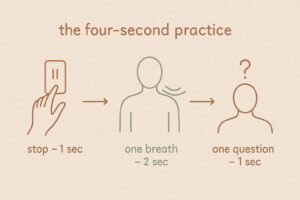
The next time the hand moves toward the phone, try this before it gets there.
STEP 1: Pause (1 second)
Before touching the screen, stop the motion.
There’s the reach — noticing it now.
No judgment. Just recognition.
STEP 2: One breath (2 seconds)
Stay exactly where you are. Inhale, then exhale with a slight release of the shoulders.
Not a performance. Just one breath, completing.
This single breath interrupts the automatic sequence and returns executive function to the prefrontal cortex — the part of the brain capable of asking whether this is actually what’s wanted right now.
STEP 3: One question (1 second)
Lightly, without pressure:
Is there something specific being looked for — or is this about filling a gap?
No full answer needed. The question alone is the intervention.
Session 3: The Automatic Sequence and Its Structure
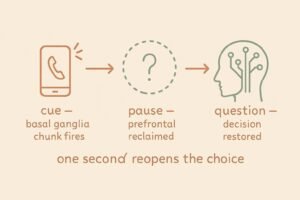
MIT neuroscientist Ann Graybiel’s research, synthesized in Annual Review of Neuroscience (2008), identified how habitual behavior is encoded in the basal ganglia. Through repetition, the brain compresses a sequence of actions into a single chunk: a unit that launches at a cue signal, executes automatically, and completes without requiring prefrontal involvement. Graybiel identified a characteristic neural signature for this — neurons in the striatum activate at the start and end of the habitual sequence while remaining quiet during its execution, bracketing the behavior as a self-contained unit. Once this compression is complete, the behavior bypasses deliberate judgment. The phone appearing in the hand without any memory of reaching for it is not an absence of willpower. It is Graybiel’s chunking process operating as designed — the basal ganglia running ahead of the prefrontal cortex.
What sustains and intensifies this automaticity is the structure of the reward signal itself. Wolfram Schultz’s electrophysiological recordings of dopamine neurons, published in Science (1997) and elaborated extensively since, established that dopamine neurons do not simply signal pleasure — they encode a reward prediction error: the difference between the reward received and the reward expected. Critically, Schultz showed that when reward is uncertain, the dopamine signal persists across the anticipation period rather than resolving at delivery. Social feeds and notifications are structured around exactly this property: the next scroll might contain something interesting, or it might not. That uncertainty generates a sustained motivational signal that a guaranteed reward would not. Graybiel’s chunk provides the automated behavioral vehicle; Schultz’s prediction error signal provides the continuous fuel.
The pause intervenes in this sequence at the transition between cue and execution. Graybiel’s research also showed that even fully automatized habits remain under the immediate supervision of cortical decision-making regions — the automaticity does not eliminate prefrontal access, it bypasses it unless that access is deliberately reclaimed. The one-second pause in Step 1 is the reclamation: a brief interruption that reinserts the prefrontal cortex before the chunk completes. The question in Step 3 — what is this reach actually for? — temporarily reroutes the impulse away from the automatic behavioral channel and into the self-monitoring circuits of the prefrontal cortex. The phone is not the problem. The question is who is doing the deciding.
Conclusion

The phone will still be picked up — often, probably. What changes gradually is whether there was a moment of noticing before it happened. That noticing is the complete practice.
Four seconds is shorter than it sounds, but sufficient for the prefrontal cortex to rejoin the sequence. As that moment accumulates across days and weeks, the experience of the reach shifts — from something that simply happened to something that was, at least briefly, chosen.
The hand moved before any decision was made. The basal ganglia moved first. Noticing that gap was the only moment the choosing came back.
KEY TERMS
Basal Ganglia
A group of subcortical structures central to habit formation and automaticity. Graybiel’s research (Annual Review of Neuroscience, 2008) established that through repetition, the basal ganglia compress behavioral sequences into chunks — automated units that launch on a cue and execute without prefrontal involvement. The automatic reach for the phone is this chunking process in its completed form.
Habit Chunking
The neural compression process identified by Graybiel, in which a repeated behavioral sequence is encoded as a single unit in the striatum. A characteristic task-bracketing pattern — neurons firing at start and end, quiet during execution — marks the behavior as automated. Once a chunk is formed, the behavior bypasses deliberate judgment and runs on cue.
Reward Prediction Error
The coding principle Schultz identified in dopamine neurons: not the receipt of reward, but the difference between received and expected reward. When reward is uncertain — as with a social feed that may or may not contain something interesting — the dopamine signal persists across the anticipation period, generating a sustained motivational pull that predictable rewards do not produce.
Dorsolateral Prefrontal Cortex (dlPFC)
The prefrontal region responsible for planning, working memory, and impulse regulation. Bypassed rather than eliminated by habitual automaticity — accessible through deliberate pause. The four-second practice is designed to reinsert dlPFC involvement before the habitual chunk completes.
Metacognition
The capacity to observe one’s own mental processes. Asking what is this reach actually for? is a metacognitive act — one that temporarily reroutes the impulse away from the automatic behavioral channel and into prefrontal self-monitoring. The question does not require a full answer; its activation of the monitoring circuit is the intervention.