
Introduction: You’ve Done This Thousands of Times and Never Once Felt It

Turning a page of a report. Flipping to the next spread in a notebook. Moving through a book one page at a time.
This happens dozens of times a day at a desk, in study sessions, in the middle of ordinary work. Fingers meet paper, the page turns, something new appears — and the whole thing takes about half a second. Have you ever actually felt it?
The answer, for most people, is no — not because they weren’t paying attention, but because the brain decided long ago that this particular motion didn’t need to be felt. Today’s practice is about overriding that decision, once, for one page, with full attention.
Session 1: Why This Particular Motion

Page-turning looks simple. Neurologically, it isn’t.
The moment a fingertip contacts the edge of a page, mechanoreceptors in the skin begin detecting texture, thickness, and surface geometry. Simultaneously, muscle spindles and tendon receptors in the fingers are tracking joint angle and force distribution in real time. The eyes follow the arc of the moving paper. The auditory system registers the sound — and notes, without being asked, that this turn sounds slightly different from the last one.
These signals aren’t processed in isolation. The brain integrates them continuously to maintain a running model of what the hand is currently doing.
The reason none of this reaches awareness is that it doesn’t need to. A motion performed thousands of times generates a highly accurate internal prediction of its own sensory consequences. When prediction and reality match — as they almost always do with familiar actions — the brain treats the incoming signals as redundant and suppresses their passage to conscious processing.
This practice is simply the decision to be present for what the brain has learned to skip.
Session 2: The Turning Practice — Three Steps
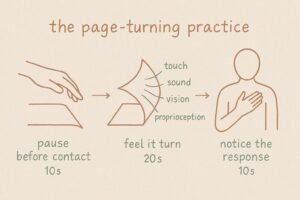
STEP 1: Pause before contact (10 seconds)
As the hand moves toward the page, stop just before the fingers touch. Hold the preparatory position for a moment — the reaching, not yet the touching. A light internal intention: I’m going to feel this one. That’s enough.
STEP 2: Feel it turn (20 seconds)
As the page moves, open attention across the available channels simultaneously.
Touch — the texture of the paper, its weight, the particular shape of this edge
Sound — the specific sound of this turn, this paper, this moment
Vision — the motion of the page, the way light shifts as the surface angle changes
Proprioception — the distribution of effort across the fingers, the arc of the wrist
Not sequentially. Not analytically. Just receiving what’s already there.
If “hurry up” arrives as a thought, notice it as a thought, and return to the sensation.
STEP 3: Check inward after (10 seconds)
Once the page has settled, take a moment to look inward. Did the body respond to anything? Did the texture, the sound, the motion land differently than expected? No analysis required — just the noticing.
Session 3: Why the Brain Cancels the Sensation Before It Arrives
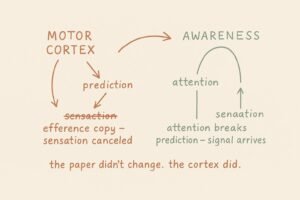
Before executing any movement, the brain generates a forward model: a prediction of the sensory feedback the movement will produce. This predictive signal — known as an efference copy — is generated collaboratively by the cerebellum and primary motor cortex, and is used to compare against incoming sensory data in real time. When the prediction matches the actual feedback closely, the brain classifies the incoming signals as expected and attenuates their transmission toward conscious awareness. The sensation is canceled before it arrives.
This is why highly practiced actions feel like nothing. The more accurate the prediction, the more thoroughly the sensation is suppressed. Page-turning, for most adults, is predicted with near-perfect precision. The rich sensory event — texture, sound, proprioceptive detail — is fully processed subcortically and never surfaces. What reaches awareness isn’t new information. What’s new, when attention is brought deliberately to the motion, is that the suppression didn’t run.
The pause before contact interrupts this cycle at the right moment. The preparatory attention shifts the system’s state before the prediction is confirmed, creating a brief window in which incoming sensory signals are treated as worth forwarding rather than canceling. A second mechanism reinforces this: directed attention to fine tactile and proprioceptive detail temporarily narrows the receptive fields of the relevant sensory cortex neurons, increasing their selective processing precision. The fingertip’s sensory representation in the cortex becomes, briefly, higher-resolution — not because the paper changed, but because the attentional state changed what the cortex does with the signal.
This is distinct from proprioceptive attention focused on the body at rest in space, or interoceptive awareness of internal bodily sensation. What this guide addresses is the sensory feedback loop active during a motion in execution — the real-time conversation between prediction and input. The inward turn after the motion moves attention from this sensorimotor loop toward interoceptive processing in the insular cortex, where the body’s response to the sensation — a slight ease, a texture that caught attention, a sound that landed unexpectedly — becomes available to awareness.
Conclusion: It Was Always This Textured

Once today. Any page, any paper. One pause, one turn, full attention — and then the brief inward check of what the body did with it.
The practice doesn’t ask for a changed relationship with every page. Just one. That one tends to make the next one easier to feel.
The prediction was accurate. That was never the same as actually feeling it.
KEY TERMS
Predictive Motor Control
The brain’s generation of forward sensory predictions before movement execution, allowing incoming feedback to be compared against expectation in real time. For familiar actions, accurate predictions result in sensory suppression — the neurological explanation for why practiced motions stop registering consciously.
Efference Copy
The internal sensory prediction generated by the cerebellum and motor cortex at the moment a movement command is issued. Used to cancel expected sensory feedback, preventing it from reaching conscious awareness. When the efference copy is highly accurate — as it is for repeated daily actions — the sensory experience of the motion effectively disappears.
Representational Resolution
The temporary increase in processing precision that occurs when focused attention is directed toward fine sensory detail. Attentional focus narrows the receptive fields of relevant sensory cortex neurons, allowing the same physical input to be processed with greater selectivity. Directed attention to texture, sound, and proprioception during the turning motion engages this mechanism.
Defusion
A core skill in Acceptance and Commitment Therapy (ACT): the capacity to observe thoughts and impulses as passing mental events rather than directives. When I need to hurry appears during the practice, recognizing it as a thought rather than a command — and returning to the sensation of the page — is defusion applied to the impulse to automate.