
Introduction: How Many Minutes Today Were You Not Playing a Role?
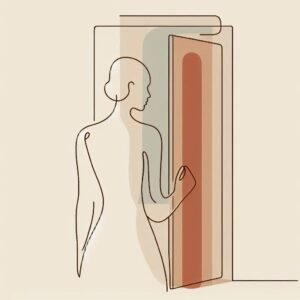
At work, there’s a version of you that’s competent and composed. In meetings, a version that’s engaged and appropriate. In the hallway, a version that looks like someone with somewhere to be.
None of this is dishonest. It’s just how social life works — a continuous, largely automatic management of how you appear to others. Most people do it so fluently they barely notice it’s happening.
But it has a cost. And a few times a day, there’s a place where it stops.
The stall door closes. For a moment, no audience.
Session 1: Why This Particular Space

Sociologist Erving Goffman described social life as performance. When others are present, we’re on the front stage — managing appearance, selecting words, displaying the emotions that fit the role. When we step away from the audience, we enter the back stage — where the performance is suspended and the maintenance work can pause.
In the context of a typical workday, genuine back stage time is surprisingly rare. Open offices, shared spaces, digital visibility — the front stage has expanded considerably. The private bathroom stall is one of the few remaining spaces where physical enclosure guarantees an audience of zero.
This matters more than it might seem. The cognitive and emotional labor of continuous self-presentation accumulates across a day. The fatigue that arrives by late afternoon isn’t only the result of the work itself. Some portion of it is the cost of staying in character.
This practice is about using the guaranteed back stage time that already exists in your day — rather than passing through it on autopilot.
Session 2: Three Steps
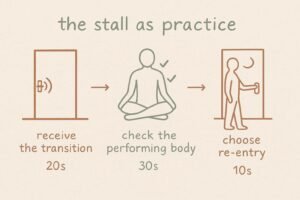
STEP 1: Receive the transition (20 seconds)
When the door closes — the sound of the latch, the shift in the quality of the air — take that moment as a deliberate threshold rather than just a mechanical action. Front stage has ended. Back stage has begun. Let that be a real event rather than a passage between two versions of the same continuous rushing.
STEP 2: Check the body that was just performing (30 seconds)
With the role temporarily set down, take stock of what’s actually present.
Contact points — the weight of the body against the seat, the feet on the floor
Breath — its depth and quality right now, compared to a few minutes ago in the meeting or the corridor
Held tension — shoulders, jaw, hands — what’s still braced that doesn’t need to be?
Don’t try to fix anything. Just notice what the performance left behind.
STEP 3: Choose the re-entry (10 seconds)
Before opening the door, one breath. Not a deep therapeutic breath — just a pause that makes the return intentional rather than automatic. The front stage is about to resume. Choosing to step back into it, rather than simply being swept back in, is the practice.
Session 3: Why the Stall Door Changes More Than Just the View
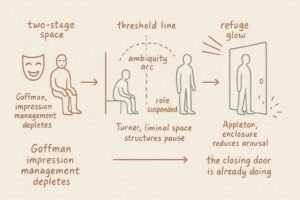
Goffman’s theatrical metaphor for social life — developed in The Presentation of Self in Everyday Life (1959) — was not a cynical observation about human inauthenticity. It was a structural one. Social interaction requires coordination, and coordination requires predictability. The roles we perform make us legible to others and allow shared activity to proceed. The performance is functional. It is also, unavoidably, work.
Impression management — the continuous monitoring and adjustment of self-presentation to produce a desired impression in others — draws on attentional, cognitive, and emotional resources. Research in social psychology has quantified aspects of this cost: self-monitoring correlates with higher cognitive load, emotional labor in professional contexts predicts fatigue and burnout independent of task demands, and the sustained suppression of authentic emotional responses — smiling when not feeling it, projecting calm when not feeling it — is measurably depleting. The accumulated cost of a full workday on the front stage is real, and taking it seriously changes how the back stage is used.
The anthropologist Victor Turner’s concept of liminality offers a complementary frame. Turner observed that transitions between social states — the passage from one role, identity, or status to another — involve a threshold period in which the old state has been left and the new one not yet assumed. This liminal space is characterized by ambiguity, openness, and a temporary suspension of the structures that normally organize experience. Applied to the everyday: the bathroom stall is a liminal space. For the duration of its use, the social categories that structure the rest of the day — job title, relational role, performance identity — are in suspension. Receiving the closing of the door as a threshold, and consciously choosing re-entry rather than being swept back automatically, are designed to make this liminal quality available to experience rather than letting it pass unnoticed.
The physical enclosure itself contributes a third dimension. Evolutionary psychologist Jay Appleton’s prospect-refuge theory proposes that humans are instinctively drawn to environments that offer both open sightlines and protected enclosure — a preference shaped by millions of years of navigating landscapes where visibility and concealment had survival relevance. Enclosed spaces that feel safe — not trapped, but sheltered — produce measurable reductions in autonomic arousal: lower vigilance, reduced threat monitoring, a subtle but real shift in physiological state. The relief of closing a stall door is not imagined. It is a refuge response, and it is available whether or not it’s consciously recognized.
Conclusion: The Back Stage Was Always There

Once today. One stall, one door, one minute. Receive the closing, check what the performance left in the body, and choose the return deliberately rather than letting momentum make the choice.
The space exists already, multiple times a day. The only question is whether it’s used or passed through.
The door closes. For a moment, no one is waiting for a version of you.
KEY TERMS
Impression Management
Erving Goffman’s term for the continuous monitoring and adjustment of self-presentation in social contexts — selecting words, regulating emotional display, maintaining the appearance appropriate to the role. Draws on attentional, cognitive, and emotional resources whose cumulative cost across a workday is real and measurable. The front stage work that the stall temporarily suspends.
Front Stage / Back Stage
Goffman’s dramaturgical framework for social space. The front stage is where performance occurs — where others are present and self-presentation is managed. The back stage is where performance is suspended — where the role can be set down. The private stall is one of the most reliably available back stage spaces in a typical workday.
Liminality
Victor Turner’s concept of the threshold state between social roles or identities — the in-between period when one state has been left and the next has not yet been assumed. Applied here: the stall is a liminal space where the day’s social categories are temporarily in suspension. Receiving the door’s closing as a threshold and choosing re-entry deliberately are designed to make this liminality available to experience rather than letting it pass automatically.
Refuge Effect
From Jay Appleton’s prospect-refuge theory: enclosed spaces that feel sheltered produce measurable reductions in autonomic arousal, reducing threat monitoring and vigilance. The instinctive relief of closing a stall door is a refuge response — evolutionary in origin, physiological in expression.
Defusion
A core skill in Acceptance and Commitment Therapy (ACT): the capacity to observe thoughts and impulses as passing mental events rather than directives. When I need to get back arrives before the minute is up, recognizing it as a thought generated by front-stage momentum — rather than an actual emergency — and staying with the breath for the remaining seconds is defusion applied to the specific urgency of workplace performance culture.