
Introduction: The Friction Is the Practice

Someone’s bag pressing into your side. A delay announcement. A conversation you didn’t ask to hear.
The commute has a particular kind of exhaustion — noise, crowding, unpredictable stimuli arriving one after another, none of them chosen. Whether that becomes something to be endured or something to be used is a different question.
The two practices here require no seat, no closed eyes, no quiet. The crowded, unpredictable environment isn’t an obstacle. It’s the material.
Session 1: Why Discomfort Is the Right Condition

Comfort tends to make reactions invisible. Discomfort makes them vivid.
Each small jolt on the train — a bag pressing in, a voice landing the wrong way — triggers the brain’s automatic evaluation: annoying, intrusive, why isn’t this moving faster. From that evaluation, a chain begins: irritation, story, a mood that arrives at the office before you do. Most of this happens below the threshold of noticing. The exhaustion it produces feels like the commute itself. It isn’t. It’s the chain.
The two practices aren’t designed to make the train comfortable. They’re designed to make the chain visible a little earlier. Each time the chain is noticed, it loosens slightly.
Session 2: Two Practices for the Journey
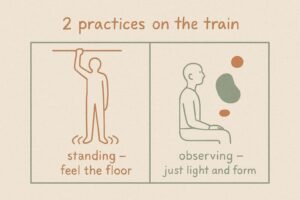
STEP 1: Standing Meditation — Feel the Ground
Most useful when it’s crowded.
Through the shoes, feel the floor. The pressure of body weight. The vibration of the train traveling through the soles of the feet.
Just this: the simple physical fact of standing here.
Notice the micro-adjustments the ankles and calves are constantly making to keep the body upright. The body is doing something quietly, without being asked.
When I hate this arrives — and it will —
There’s that feeling. Returning to the feet.
The shift from being the person who is irritated to the person who notices irritation is where the practice lives.
STEP 2: Observation Practice — The Camera Lens
Works seated or standing. Soften the gaze toward a neutral point.
No good, no bad. Just what is there. The geometry of an advertisement. The blur of passing architecture through the window. The way fluorescent light falls across a metal surface.
Color patterns. Light events. Simply present.
The same applies to sound. Train noise, voices, announcements — before the evaluation of too loud arrives, receive them as sound events that arise and dissolve. Each one appears, and passes.
Session 3: Two Neural Modes and the Gap Between Them
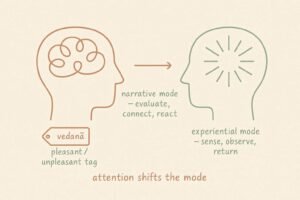
Neuroscientist Norman Farb and colleagues at the University of Toronto, publishing in Social Cognitive and Affective Neuroscience (2007), identified two neurologically distinct modes of self-reference using fMRI. The first — narrative focus — activates the medial prefrontal cortex and posterior cingulate cortex, continuously linking past experience to future expectation through evaluation and interpretation. The bag hit me again — why is it always this crowded — this is already a bad day is narrative focus running automatically. The commute’s stream of unpredictable stimuli provides exactly the conditions under which this mode activates without interruption.
What Farb’s research also established is that narrative focus has a neurologically distinct counterpart: experiential focus, in which the insula and somatosensory cortex activate instead, processing present-moment sensation directly — the pressure underfoot, the acoustic quality of a sound, the visual pattern of light on a surface. The two modes can be switched by the direction of attention. Bringing attention to the soles of the feet in Step 1, and receiving visual information non-evaluatively in Step 2, is the neural operation Farb’s research described: disengaging narrative processing and engaging direct sensory processing. The shift is not a matter of willpower. It is a matter of where the attention goes.
At the moment in Step 2 when a sound is received as a sound — before the evaluation of too loud — a further change takes place. Theravāda Buddhism identified this level of experience as Vedanā: the automatic pleasant, unpleasant, or neutral quality that tags every sensory event at the moment of contact, before conscious evaluation begins. The chain — bag contact → unpleasant tag → this always happens → bad day — starts at the tag. The practices in Steps 1 and 2 are training in noticing that the tag has appeared. That noticing is what Farb’s experiential mode makes structurally possible: the gap between tag and chain, available the moment direct sensory processing displaces the narrative.
Conclusion

One stop with the feet. Or one stop with the camera lens. Either is enough.
The moment of noticing — the chain just started — doesn’t require the chain to stop. It only requires the gap.
The bag pressing in was never an emergency. The brain had decided it was. Noticing that decision was the only moment the train became something else.
KEY TERMS
Narrative Focus
One of two neurologically distinct modes of self-reference identified by Farb and colleagues (Social Cognitive and Affective Neuroscience, 2007). Activates the medial prefrontal cortex and posterior cingulate cortex — continuously linking past experience to future expectation through evaluation and interpretation. The automatic reactive chain in the commute — stimulus → judgment → mood — is narrative focus running without interruption.
Experiential Focus
The neurologically distinct counterpart to narrative focus, identified in Farb et al. (2007). Activates the insula and somatosensory cortex, processing present-moment sensation directly rather than evaluating it. Accessible through deliberate attention to physical sensation or non-evaluative observation. The two modes can be switched by the direction of attention.
Sensory Gating
The brain’s automatic mechanism for filtering sensory input — determining which stimuli receive focused attention and which recede to background processing. Non-evaluative observation practice gradually makes this otherwise invisible process accessible to awareness, allowing the same stimuli to be received differently without requiring a change in the environment.
Vedanā
Pāli for “feeling tone.” In the Theravāda framework, Vedanā refers to the automatic pleasant, unpleasant, or neutral quality that tags every sensory experience at the moment of contact — before conscious evaluation begins. The reactive chain starts at this tag. Noticing the tag before the chain unfolds is the practical intersection between Vedanā awareness and what Farb’s research established as the neural function of experiential focus.