
Introduction: Why Trying to Improve Yourself Makes You Like Yourself Less

The app that tracks your sleep. The tool that maximizes your productivity. The device that logs your output. Social media filled with people who wake at four, train seven days a week, and have already built a side income before you’ve had breakfast. Fall short of any of it and the day ends in self-reproach.
The relentless sense of not enough is not evidence of weak motivation. It has a structural source — one that exists independently of anything you have or haven’t done.
Session 1: The Optimization Trap — A Project That Was Never Meant to Finish

The compulsion to self-optimize is driven by the fusion of a market-constructed ideal of the self with the ongoing evaluation of who you actually are.
At the center is the completeness fantasy — the image of a future self who has been optimized across every dimension, and against whom the present self is perpetually measured and found wanting. The comparison is structurally unwinnable. The ideal exists in the future; the present self exists now. The gap between them is not a problem to be solved. It is the engine of the whole system.
Layered onto this is the reduction of self-worth to measurable outputs. Steps walked, hours produced, followers accumulated, income generated — these become the operative definition of value. What they cannot capture — the quality of attention, emotional texture, the experience of being alive to something — gets quietly demoted. The self begins to be experienced as a data set rather than a life.
Then there is the permanent deferral of the present. Satisfaction becomes conditional: when I reach the goal, when I become that version of myself. The present is reframed as preparation — a staging ground for a future arrival that, by design, never quite comes. Living now becomes instrumental to living later, which means it barely counts as living at all.
The project, by design, has no completion date.
Session 2: Practice — From Optimization to Presence
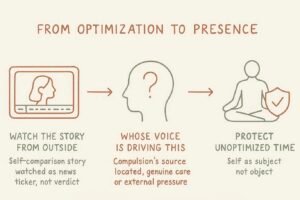
This practice is about shifting the relationship with the self from a managed project to a lived experience — from the relentless drive of external metrics toward something steadier and internal.
STEP 1: Watch the story from outside
When the self-critical thought arrives — I didn’t do enough, I’m still not where I should be — pause before receiving it as fact.
“My mind is running the story that compares the present me to an idealized future version and finds the present lacking.”
Receive that thought as a news ticker running in the background — present, audible, but not necessarily true. Recognizing it as a story rather than a verdict is the first interruption in the automatic chain of self-reproach.
STEP 2: Whose voice is actually driving this
When the compulsion surfaces — I need to study more, earn more, produce more — pause to locate where it’s actually coming from.
“Is this coming from something I genuinely care about? Or am I trying to prove something to someone?”
The desire to understand the world more deeply and the desire to score high enough to be taken seriously can look identical from the outside. Inside, they feel entirely different. One comes from a direction that feels like yours. The other comes from a pressure that has never quite identified itself. Noticing the difference — even briefly, even imperfectly — is the beginning of distance from the compulsion.
STEP 3: Protect the unoptimized time
Build into each day a stretch of time that is deliberately unproductive — not as recovery for the next productive period, but as time that belongs to no goal at all.
Ten minutes looking out a window without purpose. A novel chosen for pleasure rather than improvement. A walk measured in nothing. These are not failures of discipline. They are the recovery of the self as subject rather than object — the restoration of the person who experiences life rather than manages it. The unoptimized time is not time lost to the project. It is the time in which you actually exist.
Session 3: The Industry That Profits from Your Insufficiency
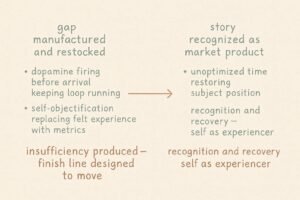
The feeling was manufactured
The Wellness Industrial Complex — fitness platforms, productivity tools, mindfulness apps, self-help publishing — constitutes one of the largest consumer markets in the world, generating hundreds of billions of dollars annually. The business model depends on a single premise: that you are currently insufficient, and that the product will close the gap. The mechanism only works if the gap remains. A person who feels genuinely adequate has no reason to purchase. And so the products are designed not to resolve the insufficiency but to shift it — to close one gap while opening the next. Better sleep leads to optimized nutrition leads to cognitive enhancement leads to emotional regulation leads to spiritual growth. The category expands as fast as the previous one is addressed.
The feeling that you are not yet enough is not a personal perception. It is a market condition, continuously produced and restocked.
Why the finish line keeps moving
Neuroscience research on dopamine and reward shows that the neurotransmitter activates most strongly before arrival, not after. It fires in the approach, not at the landing. Self-optimization tools are built around this mechanism — the next level, the next badge, the next personal record, the next metric to beat. Achievement triggers not rest but recalibration: a new target is immediately introduced, and the circuit orients toward it before the previous one has been absorbed.
The brevity of satisfaction after reaching a goal is not a sign of insufficient effort or insufficient gratitude. The finish line moves because moving it is the product.
What the metrics are actually measuring away
Psychologist Barbara Fredrickson’s research on self-objectification describes the state in which a person processes the self primarily as an object to be observed and evaluated from the outside — rather than as a subject having an experience from within. Chronic self-monitoring through metrics — sleep scores, productivity logs, body measurements, engagement numbers — systematically reinforces this orientation. The internal signals that constitute actual experience — how you feel right now, what you’re drawn toward, whether something is depleting or nourishing you — get replaced by their quantified proxies. Intuition, creativity, and the sense of being present to your own life are not measurable, and so they are treated as secondary.
Existing becomes a performance of existing, documented for review.
The treadmill was designed, not discovered
The hedonic treadmill — the psychological phenomenon by which people adapt rapidly to new circumstances, returning to a stable baseline of wellbeing regardless of achievement — describes a genuine feature of human cognition. Promotions, goal weights, new credentials: the satisfaction they produce is real, and it fades. This is not pessimism. It is a well-replicated finding about how the mind processes change. The Wellness Industrial Complex operates with full awareness of this phenomenon. New targets are positioned precisely at the point where adaptation to the previous one is complete.
The treadmill is not a metaphor for an unfortunate side effect. It is the operating principle. You keep running not because you lack discipline or vision. You keep running because the machine was built to ensure you never stop.
Conclusion: You Were Never the Problem

The system will keep generating targets.
But the question how do I actually feel right now cannot be answered by any app. The time set aside to ask it — unscheduled, unmeasured, belonging to no goal — is not time lost to the project. It is the only time in which the project’s subject actually exists.
You were never the problem to be optimized. You were the market.
KEY TERMS
Wellness Industrial Complex
The aggregate of fitness platforms, productivity tools, mindfulness applications, and self-help publishing that constitutes one of the world’s largest consumer markets. The business model requires the continuous production of insufficiency — not its resolution. Products are designed to shift the gap rather than close it, ensuring that the feeling of not being enough remains available for the next purchase. The structural origin of self-optimization compulsion as a market condition rather than a personal failing.
Dopamine and Anticipatory Reward
The neuroscientific finding that dopamine activates most strongly before achievement, not after — in the approach, not at the landing. Self-optimization tools are built around this mechanism, introducing the next level immediately after the previous one is reached. The brevity of post-achievement satisfaction is not a motivational failure — it is the designed output of a system that requires the circuit to keep running.
Self-Objectification
Barbara Fredrickson’s term for the state in which a person processes the self primarily as an object to be observed and evaluated from the outside. Chronic metric-based self-monitoring reinforces this orientation, replacing internal signals — felt experience, intuition, the sense of being present to one’s own life — with quantified proxies. What cannot be measured is treated as secondary. Existing becomes a performance of existing.
Hedonic Treadmill
The psychological phenomenon by which people adapt rapidly to new circumstances and return to a stable wellbeing baseline regardless of achievement. The satisfaction produced by reaching a goal is real and temporary. The Wellness Industrial Complex operates with awareness of this phenomenon, positioning new targets at precisely the point where adaptation to the previous one is complete. The treadmill is not a side effect of the system. It is the operating principle.
Defusion
The capacity to notice the fusion between the self-critical story — the present me compared to the ideal future me and found lacking — and one’s experience of reality, and to create observational distance from it. Receiving the thought as a running ticker rather than a verdict is the first interruption in the automatic chain of self-reproach, and the entry point into a different relationship with the compulsion to optimize.