
Introduction: Eating Without Tasting

Lunch at the desk, eyes on the screen. Dinner with something playing in the background. Somewhere between the first bite and the last, the meal just happened. What it tasted like is already gone. And despite having eaten enough, there’s a vague sense of having missed it.
This is not a quantity problem. It is a processing problem.
Today’s practice is used in mindfulness programs around the world. It requires one raisin — or one piece of chocolate, one berry, one grain of rice. Five minutes. That is all.
Session 1: Why Eating on Autopilot Leaves You Unsatisfied

Eating is, neurologically, a complex multisensory event — vision, smell, taste, texture, temperature, all processed simultaneously and integrated into a coherent experience. The meal is not just the food. It is what the brain does with the food.
The problem is that this processing gets automated. Once eating is a practiced routine, it can proceed while attention is elsewhere — the mind reviewing a meeting, composing a message, watching something on a screen. The mechanics continue, but the depth of sensory integration drops. The food is processed, but the experience isn’t fully assembled.
The feeling of having eaten without feeling like you’ve eaten is not a caloric miscalculation. It is the result of that incomplete integration — the sensory information arrived, but the processing that would have made it into a real experience was running at minimal depth. The raisin exercise interrupts that automation and deliberately reinstates it, one small piece at a time.
Session 2: The Five-Sense Raisin Practice
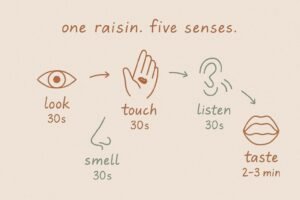
One raisin. Five minutes. Screen away.
STEP 1: Look (30 seconds)
Place the raisin in your palm and look at it as if seeing one for the first time. What color is it exactly? How does the light shift across its surface? What does the pattern of wrinkles look like? No evaluation — just observation.
STEP 2: Touch (30 seconds)
Roll it slowly between your fingers. The texture of the surface. The ridges. The slight give. The temperature. Collect the data the way a scientist would.
STEP 3: Smell (30 seconds)
Bring it slowly toward the nose. Sweet? Slightly fermented? Something more subtle? When you inhale — does anything shift in the mouth or the body? Stay with whatever is there.
STEP 4: Listen (30 seconds)
Hold it near the ear and press gently. Almost certainly: silence. Let that silence itself be part of the experience. The stillness before eating is its own form of awareness.
STEP 5: Taste — slowly (2–3 minutes)
Place the raisin in the mouth. Don’t chew yet.
Feel it on the tongue — the texture, the weight, any initial sensation. Then one slow bite. The release of flavor and aroma — that first moment. Continue chewing deliberately, following how the taste and texture change with each movement. When swallowing, follow the sensation as it moves through the throat.
Session 3: Why the Same Raisin Tastes Different Now
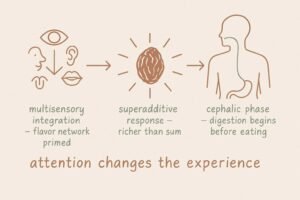
Dana Small and colleagues at Yale, publishing in Experimental Brain Research (2005), demonstrated that flavor perception is not a single sense but the product of multisensory integration — taste, smell, and oral somatosensation converging across a distributed network that includes the insula, frontal operculum, and orbitofrontal cortex. Critically, they found that congruent combinations of taste and smell — familiar pairings — produced superadditive neural responses in these regions: activation that exceeded the simple sum of the individual sensory inputs. The experience of flavor is not additive. When the senses are processed together, attentively, the result is qualitatively richer than any of them alone. During automatic eating, this integration runs at low depth — the signals arrive, but the network isn’t fully engaged. The feeling of having eaten without tasting anything is precisely this: partial processing where full integration was available.
Deliberate sensory attention restores that integration. The first four steps of this practice — sight, touch, smell, the brief stillness before tasting — are not delay for its own sake. They activate the sensory systems that Small’s flavor network depends on, sequentially and consciously, before the food enters the mouth. By the time tasting begins, multiple sensory channels are already primed. The same raisin, processed with that preparation, produces a different depth of experience than one eaten automatically.
There is a third function operating through Steps 1 through 3 that rarely appears in standard accounts of mindful eating. Richard Mattes at Purdue University, summarizing research in the Journal of the American Dietetic Association (1997), documented that sensory contact with food — sight, smell, taste — triggers a set of anticipatory digestive responses before eating begins. Saliva production increases. Gastric acid and digestive enzymes begin to be released. This cephalic phase response is mediated through the vagus nerve, preparing the digestive system for what is about to arrive. The moment in Step 3 when something shifts in the mouth while smelling the raisin — that is this response, directly experienced. Eating meditation does not only enrich the conscious experience of food. It activates the body’s preparatory physiology, synchronizing awareness and digestion in a process that distracted eating bypasses entirely.
Conclusion

This practice is not a prescription for how every meal should be eaten. One bite is enough — the first sip of morning coffee, the opening moment of lunch, a single piece of chocolate at the end of a long day.
What eating on autopilot misses is not the food. The food was there. The sensors were working. The integration just wasn’t being asked for.
KEY TERMS
Flavor Network
The distributed neural circuit identified by Dana Small and colleagues — spanning the insula, frontal operculum, and orbitofrontal cortex — that integrates taste, smell, and oral somatosensation into unified flavor perception. Produces superadditive responses when congruent sensory inputs are processed together: the experience of flavor is richer than the sum of its individual components.
Multisensory Integration
The neural process by which inputs from multiple sensory modalities are combined into a single coherent perceptual experience. In eating, the subjective sense of having genuinely tasted something depends on the depth of this integration — which drops significantly during automatic, distracted eating.
Cephalic Phase Response
The anticipatory digestive preparation triggered by sensory contact with food before eating begins. Documented by Richard Mattes at Purdue, this response — increased salivation, gastric acid, and digestive enzyme release — is mediated through the vagus nerve and initiates as soon as the sight, smell, or taste of food is consciously registered. Largely absent during distracted eating.
Superadditive Response
A neural response to congruent multisensory inputs that exceeds the sum of individual unimodal responses. Identified by Small and colleagues in the insula and orbitofrontal cortex during flavor perception — the mechanism by which attentive, integrated eating produces a qualitatively richer experience than automatic eating of the same food.
Insula
The brain region central to integrating bodily sensation with conscious awareness, and a key node in the flavor network. Activated by deliberate attention to taste, smell, and texture — and increasingly recognized as foundational to how the subjective experience of eating is constructed.