
Introduction: Before “I Did It Again”

Midnight, and somehow an order has already gone through for something that wasn’t needed. Irritation building until something sharp comes out toward someone at home. An app opened without any memory of deciding to open it.
And then, immediately after: the familiar collapse into regret and self-criticism. If only I had more willpower. If only I weren’t like this.
This loop is not a willpower problem. When an impulse runs, a specific structure is operating in the brain — one that has nothing to do with character.
Session 1: What the Impulse Actually Is

When impulsive behavior becomes impossible to stop, what is happening inside is a process of fusion — desire and action collapsing into a single uninterrupted motion.
A feeling arrives: if I do this, things will feel better. Before that feeling can be examined, the body is already moving — hand reaching, app opening. The recognition of that was a mistake comes only after, when the desire and the action have already run their course together.
Psychologist Steven Hayes, in developing the concept of cognitive defusion, described this state — in which a craving is experienced not as a hypothesis to be tested but as an absolute certainty — as fusion. When fusion is happening, the full emotional weight of a desire arrives before its content has been checked against anything real.
The environment accelerates this. Boredom, loneliness, chronic low-grade exhaustion — the ordinary discomforts of urban life are met, at every turn, with an immediately available solution in the form of a product, a feed, a stimulus. The impulse is not a failure of will. It is an adaptation to that structure.
Session 2: Practice — Creating Space Between the Impulse and What Happens Next
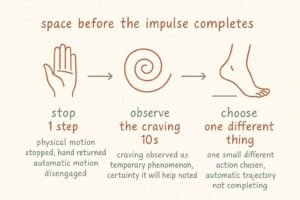
This practice is not about eliminating impulses. It is about creating a small gap — in the moment the impulse runs — between the automatic response and what actually happens next.
STEP 1: Stop
When an impulse surges, stop every physical movement. If a hand was reaching, bring it back. If a screen was about to be opened, put it down.
Stop. Just that.
Impulses are tightly coupled with immediate action. Physically stopping the body is the first intervention — the one that disengages the automatic motion before it completes.
STEP 2: Observe the craving
Staying still, spend ten seconds observing what is actually happening inside.
There’s something pulling in the chest. A sense of certainty that this will help — that if I just do it, the feeling will ease.
Watching the craving as a temporary phenomenon happening right now — rather than as an urgent problem demanding immediate resolution — reduces its emotional grip. No judgment is needed. Just looking.
STEP 3: Choose one small different action
After observing, instead of following the impulse, identify the smallest available action that is actually within reach and choose it.
A sip of water. Open a window. Reply in five minutes instead of now.
There is no requirement to choose correctly. The only thing that matters is that one thing was chosen rather than the automatic trajectory simply completing itself. That one choice gives the brain new data.
Session 3: What the Impulse Was Actually Reaching For
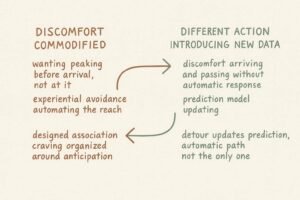
Discomfort had been designed to have a consumer solution
Health sociologist Robert Crawford’s analysis of healthism — the individualization of bodily management — points toward a structural companion: the progressive commodification of discomfort itself. The boredom, loneliness, and chronic fatigue that urban life generates are structural conditions. But when an immediately available product, piece of content, or stimulus is offered as the solution to each of these feelings the moment they arise, the pattern of reaching for something the instant discomfort appears becomes installed as a daily automatic response. Hayes’s concept of experiential avoidance captures this mechanism — behaviors taken to escape or avoid unwanted internal experiences function well enough in the short term to be repeated, and through repetition become automatic. The impulse is not weakness. It is the brain’s faithful adaptation to a pattern that was designed from outside: discomfort arrives, consumption resolves it, the association deepens.
The dopamine peaked before arrival — and arrival was never the point
Neuroscientist Kent Berridge’s research introduced a distinction that reframes the entire experience of craving: wanting and liking are processed by neurologically distinct circuits. The anticipatory circuitry — not the satisfaction of having received something, but the anticipation of receiving it — peaks in the moment just before arrival. This is the structural core of why impulses are so difficult to resolve through acting on them. What the brain is generating is a prediction — this will satisfy — not an accurate report of what satisfaction will actually feel like once it arrives. Which is why the purchase produces a flatness immediately after. Why opening the feed produces an almost instant sense of why am I here. The craving was never organized around the thing itself. It was organized around the moment just before reaching it — a moment the brain had learned to produce on demand, independent of any actual object.
Each small detour was updating the prediction model
James Gross’s research on emotion regulation established that reappraisal — offering a different interpretive frame to the same situation — produces genuine reductions in emotional intensity, distinct in mechanism from suppression, which leaves the underlying response intact and often amplifies it over time. Applied to impulse, this reframes what the small actions in Session 2 are actually doing. Drinking a sip of water instead of reaching for the impulse object is not a distraction technique. It is the introduction of new behavioral data into the system that generated the original prediction — data that says: discomfort arrived, and something other than the automatic response happened, and the discomfort passed anyway. Repeated over time, this gradually updates the prediction pattern itself. Not through willpower, and not through suppression — but through accumulating evidence that the automatic trajectory was not the only available path. The detour does not need to succeed. It only needs to introduce new data — that discomfort arrived, something else happened, and the pattern was not the only available path.
Conclusion: The Wanting Was a Structure, Not a Signal

The external design of discomfort-as-consumer-problem continues. Anticipatory dopamine will keep peaking just before arrival, generating the wanting that arrival was never built to resolve. The impulse will keep running.
But the moment of noticing that this is the anticipation — not the thing itself — can be brought into any point where the automatic reach begins. That noticing is the first step off the automatic trajectory — and off is where new data starts to accumulate.
The wanting was never about the thing. It was about the moment just before reaching it — which the brain had learned to manufacture on demand.
KEY TERMS
Experiential Avoidance
Steven Hayes’s concept from ACT describing behaviors taken to escape or reduce unwanted internal experiences — discomfort, boredom, anxiety. In the short term these behaviors work well enough to be repeated; through repetition they become automatic. The impulse is not a failure of self-control. It is a learned adaptation that was reinforced each time it provided even partial relief.
Anticipatory Dopamine
Kent Berridge’s research distinguishing wanting from liking as neurologically separate processes. Dopamine activity peaks in the moment just before receiving something — in the anticipation, not the arrival. This is why acting on an impulse rarely resolves it: what was generated was a prediction of satisfaction, not satisfaction itself. The wanting was organized around the approach, not the thing.
Cognitive Defusion
Steven Hayes’s core concept from ACT. The practice of relating to thoughts and cravings as observable events in the mind rather than as facts about the world. In fusion, the full emotional weight of a craving arrives before its content has been examined. Defusion creates a small distance — not by suppressing the craving, but by changing the relationship to it.
Cognitive Reappraisal
James Gross’s concept from emotion regulation research. Offering a different interpretive frame to the same situation produces genuine reductions in emotional intensity — unlike suppression, which leaves the underlying response intact and can amplify it over time. Applied to impulse: choosing a small different action introduces new data into the prediction system, gradually shifting how the same signal is processed in future.
Healthism / Commodification of Discomfort
Robert Crawford’s analysis of how bodily and emotional management becomes individualized — and its structural extension: the design of consumer environments that position a product or stimulus as the immediate solution to each moment of discomfort. The pattern of reaching for something the instant discomfort arises is not a personal weakness. It is an adaptation to an environment built to install exactly that pattern.